Railways should diversify freight portfolio: Ficci-Crisil White paper

Another key proposal is to allow private players to run trains on the dedicated freight corridors
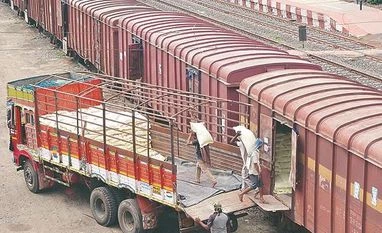
freight
According to the white paper, the Railway's freight basket has been dependent on select commodities, such as cement, coal, fertilisers, food grains, iron ore, and steel
BS Reporter New Delhi
3 min read Last Updated : Jan 28 2021 | 8:00 PM IST
The Indian Railways will have to diversify its freight portfolio to meet the goals of having a larger share of the total goods movement in the country. According to a joint report by the Federation of Indian Chambers of Commerce and Industry (FICCI) and CRISIL Risk and Infrastructure Solutions (CRISIL), the Indian Railways should focus on capturing new freight opportunities in the transport of cement, steel and automobiles, among others.

Another key proposal is to allow private players to run trains on the dedicated freight corridors. As per the institutional arrangement envisaged for operations of DFCs, IR will be the sole customer for DFCCIL, which will provide the infrastructure for the operation of trains. IR will pay a track access charge (TAC – user fee) to DFCCIL and other customers/freight operators shall be routed through it.

“To enhance competition in the sector and service levels, and leverage private sector capital for induction of world class rolling stock, IR may consider allowing private players to run freight trains on the DFC network by paying track access charge to DFCCIL. This is one of the models followed in many countries and several players operating internationally may be interested in investing and operating in this area,” the report said.

This white paper titled Indian Railways 2.0: Re-claiming Pole Position in Freight Transport was released by Rail Minister Piyush Goyal. Speaking at the event, he said, “Freight trains are part of a new table that will be coming out. It will be a zero-based time table.”

This zero-based time is focused on minimising waiting lists and optimising train movement to cater to high demand routes. Goyal also said that the speed of freight trains has doubled compared to last year and that the Railways was able to complete multiple long-standing projects that were stuck for long, during the COVID-19 lockdown months.

He said that any state which wants new railway projects will have to ensure land availability to ensure a smooth and timely completion.

According to the white paper, the Railway's freight basket has been dependent on select commodities, such as cement, coal, fertilisers, food grains, iron ore, and steel, which constitute over 75 per cent of the total rail freight volume. Coal alone accounts for around 50 per cent of the freight volume and revenue.

“The dependence on select commodities for freight traffic outlines the inherent risk from demand shocks from end-users of these commodities. Further, it has been observed that while the share of rail is high in conventional bulk commodities, its play is considerably low in high value and unconventional commodities,” the white paper said.

“The first step towards increasing the Indian Railway's freight volume will be to enhance volume of the existing commodities, by increasing the modal share. Some of the commodities that can be targeted are automobiles, cement, containers, and steel. These products will require targeted and customised interventions to make rail competitive vis-à-vis road transport for the consignors,” the white paper added.

Elaborating further on steps that can be taken to bring more automobile transport onto the Indian Railways networks, the white paper said, “The Indian Railway should identify key measures to capture the traffic from this high potential segment. It could also make changes in the design of wagons to enable the movement of two wheelers, SUVs and LCVs and enhance the capacity of wagons for double decker movement.”

One subscription. Two world-class reads.

Already subscribed? Log in

Subscribe to read the full story →
*Subscribe to Business Standard digital and get complimentary access to The New York Times

Smart Quarterly

₹900

3 Months

₹300/Month

SAVE 25%

Smart Essential

₹2,700

1 Year

₹225/Month

SAVE 46%
*Complimentary New York Times access for the 2nd year will be given after 12 months

Super Saver

₹3,900

2 Years

₹162/Month

Subscribe

Renews automatically, cancel anytime

Here’s what’s included in our digital subscription plans

Exclusive premium stories online

  • Over 30 premium stories daily, handpicked by our editors

Complimentary Access to The New York Times

  • News, Games, Cooking, Audio, Wirecutter & The Athletic

Business Standard Epaper

  • Digital replica of our daily newspaper — with options to read, save, and share

Curated Newsletters

  • Insights on markets, finance, politics, tech, and more delivered to your inbox

Market Analysis & Investment Insights

  • In-depth market analysis & insights with access to The Smart Investor

Archives

  • Repository of articles and publications dating back to 1997

Ad-free Reading

  • Uninterrupted reading experience with no advertisements

Seamless Access Across All Devices

  • Access Business Standard across devices — mobile, tablet, or PC, via web or app

Topics :Indian Railways

Next Story



