Textile Ministry issues draft BIS-based quality standards for cotton bales

Industry experts say this would help Indian cotton to get better prices in the long run and, in turn, benefit farmers
Textile Ministry issues draft BIS-based quality standards for cotton bales
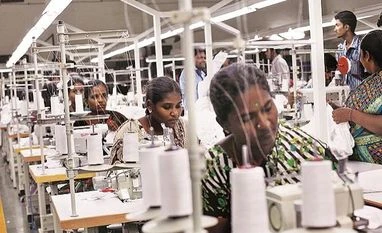
Sewn up: Employees sew clothes at the Estee garment factory in Tirupur, in Tamil Nadu. Relatively high labour cost is costing the textile town its competitive advantage. Photo: Reuters
T E Narasimhan Chennai
Last Updated : Sep 03 2018 | 11:43 PM IST
The Union Ministry of Textiles has issued a draft notification prescribing quality standards for cotton bales as per Bureau of Indian Standards (BIS) norms. Industry experts say this would help Indian cotton to get better prices in the long run and, in turn, benefit farmers.

According to the notification cotton Bales shall conform to IS 12171:2013 and shall bear the Standard Mark under a licence from the Bureau of Indian Standards as per Scheme–II of schedule II of BIS Conformity Assessment) Regulations, 2018.

Nothing in the Order shall apply in relation to Cotton Bales meant for export, which conform to any specification required by the foreign buyer.

The Bureau of Indian Standards shall be the certifying and enforcing authority. In addition, an officer not below the rank of General Manager, District Industries Centre in the Department of Industries of the State Government shall also be the enforcing authority.


Penalty for Contravention: Any person who contravenes the provisions shall be punishable under the provisions of the Bureau of Indian Standards Act, 2016, said in the notification. 

Cotton Association of India (CAI) president Atul Ganatra said that this was in line with the Prime Minister's vision to double farm income in India.

Today, Indian cotton is sold at a discount of 10-15 per cent to international prices due to quality issues in ginning, processing, and labelling stages. Nearly 18 types of trash contamination creep into Indian cotton, which, in turn, affects the spinning mills.

If this all issues of trash contamination are sorted out at the ginning stage itself then spinning mills may also be willing to pay a better price. Once the new quality standards kick in, Indian cotton may command a higher price globally. While that may still not be at par with international prices in the short term, the farmers will stand to gain.


Ganatra says the customer would not mind paying extra percentage for quality cotton.

According to the Cotton Advisory Board, total domestic consumption of cotton in 2017-18 is estimated at 31.55 million bales.

Further, in order to provide remunerative prices to growers, the government has fixed the Minimum Support Price (MSP) of cotton for 2018-19 season at Rs 5,150 per quintal for medium staple and Rs 5,450 per quintal for long staple.

Total production and consumption during the current crop year 2018-19 is not available, but state-wise estimated production, as per the Third Advance Estimates for the year 2017-18 is 34.86 million bales, say reports. 

One subscription. Two world-class reads.

Already subscribed? Log in

Subscribe to read the full story →
*Subscribe to Business Standard digital and get complimentary access to The New York Times

Smart Quarterly

₹900

3 Months

₹300/Month

SAVE 25%

Smart Essential

₹2,700

1 Year

₹225/Month

SAVE 46%
*Complimentary New York Times access for the 2nd year will be given after 12 months

Super Saver

₹3,900

2 Years

₹162/Month

Subscribe

Renews automatically, cancel anytime

Here’s what’s included in our digital subscription plans

Exclusive premium stories online

  • Over 30 premium stories daily, handpicked by our editors

Complimentary Access to The New York Times

  • News, Games, Cooking, Audio, Wirecutter & The Athletic

Business Standard Epaper

  • Digital replica of our daily newspaper — with options to read, save, and share

Curated Newsletters

  • Insights on markets, finance, politics, tech, and more delivered to your inbox

Market Analysis & Investment Insights

  • In-depth market analysis & insights with access to The Smart Investor

Archives

  • Repository of articles and publications dating back to 1997

Ad-free Reading

  • Uninterrupted reading experience with no advertisements

Seamless Access Across All Devices

  • Access Business Standard across devices — mobile, tablet, or PC, via web or app

Next Story



