
Australia's RBA holds rates, puts easing on table
Said subdued inflation meant there might be room for a further easing if needed to support the economy
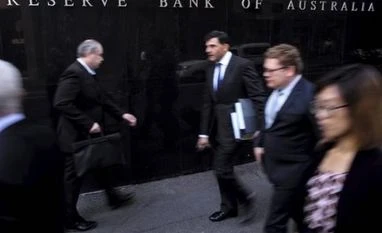 "Australia's RBA holds rates, puts easing on table")
WebinarsNew
Deep DiveNew
Explore Business Standard
Said subdued inflation meant there might be room for a further easing if needed to support the economy
Australia's central bank kept its cash rate steady at a record low of 2.0% on Tuesday, but said subdued inflation meant there might be room for a further easing if needed to support the economy.
The Reserve Bank of Australia (RBA) disappointed some by not cutting straight away at its monthly policy meeting, though the shift to an explicit easing bias kept alive the prospect of a move at some stage.
In a brief statement, RBA Governor Glenn Stevens said the outlook for the economy had actually "firmed a little" in recent months with business conditions improving and employment stronger than expected.
"(Board) Members also observed that the outlook for inflation may afford scope for further easing of policy, should that be appropriate to lend support to demand," he added.
That was a change from the October statement when no guidance on policy was offered.
"They've obviously left the door open to cut rates but something needs to happen to get that rate cut over the line," said Michael Blythe, chief economist at CBA.
"It's probably the mix you want to make sure you don't see the Aussie dollar charging up."
The central bank has long argued that a softer local currency was needed to help offset weak prices for Australia's major resource exports. The dollar was a shade firmer at $0.7188 after the RBA statement.
Debt markets seemed to suggest investors were not counting on the RBA cutting by year end. Interbank futures for December slid to imply around a 36% chance of an easing, from above 70% earlier in the day.
A drop to 1.75% is fully priced in by April.
Since last easing in May, RBA officials have sounded reluctant to cut even further in part for fear of inflating a debt-driven bubble in home prices.
There have also been hopeful signs of a pick up in non-mining investment with business conditions, confidence and borrowing all improving.
Yet, speculation about a cut had mounted after Australia's major banks last month decided to lift mortgage rates in an effort to shield profits from rising regulatory costs.
A surprisingly low reading on price pressures out last week had added to the talk. Underlying inflation slowed to an annual 2.15% in the third quarter, near the floor of the RBA's long-term target band of 2 to 3%.
With the broader economy still weighed by falling mining investment and weak commodity prices, some analysts had argued an easing would be warranted in the next few months.
First Published: Nov 03 2015 | 10:01 AM IST


 Connect with us on WhatsApp