BRICS warns against US monetary stimulus withdrawal
Say sudden withdrawal could have negative spillovers on global economy
Press Trust of India St Petersburg Echoing the views articulated by Prime Minister Manmohan Singh, the BRICS nations today warned that imminent withdrawal of monetary stimulus by the US could have "unintended negative spillovers" on the global economy.
Prime Minister Singh had emphasised the need for an "orderly exit" from unconventional monetary policies being pursued by the developed world to avoid "damaging" growth prospects of the developing world.
A media note on the informal meeting of BRICS leaders ahead of the G20 Summit said, "In light of the increase in financial market and capital flow volatility during recent months, the BRICS Leaders reiterated their concerns they had expressed in the Durban Summit in March, regarding the unintended negative spillovers of unconventional monetary policies of certain developed economies."
"They emphasised that the eventual normalisation of monetary policies needs to be effectively and carefully calibrated and clearly communicated," it said.
BRICS comprises of Brazil, Russia, India, China and South Africa. The BRICS leaders are Prime Minister Manmohan Singh, Chinese President Xi Jinping, Russian President Vladimir Putin, South African President Jacob Zuma and Brazilian President Dilma Rousseff.
Later addressing the G-20 summit, Singh attacked the developed countries for unconventional monetary expansion and sudden moves for its reversal triggering currency volatility in countries like India. He asked the G-20 to show collective commitment for restoring robust growth in emerging markets.
He also called for extensive consultations within the G-20 grouping to tackle the current currency crisis.
Singh declared that India has been affected by currency volatility in the past few weeks and was taking steps to finance the current account deficit (CAD) in an environment that is seen to be friendly for stable foreign capital flows.
The Prime Minister announced that India would continue to work within the framework of an open economy to restore growth to earlier levels.
"Our efforts at restoring growth will be greatly helped if we have a stable external environment that is supportive of growth.
"The G-20 has a major role to play in this context. This Summit must send a clear signal of our collective commitment to work together for the revival of growth, which is the only way of ensuring a sustainable growth in quality jobs.
"We must focus especially on the need to restore robust growth in the emerging market countries, which will also contribute to global recovery," he said.
With the five countries in the BRICS bloc hard hit by slow economic growth, host Russia and China, also articulated their concerns separately about the planned 'tapering' of the US Federal Reserve's multi-billion dollar monetary stimulus policy.

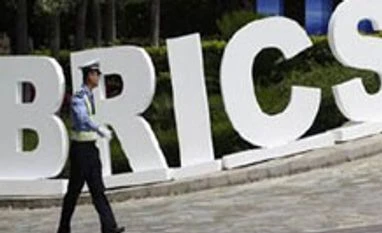 "BRICS warns against US monetary stimulus withdrawal")


 Connect with us on WhatsApp