Donald Trump's Twitter threats put American credibility on the line

Countries are unsure whether to take his words as policy pronouncements, or whether they can be safely ignored
Donald Trump tweets, Donald Trump, US President
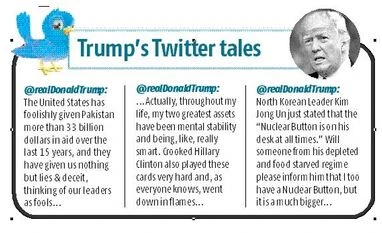
Donald Trump's Twitter Tales
Steven Erlanger Brussels
7 min read Last Updated : Dec 10 2019 | 2:27 PM IST
Since the first of the year, President Donald Trump has attacked a variety of countries in Twitter posts, urging protesters to overthrow the Iranian government, threatening to blow up North Korea and calling for cuts in aid to the Palestinians. In bluster and tone, he has begun 2018 where he left off.

Two things stand out about the foreign policy messages Trump has posted on Twitter since taking office: How far they veer from the traditional ways American presidents express themselves, let alone handle diplomacy. And how rarely Trump has followed through on his words. Indeed, nearly a year after he entered the White House, the rest of the world is trying to figure out whether Trump is more mouth than fist, more paper tiger than the real thing.

Countries are unsure whether to take his words as policy pronouncements, or whether they can be safely ignored. In a series of Twitter posts on Saturday, Trump reacted to questions about his mental fitness by calling himself a “very stable genius.” 

Donald Trump's Twitter Tales

Richard N Haass, president of the Council on Foreign Relations in New York, recently repeated some of Trump’s more belligerent tweets and said: “This is our commander in chief. Think about it.” The words of the American president matter, he added in a Twitter message: “That is why so many of this president’s tweets alarm. The issue is not just questionable policy on occasion but questionable judgment and discipline.”

The bottom line, Haass said, is that Twitter posts should be handled as seriously as any other White House statement. 

Secretary of State Rex W Tillerson addressed Trump’s Twitter posts in a recent interview with The New York Times Magazine, saying his department’s approach was “resilient enough” to handle the unexpected and still pursue long-term goals. “I take what the president tweets out as his form of communicating, and I build it into my strategies and my tactics,” he said. But the Twitter posts have already devalued the president’s words, argues R Nicholas Burns, a former career diplomat and ambassador to NATO, who teaches at Harvard and worked with Hillary Clinton’s campaign. “These are statements of the president, of the US government, so the tweets are important,”  Burns said.

“Even when Mr Trump is right,” defending Iranian protesters or objecting to North Korean missile tests, “there’s always some excess or some objectionable statement that undermines American credibility, and it’s hard to win that back,” he said. “Allies and opponents invest in your judgment and common sense.” “When you give away the status of Jerusalem unilaterally and get nothing from Israel and anger the Palestinians and challenge the world and then you lose, it’s a disastrous example of lack of US credibility,” Burns said. The decision infuriated the Palestinians and the Europeans. Then, Trump and his UN envoy, Nikki R Haley, threatened to cut off aid to any country that opposed the new American position in a vote in the General Assembly.

In the end, the vote was a humiliating rebuke of the US, 128 to 9, with 35 abstentions.  On North Korea, despite Trump’s Twitter posts, Pyongyang has gone ahead with tests of intercontinental ballistic missiles and has given no indication that it will agree to denuclearize in exchange for talks with Washington. Instead, it has gone around Washington to reopen talks with Seoul. Even on Pakistan, where Trump followed through last week on threats to suspend aid over the country’s ambiguous support for the American battle against the Taliban, the president was for the Pakistanis before he was against them. 

In one of his first calls with a foreign leader after being elected,  Trump spoke with the Pakistani prime minister, Nawaz Sharif, and gushed that he was a “terrific guy.” More recently, Trump switched to threatening them, saying on Twitter that Pakistan had “given us nothing but lies & deceit” and accusing it of providing “safe haven to the terrorists we hunt in Afghanistan.” The public humiliation outraged Islamabad, giving an opening to China, which moved within 24 hours to praise Pakistan’s fight against terrorism. 

Pakistan then agreed to adopt the Chinese currency for transactions, to improve bilateral trade.

François Heisbourg, a French defense and security analyst, commented tersely about Trump’s anger this way: “Pushing Pakistan into an exclusive relationship with China.” Trump has been equally changeable with the Chinese, whom the president repeatedly threatened to punish for what he termed trade dumping and currency manipulation, only to say in December that he had “been soft” on Beijing, needing its help on North Korea. Some suggest that  Trump’s Twitter posts should not be taken so seriously. 

Daniel S. Hamilton, a former State Department official who directs the Center for Transatlantic Relations at Johns Hopkins University, says that Mr. Trump “uses these tweets and social media to secure his political base,” and “whether the tweets turn into a policy or not is a whole different question.”

One cannot ignore presidential tweets, Mr. Hamilton said, “but their purpose is not to make daily policy pronouncements.” Mr. Trump is well aware of their impact and timing, and when he tweets so early in the morning, Mr. Hamilton said, “it sets up the media for the whole day.”

For those around Mr. Trump in Washington, the daily battle is to “try to temper his temperament,” Mr. Hamilton said. “But for the allies it’s very hard to read.”

But when Mr. Trump’s threats are not followed through — or are tempered by White House staff, Congress or the courts — that undermines American credibility, too.

While allies do not necessarily take his Twitter posts as policy pronouncements, they still create significant confusion, said Pierre Vimont, former French ambassador to Washington and former top aide to the European Union foreign policy chief.

Even in areas where allies agree — for example, on the threat posed by North Korea and its leader, Kim Jong-un — “we have a hard time understanding the real policy line from Washington,” Mr. Vimont said.

There are clear differences with European allies on climate change, multilateral trade and Jerusalem, he said, “but even on Ukraine and Syria, where we could agree, we have difficulty understanding where U S leadership is, what they are really looking for.”

On Iran, for example, many Europeans agree with those protesting against the Islamic government, but believe that Mr Trump’s full-throated support for them on Twitter helps the hard-liners and hurts the moderates.

The Europeans are united in trying to keep a dialogue going with Iran and to preserve the nuclear accord, which many say should be improved but kept separate from other issues.

President Emmanuel Macron of France criticized the United States, Israel and Saudi Arabia last week for encouraging the antigovernment protests, saying the stance “is almost one that would lead us to war.” Mr. Macron said France wanted to avoid “surreptitiously rebuilding an ‘axis of evil,’” a reference to the countries singled out by former President George W Bush — Iran, North Korea and Iraq.

“Trump’s tweets do shape how others react,” said Leslie Vinjamuri of SOAS, University of London. “If they were once aimed at his base, they now seem a way for Trump to shout back at the world, and he keeps circling back to the same issues. In some ways, he’s predictable, emotional and erratic, but he’s not consistent.”

But no one can ignore the president of the United States, Ms. Vinjamuri said.

“The U S still matters, and people are a bit afraid,” she said. “There’s a lot of hedging going on, countries abstaining but not voting against him. But that’s not enough for Trump. This is a man who wants loyalty.”

One subscription. Two world-class reads.

Already subscribed? Log in

Subscribe to read the full story →
*Subscribe to Business Standard digital and get complimentary access to The New York Times

Smart Quarterly

₹900

3 Months

₹300/Month

SAVE 25%

Smart Essential

₹2,700

1 Year

₹225/Month

SAVE 46%
*Complimentary New York Times access for the 2nd year will be given after 12 months

Super Saver

₹3,900

2 Years

₹162/Month

Subscribe

Renews automatically, cancel anytime

Here’s what’s included in our digital subscription plans

Exclusive premium stories online

  • Over 30 premium stories daily, handpicked by our editors

Complimentary Access to The New York Times

  • News, Games, Cooking, Audio, Wirecutter & The Athletic

Business Standard Epaper

  • Digital replica of our daily newspaper — with options to read, save, and share

Curated Newsletters

  • Insights on markets, finance, politics, tech, and more delivered to your inbox

Market Analysis & Investment Insights

  • In-depth market analysis & insights with access to The Smart Investor

Archives

  • Repository of articles and publications dating back to 1997

Ad-free Reading

  • Uninterrupted reading experience with no advertisements

Seamless Access Across All Devices

  • Access Business Standard across devices — mobile, tablet, or PC, via web or app

Topics :Donald Trump

Next Story



