
India, 5 Central Asian nations to set up joint working group on Afghanistan
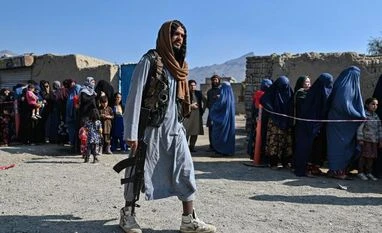
The humanitarian situation in Afghanistan has deteriorated drastically since the Taliban took control of Kabul in mid-August last year.
 "India, 5 Central Asian nations to set up joint working group on Afghanistan")
WebinarsNew
Deep DiveNew
Explore Business Standard
The humanitarian situation in Afghanistan has deteriorated drastically since the Taliban took control of Kabul in mid-August last year.
India and five Central Asian countries on Thursday discussed the evolving situation in Afghanistan and its impact on security in the region and decided to establish a joint working group on Afghanistan at the senior officials level.
The first India-Central Asia Summit, hosted by Prime Minister Narendra Modi, in virtual format was attended by five presidents -- Kazakhstan's Kassym-Jomart Tokayev, Uzbekistan's Shavkat Mirziyoyev, Tajikistan's Emomali Rahmon, Turkmenistan's Gurbanguly Berdimuhamedow and Kyrgyz Republic's Sadyr Japarov.
The timing of the meeting is of particular significance as India and Central Asia countries are celebrating the 30th anniversary of diplomatic relations with the 5 Central Asian countries this year.
"The Leaders discussed the current situation in Afghanistan and its impact on the security and stability of the region," the Ministry of External Affairs (MEA) said in a statement.
The leaders reiterated strong support for a peaceful, secure and stable Afghanistan while emphasizing the respect for sovereignty, unity and territorial integrity and non-interference in its internal affairs.
They also discussed the current humanitarian situation and decided to continue to provide immediate humanitarian assistance to the people of Afghanistan.
"The Leaders reaffirmed the importance of UNSC Resolution 2593 (2021) which unequivocally demands that Afghan territory not be used for sheltering, training, planning or financing terrorist acts and called for concerted action against all terrorist groups, including those sanctioned by the United Nations Security Council (UNSC)," read the statement.
"They also agreed to continue close consultations on the situation in Afghanistan. In this context they decided for the establishment of a Joint Working Group on Afghanistan at Senior Officials Level," the statement said.
The leaders also noted that there is a broad 'regional consensus' on the issues related to Afghanistan, which includes the formation of a truly representative and inclusive government, combating terrorism and drug trafficking, the central role of the UN, providing immediate humanitarian assistance for the people of Afghanistan and preserving the rights of women, children and other national ethnic groups and minorities.
In this regard, the Leaders noted the initiative of Uzbekistan to hold a High-Level International Conference on Afghanistan under the auspices of the SCO in July 2022 in Tashkent, the statement said.
The humanitarian situation in Afghanistan has deteriorated drastically since the Taliban took control of Kabul in mid-August last year.
A combination of a suspension of foreign aid, the freezing of Afghan government assets, and international sanctions on the Taliban have plunged the country, already suffering from high poverty levels, into a full-blown economic crisis.
(Only the headline and picture of this report may have been reworked by the Business Standard staff; the rest of the content is auto-generated from a syndicated feed.)
First Published: Jan 28 2022 | 6:43 AM IST


 Connect with us on WhatsApp