Sri Lanka on the edge after Easter Sunday bomb attacks kill over 200

Seven suspects have been arrested in connection with the attacks. An indefinite curfew has been imposed across the island nation and social media has been temporarily banned

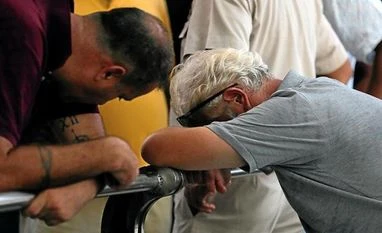
Sri Lanka blasts, crying kin
Foreign relatives of a victim of the explosion react at the police mortuary in Colombo
Agenices
4 min read Last Updated : Apr 21 2019 | 6:03 PM IST
The deadly blasts that shattered years of relative calm in Sri Lanka risk dragging the island nation back to the days of violent political instability with a series of unprecedented attacks on Christian minorities and foreign tourists.

More than 207 people including as many as 30 foreigners were killed in a series of coordinated explosions on Easter Sunday at three churches and luxury hotels across the country, including the capital city Colombo. Authorities said there were more than 450 injured in the worst violence since the civil war ended in 2009.


Seven suspects have been arrested in connection with the attacks. An indefinite curfew has been imposed across the island nation, Harsha De Silva, a minister in the Sri Lankan government tweeted. Silva also said that a temporary social media ban has been imposed in the country.

The attacks follow a prolonged constitutional crisis last year, triggered when President Maithripala Sirisena sacked Prime Minister Ranil Wickremesinghe following months of political infighting. Wickremesinghe was sworn back in as prime minister in December after the Supreme Court ruled against Sirisena plan to dissolve the parliament and call a new national vote. But the damage was already done -- it led Moody’s Investors Service, Fitch Ratings and S&P Global Ratings to downgrade the country’s credit rating.


"What these bombings potentially do, is take it from inertia and political infighting and rudderlessness to a real fear of instability and a sense of a return to the bad old days,” said Alan Keenan, a senior Sri Lanka analyst with the International Crisis Group based in London.
 
He noted the targeting of foreign tourists was a worrying new development in the country."It’s striking that in almost three decades of war between the Tamils and government forces, foreign tourists were never targeted."


Sri Lanka has a history of communal violence between virtually all groups, Keenan said.

"What’s surprising about this is the particularly brutal and coordinated nature of the attacks and targets, this combination of what appear to be Tamil Catholic churches and high-end hotels," he said. “These are the first classically terrorist attacks since the end of the war.”


Appeal for Calm

Wickremesinghe said his government is taking immediate steps to contain the situation and appealed to citizens to maintain peace and avoid propagating unverified reports and speculation. Local media reported that WhatsApp, Viber and Facebook platforms had been blocked temporarily to prevent false news distribution.

"You will find a downward trend in the economy," Wickremesinghe said in a televised statement. "Tourism will get affected. There maybe fund outflows."

The blast could not have come at a worse time for a leadership focused on accelerating growth in an economy that saw expansion dip below 2 percent in the quarter ended December, the first time since 2014. Sri Lanka, which has an ongoing $1.5 billion loan program with the International Monetary Fund, is aiming for 3.5 percent growth in 2019.

"That is bad news for the country where the memories of the civil war are still very much alive," said Raffaele Bertoni, head of debt-capital markets at Gulf Investment Corp. in Kuwait City. "Tourism is a very important sector for the economy and one of the major source of external reserves."

Ethnic Strife

Sri Lanka has been weighed down by conflict since gaining independence from Britain in 1948.

The Sinhalese sought to disenfranchise Tamil migrant workers from India -- Tamils make up 9.4 percent of the population -- and made Sinhala the official language. In 1972, the country’s name was changed from Ceylon to Sri Lanka and Buddhism was established as the main religion. Tamils are mostly Hindu.

The Liberation Tigers of Tamil Eelam, or Tamil Tigers, was formed in 1976 and began to campaign for a Tamil homeland in the north and east. The civil war that ensued saw violations from both the Tamil Tigers and the Sri Lankan military, including the use of child soldiers. It ended in 2009 with a government victory -- by then more than 100,000 had died.

Still, targeted attacks on Christian minorities have been rare.

Catholics, split between the Sinhalese majority and the Tamil minority, make up 6.5 percent of Sri Lanka’s population, according to the nation’s 2012 census. Buddhists account for 70 percent of the total, while Hindus and Muslims make up the rest.

One subscription. Two world-class reads.

Already subscribed? Log in

Subscribe to read the full story →
*Subscribe to Business Standard digital and get complimentary access to The New York Times

Smart Quarterly

₹900

3 Months

₹300/Month

SAVE 25%

Smart Essential

₹2,700

1 Year

₹225/Month

SAVE 46%
*Complimentary New York Times access for the 2nd year will be given after 12 months

Super Saver

₹3,900

2 Years

₹162/Month

Subscribe

Renews automatically, cancel anytime

Here’s what’s included in our digital subscription plans

Exclusive premium stories online

  • Over 30 premium stories daily, handpicked by our editors

Complimentary Access to The New York Times

  • News, Games, Cooking, Audio, Wirecutter & The Athletic

Business Standard Epaper

  • Digital replica of our daily newspaper — with options to read, save, and share

Curated Newsletters

  • Insights on markets, finance, politics, tech, and more delivered to your inbox

Market Analysis & Investment Insights

  • In-depth market analysis & insights with access to The Smart Investor

Archives

  • Repository of articles and publications dating back to 1997

Ad-free Reading

  • Uninterrupted reading experience with no advertisements

Seamless Access Across All Devices

  • Access Business Standard across devices — mobile, tablet, or PC, via web or app

Next Story




