Home / World News / Toyota's US robotics boss promises results within 5 years
Toyota's US robotics boss promises results within 5 years
A former program manager said in future, all robots will be connected together in a network, sharing information on cloud and helping each other improve
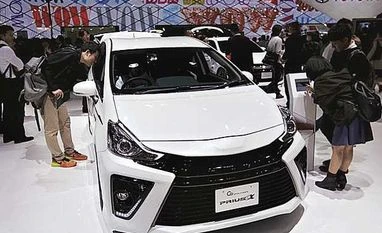
Visitors look at Toyota Motor Corp’s G’s Prius Alpha at the 44th Tokyo Motor Show in Tokyo
The US robotics expert tapped to head Toyota's Silicon Valley research company said the $1 billion investment by the giant Japanese automaker will start showing results within five years.
Gill Pratt told reporters that the Toyota Research Institute is also looking ahead into the distant future when there will be cars that anyone, including children and the elderly, can ride in on their own, as well as robots that help out in homes.
Pratt, a former program manager at the US military's Defence Advanced Research Projects Agency, joined Toyota Motor Corp. First as a technical adviser when it set up its artificial intelligence research effort at Stanford University and MIT.
He said safety features will be the first types of AI applications to appear in Toyota vehicles. Such features are already offered on some models now being sold, such as sensors that help cars brake or warn drivers before a possible crash, and cars that drive themselves automatically into parking spaces or on certain roads.
"I expect something to come out during those five years," Pratt told reporters recently at Toyota's Tokyo office of the timeframe seen for the investment.
"It is very important to understand that what we are doing has high risk and that some of our efforts will not be entirely successful but we expect some of them to be very successful," he said.
Most automakers, such as General Motors, Tesla and Nissan, are competing on autonomous driving and connecting cars to the internet, while several big companies outside the auto industry, including Google, Apple and Uber, are also eyeing the business.
He said that only in the future will there be what he called "hyper-exponential growth" in capability, when all robots are connected together in a network, sharing information on the cloud and helping each other improve.
No one knows when that might happen, although Pratt said that was likely within two decades.
"Someday, these cars will be safe enough that children could go from one place to the other without having a soccer mom having to drive or a soccer dad," he said.
Toyota has already shown an R2-D2-like robot designed to help the elderly, the sick and people in wheelchairs by picking up and carrying objects. The automaker has also shown human-shaped entertainment robots that can converse and play musical instruments.

 "Toyota's US robotics boss promises results within 5 years")


 Connect with us on WhatsApp