US-China tensions, rising Covid-19 cases hit indices; Sensex falls 661 pts

The benchmark Nifty ended the session at 10,607, a fall of 1.8 per cent or 195 points. The Sensex fell 661 points, or 1.8 per cent - the most since June 11
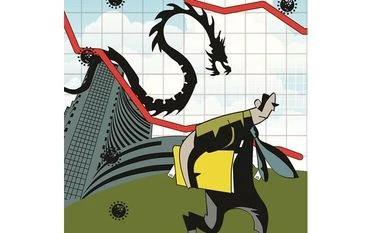
Most global markets, too, fell and the US dollar strengthened as investor sentiment took a hit amid signs that the second wave of infections is hampering reopening plans across the world
Sundar Sethuraman Thiruvananthapuram
3 min read Last Updated : Jul 15 2020 | 1:39 AM IST
The benchmark indices posted their biggest drop in more than a month as rising tensions between the US and China, coupled with a resurgence in Covid-19 cases, pushed investors to ditch riskier assets.

The benchmark Nifty ended the session at 10,607, a fall of 1.8 per cent or 195 points. The Sensex fell 661 points, or 1.8 per cent — the most since June 11 — to end the session at 36,033. Banking stocks were the biggest drag on the market as the Bank Nifty index fell 3.2 per cent. Seven of 10 major losers on the Sensex were financial stocks.

Most global markets, too, fell and the US dollar strengthened as investor sentiment took a hit amid signs that the second wave of infections is hampering reopening plans across the world. Many places in the US are witnessing record jump in new cases after a period of decline. India's Covid-19 infection tally, too, is fast-approaching the one million-mark.

“The Indian markets are worried about the increasing number of localised lockdowns, which may, in turn, delay the predicted recovery for businesses. Volatility is expected to remain, and investors are advised to be cautious,” said Vinod Nair, head of research at Geojit Financial Services.  Investors are also concerned about the stretched valuations as indices are trading near their pre-pandemic highs.
The benchmark Sensex, for example, is up almost 40 per cent since March 23. Investor enthusiasm fuelled by monetary easing provided by central banks across the globe made the battered stocks an attractive buy.


“We’re not surprised by the fall as the markets were signalling exhaustion at the higher levels. Indications are in favour of a further decline. The rising number of cases in India has increased fears of the imposition of lockdown in certain parts. We advise continuing with the stock-specific trading approach and accumulating defensive on the dip,” said Ajit Mishra, vice-president (research), Religare Broking.

The rising US-China tensions added to the investor woes. The US administration rejected China’s claims in the South China Sea. The US move is seen as a retaliation against Beijing’s campaign to dominate the resource-rich South China Sea.

“We do not know how the South China Sea dispute will shape up. US President Donald Trump is trailing in opinion polls, and he could ride on this (tensions with China) for a comeback. Moreover, there is no news on a medical breakthrough on coronavirus. We are also bracing the June quarter results,” said U R Bhat, director Dalton Capital India.
Some analysts said this trend of the pullback would be the norm for some time. “This has been a steady pattern since late March. We have three weeks of the rally followed by one week of pullback. The same trend is being seen in the way lockdowns are imposed. It has been three-four weeks of opening up, followed by a week of lockdown. As Covid-19 protocols improve, the periodicity of lockdowns will reduce," said Saurabh Mukherjea, founder, Marcellus Investment.

Market breadth was negative, with 831 stocks advancing and 1,854 stocks declining on the BSE. All the Sensex components, barring three, ended the session with losses. IndusInd Bank was the worst-performing stock and fell 5.3 per cent.

Shares of HDFC Bank fell 2.74 per cent on Tuesday after it launched an enquiry into its auto lending practices. As many as 17 of the 19 sectoral indices ended the session with losses.

One subscription. Two world-class reads.

Already subscribed? Log in

Subscribe to read the full story →
*Subscribe to Business Standard digital and get complimentary access to The New York Times

Smart Quarterly

₹900

3 Months

₹300/Month

SAVE 25%

Smart Essential

₹2,700

1 Year

₹225/Month

SAVE 46%
*Complimentary New York Times access for the 2nd year will be given after 12 months

Super Saver

₹3,900

2 Years

₹162/Month

Subscribe

Renews automatically, cancel anytime

Here’s what’s included in our digital subscription plans

Exclusive premium stories online

  • Over 30 premium stories daily, handpicked by our editors

Complimentary Access to The New York Times

  • News, Games, Cooking, Audio, Wirecutter & The Athletic

Business Standard Epaper

  • Digital replica of our daily newspaper — with options to read, save, and share

Curated Newsletters

  • Insights on markets, finance, politics, tech, and more delivered to your inbox

Market Analysis & Investment Insights

  • In-depth market analysis & insights with access to The Smart Investor

Archives

  • Repository of articles and publications dating back to 1997

Ad-free Reading

  • Uninterrupted reading experience with no advertisements

Seamless Access Across All Devices

  • Access Business Standard across devices — mobile, tablet, or PC, via web or app

Topics :CoronavirusLockdownstock marketSensexNiftySouth China Sea

Next Story



