Ironing out the wrinkles in GST

Inconsistencies need sorting out and the process of getting credits speeded up and simplified
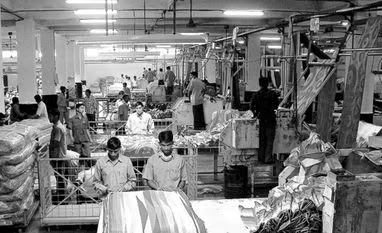
Manufacturing, Manufacturing sector, Manufacturing regime
Amar Kaul
Last Updated : Jul 22 2017 | 8:29 PM IST
The new GST regime for indirect taxes is being heralded as the biggest tax reform in post-independence India. There is no doubt that political will and consensus will help make India a much easier country to do business in, as goods start flowing easily through the length and breadth of the country. It will also further boost the manufacturing sector in India, giving an impetus to “Make in India”.

The new regime will trigger a transformational shift from a complex multi-layered indirect taxation system to a unified indirect taxation system, propagating a positive change and bringing efficiencies in the economy. Manufacturers can now concentrate on their main business of production without the complexity of multiple tax compliances. 

However, since these are still early days, we do need to look out for how smoothly processes will flow for transactions across the GST network. This is especially relevant for the manufacturing sector and, in particular, the capital goods industry, as they are highly capital-intensive and are run with huge cash-flow requirements. Therefore, while GST will have multiple benefits for the manufacturing sector, as it was earlier bogged down by multiple tax and compliance legislations and the collateral delays due to inspector raj, we are still looking to sort out some inconsistencies and hope that the process of getting credits for the sector is speedy and simple.

For instance, take the case of air compressors, where the duty rate has been fixed at 28 per cent, while major components used to manufacture the air compressor (such as castings, electric motors and valves) have been placed under the 18 per cent rate. This is not logical, as it does not allow the full tax benefit to flow to the consumer for a product which serves as a critical input for sectors such as textiles, pharmaceuticals, refineries, FMCG, mining and power, among others. 

Clearly, if the government wants India to be among the five most competitive manufacturing nations by 2020, and increase the contribution of the manufacturing sector from 16 per cent of GDP to 25 per cent, then it needs to make sure that the tax structures are perfectly aligned with the goal of reducing the costs of setting up manufacturing operations. The point is further emphasised by the fact that the second-highest driver of growth, according to a study done by Deloitte on manufacturing, is cost competitiveness, next only to talent (where we have a natural advantage). 

No doubt, doing away with the cascading effect of taxes and the abolition of central sales tax will bring down the cost of production and synergise the supply chain in the GST regime. However, we have a situation where inter-state transfers to own warehouses are taxable, and though credit is available, it will lead to an increase in working capital requirements as well as increase in transactions for the government.

With online return filing and the requirement of invoice level matching to avail of credit, suppliers are worried about possible delays and disputes in availing of credit, and this will remain until the credit is given. Further, interest rates in India are still among the highest, especially for working capital. Therefore, the competitiveness of manufacturing companies is likely to get impacted, as finance costs will add to the burden. To improve competitiveness, automatic credit needs to be given in order to make the system more efficient. 

Another example of this is exports of manufactured goods. The new GST policy does not provide for automatic credits for exports under the EPCG or Export Promotion Capital Goods scheme (which allows import of capital goods, including spares, for pre-production, production and post-production at zero duty, subject to an export obligation of six times the duty saved on capital goods imported under the EPCG scheme, to be fulfilled in six years). Therefore, exporters must take the benefit by way of refunds. In a framework where we are looking to remove intervention and let number-based credits be provided automatically, this is a clear lacuna. This is especially glaring for exports. Remember that we run a current account deficit and the government is always looking to boost foreign exchange reserves. 

It is also important to note that all these factors impact micro, small and medium enterprises (MSMEs) even more than the larger players. Therefore, the government needs to look at providing clarity on these issues on a priority basis, so that any adverse impact on manufacturers is averted. 

I am hopeful though that the GST Council and the government will consider these lacunae and address them quickly, because the intent is to “Make in India” and soon regain the title of the fastest-growing economy in the world. The manufacturing sector and the capital goods industry need all the support that the government can provide, because they are working in a global market where trade restrictions are coming down every day and the manufacturing sector is a big potential employer of our workforce. 

The writer is Chairman and Managing Director, Ingersoll Rand (India) Limited. He is also a member of the CII National Committee on Capital Goods

One subscription. Two world-class reads.

Already subscribed? Log in

Subscribe to read the full story →
*Subscribe to Business Standard digital and get complimentary access to The New York Times

Smart Quarterly

₹900

3 Months

₹300/Month

SAVE 25%

Smart Essential

₹2,700

1 Year

₹225/Month

SAVE 46%
*Complimentary New York Times access for the 2nd year will be given after 12 months

Super Saver

₹3,900

2 Years

₹162/Month

Subscribe

Renews automatically, cancel anytime

Here’s what’s included in our digital subscription plans

Exclusive premium stories online

  • Over 30 premium stories daily, handpicked by our editors

Complimentary Access to The New York Times

  • News, Games, Cooking, Audio, Wirecutter & The Athletic

Business Standard Epaper

  • Digital replica of our daily newspaper — with options to read, save, and share

Curated Newsletters

  • Insights on markets, finance, politics, tech, and more delivered to your inbox

Market Analysis & Investment Insights

  • In-depth market analysis & insights with access to The Smart Investor

Archives

  • Repository of articles and publications dating back to 1997

Ad-free Reading

  • Uninterrupted reading experience with no advertisements

Seamless Access Across All Devices

  • Access Business Standard across devices — mobile, tablet, or PC, via web or app

More From This Section

Disclaimer: These are personal views of the writer. They do not necessarily reflect the opinion of www.business-standard.com or the Business Standard newspaper
Next Story



