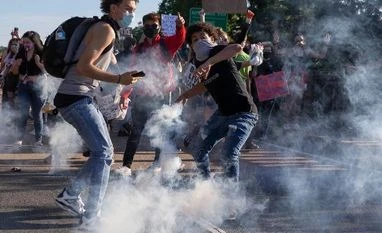
A wave of protests and violence has erupted in the United States following the death of an African-American, George Floyd, in Minneapolis when a beefy white policeman planted his knee on the victim’s neck for nine minutes. This is bloody murder; it can in no way be described by any other, softer, term. It brings to mind how a similar, potentially explosive, crisis was defused relatively peaceably 51 years ago.
The 1968 spring was marked by the assassinations of Rev Martin Luther King and senator Robert F Kennedy. City after city witnessed violent race riots in the summer, with black ghettos going up in flames. The Chicago Democratic Party convention in August that nominated vice president Hubert Humphrey as its candidate for the presidential election in November was marred by angry confrontations between mounted police and youthful protestors.
Cooler weather brought in a semblance of normalcy, but the tensions continued to simmer. Richard Nixon’s victory over Humphrey aggravated the situation, especially among students who had long opposed the continuing and steadily escalating war in Vietnam. Campuses were alive with meetings and fiery speeches.
Cornell University, where I was a doctoral student then, was no exception. Its hilltop campus, arguably the most beautiful in the entire country, overlooked the small town of Ithaca, in the Finger Lakes region of upstate New York. The vertical distance was symbolic of the ideological gap between town and gown. Ithaca was amidst conservative Republican territory, while Cornell was among the most liberal institutions.
The university had sensed the need to change with the times. It had expanded its admissions of African-Americans through an affirmative action programme several years earlier, the first major university to do so.
In the small hours of April 17, a burning cross was found on the lawns of a black women’s co-operative residence. The next morning, students belonging to the Afro-American Society, led by my good friend Edward Whitfield, occupied Willard Straight Hall, as a protest against perceived racism and the university’s slow reaction to it. The Straight housed the students union and a large eating facility, considered the epicentre of campus activity. Later that day, some white fraternity men forced entry into the Straight. They were repelled after a fight. The black students then brought in guns to defend themselves in case of further attacks. That escalated tension to crisis proportions. The mayor, an arch-conservative named Hunnah Jones (ridiculed by students as Hunka Junk), assembled his police and county sheriff’s deputies downtown and requested reinforcements from nearby cities of Syracuse and Rochester. He also sent a message to governor Nelson Rockefeller for state troopers and National Guard. A wise liberal, Rockefeller refrained. Cornell was headline news on every channel that evening.
That night, which was bitterly cold with freezing rain, some of us feared the worst and decided to surround the Straight to try and prevent entry of armed police which would certainly cause bloodshed. This was wrongly described as an action of the radical Students for Democratic Society (SDS). There were a few SDS members, but most of the rest were simply concerned and compassionate individuals who wanted to avoid violence and protect everyone. Ed allowed some of us to enter and talk to his group.
The outcome was that the siege ended when the occupiers peacefully left the Straight 36 hours after they had marched in. The picture of Ed walking out with bandoleers across his chest and a gun in his hand made every newspaper and won the Pulitzer Prize. News magazines covered the event extensively. Newsweek had it as its cover story. A large picture inside showed Rita walking arm-in-arm with me with her long flowing hair on the back and a cigarette stub in hand to keep warm. I had to write to her brother to ensure that her parents did not get to see it!
Many changes followed. The university president James Perkins, liberal but perceived as ineffectual, resigned. A constituent assembly comprising members from all stakeholders (I was a graduate student representative) drew up a fresh charter of duties and rights of the various groups. The Black Studies Programme was expanded. But social interaction between black students and the rest was limited and very edgy at best.
The United States has changed vastly since then. African-Americans have broken through many a glass ceiling, with one of its most erudite and globally respected members, Barack Obama, being elected president for two terms. And then Minneapolis happens, showing how racially polarised the country still is. President Donald Trump is an infinitely more powerful and appallingly more bigoted version of mayor Hunka Junk with the military at his command and a large swathe of ageing Middle America in support. That is ominous.
That is not the America I knew intimately for six years and have admired intensely for six decades, which I earnestly hope will still prevail.
Read this article for free
Register to continue reading premium journalism and analysis from Business Standard.
Disclaimer: These are personal views of the writer. They do not necessarily reflect the opinion of www.business-standard.com or the Business Standard newspaper

 "The America I knew")












 Connect with us on WhatsApp