
Fares of bullet train between Mumbai and Ahmedabad could start from Rs 250
The business class fares, however, is likely to be higher than Rs 3000
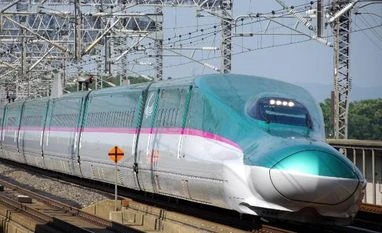 "Fares of bullet train between Mumbai and Ahmedabad could start from Rs 250")
WebinarsNew
Deep DiveNew
Explore Business Standard
The business class fares, however, is likely to be higher than Rs 3000
Passengers on board the bullet train, proposed to run between Mumbai and Ahmedabad, have to shell out anything between Rs 250 to Rs 3,000 depending on their destination, a senior official said.
Giving the first official indication of the likely fares of the government's ambitious project, Achal Khare, the managing director of National High Speed Rail Corporation Ltd (NHSRCL), told mediapersons that the fares are based on present projections and calculations.
It would be Rs 3,000 between Mumbai and Ahmedabad and as low as Rs 250 between Banda-Kurla Complex (BKC) and Thane, he said.
Khare said, "The fares have been based on present projections and calculations. There would be one business class and the fares for this is likely to be higher than Rs 3,000."
"The journey will be much more affordable and less time consuming than in a flight, if the trip to the airport, getting boarding passes and security checks are taken into consideration," he said.
An official said, a taxi takes anywhere between one and, one and a half hours to travel between Thane and Banda-Kurla Complex and charges around Rs 650.
But with the high-speed train, the journey time will come down to only 15 minutes and Rs 250 in fare, he said, adding the fares would be 1.5 times higher than AC first class fares.
A train set comprises 10 'standard' coaches, one of which will be business class. Food will be complimentary in business class and will be available in other coaches as well.
Khare said construction work under the project could start as early as December this year, by which time land acquisition is expected to be over.
The ministry would require 1,415 hectare of land for the project, and has earmarked Rs 10,000 crore for its acquisition.
"The Maharashtra government has already issued notification for land acquisition and those who give consent for the acquisition of their land, will be given 25 per cent more than the circle rate fixed by the state government or the market rate, whichever is higher," Khare said.
The officer also said 3,000-4,000 people will be directly employed by the executing authority while around 30,000-40000 workers would be engaged during the construction phase of the project.
Rubbishing reports about higher Japanese component in the project, Khare said only 18.6 per cent of their components will be involved and their contribution would be limited to a few stretches of the project, like building a corridor between Ahmedabad and Vadodara, and the under-sea tunnelling work.
"Indian contractors would build 460 km, while Japan would be involved in the construction of only 21 km under sea," he said.
Safety and punctuality would be the hallmark of the high-speed corridor and Khare asserted that they will not hesitate from emulating the safety and punctuality standard maintained by Japan's high speed bullet trains, also known as Shinkansen trains.
Khare said 360 people from India will be sent to Japan for training, of which 80 will be given on job training there.
Around 80 Japanese nationals are already working along with Indian officials, he said, adding, "As far as delays are concerned, it would not be more than 40 seconds."
The bullet train will cover 70 trips per day between Mumbai-Ahmedabad and each rake will have 10 state-of-the-art coaches, Khare said.
The proposed bullet train will run approximately 500 km, between Mumbai and, at a top speed of 320 kmph, and is expected to be up and running by 2022.
First Published: Apr 13 2018 | 6:38 PM IST


 Connect with us on WhatsApp