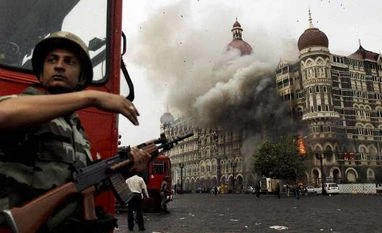
Soon after the 2008 Mumbai terror attack the then chief of Pakistan's ISI conceded that some of the powerful spy agency's retired members were engaged in training those involved in the heinous crime but refused to take action, a former CIA chief has said in a new book.
In his latest book 'Playing to the Edge', Michael Hayden, the former CIA Director, expressed his deep frustration of the "duplicity" of the Pakistani leadership when it came to taking action against terrorist groups in particular al Qaeda, Taliban, LeT and the Haqqani network.
Arguing that the Pakistan Army is built to fight against India and not terrorists, the top leadership in the country, in particularly those from its military in the past one decade, have repeatedly expressed its inability to take on the terrorist groups in the tribal regions as desired by the US, he wrote.
Referring to the Mumbai terrorist attack, Hayden, who was the CIA chief till 2009, said it was very clear that there seemed to be so many Pakistani fingerprints on the atrocity.
"I began routinely harassing my counterpart in Pakistan, now Ahmed Shuja Pasha (the former director general of Military Operations, the Pakistan army's top operational post), on the phone, urging him to get to the bottom of the attack and to discuss it frankly with us," he wrote.
"We had no doubt that the attack was the work of LeT, and there was mounting evidence that preparation for and direction of the attack took place from within Pakistan, where LeT enjoyed the protection and support of ISI," Hayden said.
Pasha, who had come to ISI only a few weeks earlier and had no previous intelligence experience, came to the US on Christmas Day and spent most of the next afternoon in his office.
"He worked carefully from notes. His investigation had revealed that some former ISI members were involved with Lashkar-e-Taiba (no surprise there). Pasha admitted that these unspecified (and still uncaptured) retirees may have engaged in some broad training of the attackers, but he was characteristically vague about any detailed direction the attackers had gotten during the attack via cell phone from Pakistan," Hayden wrote in the book.
"I took to passing sufficiently sanitised intelligence to Pasha on what we believed was going on in order to try to goad him into action. If he knew that we knew...Perhaps we could get some movement. We didn't have a whole lot of success," Hayden wrote.
Narrating an incident when the then Pakistani president Pervez Musharraf refused to fill up gas in the airplane that flew him to Islamabad, where he had gone to press him to take action against terrorists, Hayden wrote: "One more bit of evidence that these guys really were the ally from hell".
The crew had forgotten their government credit card- you can't make this stuff up- and the Pakistanis wouldn't budge, he wrote.
Musharraf refused to take action, despite some crucial evidence being provided to him.
"And every time he was pressed, the response was his army
was built to fight India, not tribal insurgents, and he wasn't going to bleed it in Waziristan's mountains chasing Pashtun, Uzbek or Arab jihadists," Hayden said.
The US received similar response from other leaders of the Pakistan Army including General Ashfaq Pervez Kayani and the ISI's chiefs, he said.
"(The then) ISI chief Ashfaq Kayani didn't say anything to ease our concerns when he reported that there was little prospect of the Pakistani military conducting robust ops in the tribal region. He said that it was less a matter of will than of capacity. His army was certainly India-focused," Hayden wrote.
"Indeed, one senior Pakistani official told me that his was the only army in the world that sized the perception of the threat (India) to meet the desired end strength of the military. So PAKMIL was big, artillery heavy, and road bound- and ill-suited to navigating mountain trails or dealing with insurgents," Hayden says in the book.
"When the US government presented Pakistani officials with intelligence that pinpointed an al-Qaeda leader and a plan of action to 'take him off the battlefield'", the response was "no, maddening delay, or our target suddenly and unexpectedly relocated".
Many Pakistanis viewed LET (like the Haqqani network and the Taliban) as some sort of strategic reserve rather than the strategic liability and regional danger they really were, he wrote.
Hayden said in his view, the United States will need to keep this capacity and be willing to use it.
"Islamist terrorism thrives in places- Pakistan, Somalia, Yemen, Syria, Libya, Mali, the list goes on- where governments cannot or will not act. In some of these instances, the United States must," he argued.

 "Pasha admitted ISI's role in Mumbai attack: Ex-CIA chief")


 Connect with us on WhatsApp