The world’s second largest edible oil market, India, is a crowded place to be in. There are as many as 500 brands vying for consumers’ wallet share and shelf space in their kitchen. In a commodity market with little product differentiation and thin margins, players have no choice but to invest heavily in marketing activities to create a buzz around the brand and leverage technology to minimise operational inefficiency to drive growth.
Cargill Foods India Limited, for one, is investing heavily in automation tools and data analytics to improve sales efficiency and enhance the quality of retail coverage of its edible oil business.
Operating in an unorganised sector, Cargill Foods India Limited, like its competitors, is faced with the challenge of getting the right set of sales data and faces issues including authentication of sales figures provided by retailers. To address these issues, the company has introduced sales force automation (SFA) tools in a majority of its retail outlets.
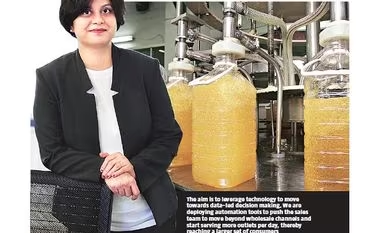
“The aim is to leverage technology to move towards data-led decision making. We are deploying automation tools to push the sales team to move beyond wholesale channels and start serving more outlets per day, thereby reaching a larger set of consumers,” says Neelima Burra, chief marketing officer, Cargill Foods India.
Cargill Foods India Limited boasts a retail footprint of 78,798 outlets with north India accounting for half of its total distribution network. It has a strong presence in markets such as Maharasthra, Delhi, Uttar Pradesh, Bihar, Jharkhand and Gujarat.
With a focus on data-led decision making, Cargill Food India’s sales team is using SFA to capture orders, fulfil distribution orders for retailers, and move the orders back to the company for stock replenishment etc. Also, since the entire retail network is now geo-tagged, the corporate office can see how and where the stock is moving across the company. The SFA-led analytics is leading to highly customised and detailed reports, and a user-friendly dashboard is facilitating managers to visualise and interpret data to run their operations better. With the elimination of manual interference and capturing of outlet-wise sales the marketing team is in a stronger position to devise more effective promotional schemes and product launches.
Additionally, by using SFA and smartphones, the sales force team is also able to track its feed orders and incentives at the click of a button. With requisite market numbers on their connected devices on the go, the sales personnel are able to plan demand with more accuracy.
Burra points out that the adoption of SFA tools has impacted performance and efficiency of the sales team.
“Earlier the personnel spent a lot of their productive time on repetitive administrative jobs. But now, they get real-time key performance indicator measures on their smartphones and are therefore more productive. Rather than spending time in office, the sales team is out in the market for longer periods thereby improving prospects of higher sales,” she says.
The Indian retail edible oils market is competitive, with the presence of well-established brands like Marico (Saffola), Adani Wilmar (Fortune), Sundrop (AgroTech) and Mother Dairy (Dhara).
Cargill Foods India offers brands like Gemini, Nature Fresh, Rath and Sunflower Vanaspati oil. Even as big brand names dominate the edible oils market, it’s a highly fragmented space with a large number of regional and local players commanding as much as 40 to 50 per cent of the sales in certain pockets of the country.
In such a cluttered market, Cargill Foods India is going all out to cut costs and improve margins by deploying technology to promote better coordination and transparency among the sales and marketing team, and retailers.
Automation tools are helping the company collect sales data related to primary and secondary stock keeping units (SKUs), maximum retail price, product related schemes and promotions.
The company is working towards coming up with specific promotional campaigns for pushing sales of its dominant brand Gemini, which leads the edible oil segment with a market share of 27 per cent. Similarly, the Leonardo range of olive oils which the company claims is a market leader with 20.2 per cent pan-India share in premium olive segment. Also, in north India, the company wants to be the numero uno player by pushing Rath Vanaspati through targeted promotions. At present, Rath Vanaspati is the second leading brand in the region with a market share of 15.1 per cent.
Since most of Cargill Foods India’s offerings are positioned as premium brands, a large set of consumer and sales data from the ground helps it to avoid mass distribution of products. Using data analytics, it’s in a stronger position to undertake customer segmentation for its different brands on the basis of consumer choice, geography etc.
According to industry sources, Cargill Foods India’s cumulative revenue (including commodities trading) are estimated to be in the range of Rs 8,000-10,000 crore annually. The company’s growth is driven by its growing consumer and retail business. The consumer and branded retail business contributes to about 50 per cent to Cargill Foods India’s overall business putting its retail business in the range of Rs 4,000-5,000 crore.
Burra sums up that with the ubiquity of affordable mobile devices, it is possible to get real-time data pertaining to sales and market operations. This data can then be sliced and diced to provide highly accurate and intelligent business inputs, thereby accelerating business growth.




