Home / Specials / News / Chitra Ramkrishna's fall from grace: 'Queen of bourses' to Rs 3-cr penalty
Chitra Ramkrishna's fall from grace: 'Queen of bourses' to Rs 3-cr penalty
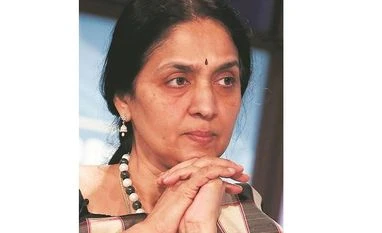
Ramkrishna was the third woman to head an exchange in the Asia-Pacific region after Sri Lanka's Colombo Stock Exchange and China's Shenzhen Stock Exchange
4 min read Last Updated : Feb 17 2022 | 12:02 PM IST
Don't want to miss the best from Business Standard?
It’s been quite a fall from grace for a woman who was earlier hailed as the “queen of the bourses” and was among the few women globally to have helmed a stock exchange.
Last week, the Securities and Exchange Board of India (Sebi) slapped a penalty of Rs 3 crore on Chitra Ramkrishna, former boss of the National Stock Exchange of India (NSE) in a fresh order in the co-location case. The 190-page order also faulted Ramkrishna for running the exchange at the behest of a mysterious yogi.
The regulator, however, dropped the allegations of fraudulent and unfair trade practices against her, charging her for violation of the Securities Contracts Stock Exchanges and Clearing Corporations (SECC) Regulations, instead.
A chartered accountant by training, Ramkrishna began her career with IDBI in 1983 and was among the five people to be hand-picked by the legendary S S Nadkarni, then chairman of IDBI, to set up a professionally run, transparent and tech-driven stock exchange that could put India on the world stage. This was in 1992, a year in which the infamous Harshad Mehta scam came to light in the Bombay Stock Exchange.
She spent 12 years working under Ravi Narain, who took over from Nadkarni. She regarded Narain, later vice chairman of NSE, as a mentor and friend. She was appointed as joint managing director of the exchange in September 2009 and took over the corner office as managing director & CEO on April 1, 2013, more than two decades after joining the exchange.
Ramkrishna was the third woman to head an exchange in the Asia-Pacific region after Sri Lanka’s Colombo Stock Exchange and China’s Shenzhen Stock Exchange. She was also appointed chairperson of the Board of World Federation of Exchanges, a global industry association for exchanges and clearing houses.
With Ramkrishna at the helm, NSE’s daily average turnover, including both cash and derivatives, doubled to Rs 3.5 trillion, from Rs 1.6 trillion in the three-and-a-half years since she took over as chief executive. The exchange posted a consolidated net profit of Rs 1,026 crore in FY16, making it 10x more profitable than rival BSE with a virtual monopoly in the high-volume derivatives space.
Ramkrishna was the second-highest paid executive in the financial services industry in FY16, before she quit. Her salary that year was second only to Aditya Puri’s, then managing director of HDFC Bank, who took home Rs 9.7 crore, and almost three times that of BSE CEO Ashishkumar Chauhan, who earned Rs 3.3 crore.
But in 2015, things started to unravel. A Singapore-based whistle-blower alleged that a Delhi-based member on the NSE was able to access privileged price information by linking to servers and getting access to least crowded servers. This later came to be known as the co-location scam where select traders were allegedly given preferential access to data and trading systems through the co-location facility at the exchange.
A technical advisory committee appointed by Sebi had found some evidence that the NSE was favouring a few traders over others. Questions then began to be asked about Ramkrishna’s corporate governance practices, such as appointing as senior consultant one Anand Subramanian, whose remuneration rose steadily even though he was not part of the executive management team.
Shareholders also accused her of delaying an initial public offering. “Investors had reached out to her on a number of issues ranging from the timing of the IPO to the co-location issue to the appointment of the COO. You need to take investors seriously, which she did not. She was not responsive and did not make herself very accessible,” said a person familiar with the matter.
Ramkrishna resigned from the NSE in December 2016, citing personal reasons, but key issues about how a CEO could enjoy the latitude she did in such a significant institution remain unanswered.




