Lenin’s mausoleum is smaller than you expect. It doesn’t loom in the middle of Red Square, like Mao’s does in Tiananmen. Its red granite walls melt into the red brick walls, five centuries older, that stretch behind it. Most of the time, there is no long, snaking line of respectful visitors to guide your eye there; no goose-stepping sentries command your attention. It is just there — unguarded and unattended and startlingly familiar, with at best a few foreign tourists in front taking selfies. For the vast majority of visitors to Red Square, the real attractions are the dragon-scaled onion domes of St Basil’s, or the guards in front of the ceremonial entrance to the Kremlin. Lenin’s tomb – and the busts amid the birch trees behind it, the burial places of the Communist pantheon including Stalin and Soviet spymaster Dzherzhinsky — really only appeals to foreigners; and there are very few foreigners in Red Square. You could wander the entire square for an hour, and not hear snatches of any language except Russian.
Across Red Square from Lenin’s Tomb, along the frontage of the giant department store GUM, café tables stand empty. I sat there happily undisturbed earlier this month, with a coffee, an Italian white and a salmon salad, staring across the expanse of the square to the turrets and high towers dotting those 15th-century walls, and wondering if there was anywhere else in the world where such a famous view could be enjoyed so comfortably and so cheaply. Somewhere behind those walls, President Vladimir Putin was contemplating the next step in what seems to be an endlessly escalating confrontation with the West, a confrontation that includes sanctions against Russian companies. One consequence of this, and of the oil price crash, is that the rouble has lost about half its value in a year. Thus a city long unaffordable — regularly considered one of the most expensive in the world, after only Tokyo — is now both uncrowded and cheap. The very good coffee I was having, with a slice of lemon in the Russian style, was the same price as in Khan Market in Delhi. Tonight, a room at the five-star art nouveau landmark Hotel Metropol around the corner, the very heart of every Cold War spy story, would cost you Rs 7,500.
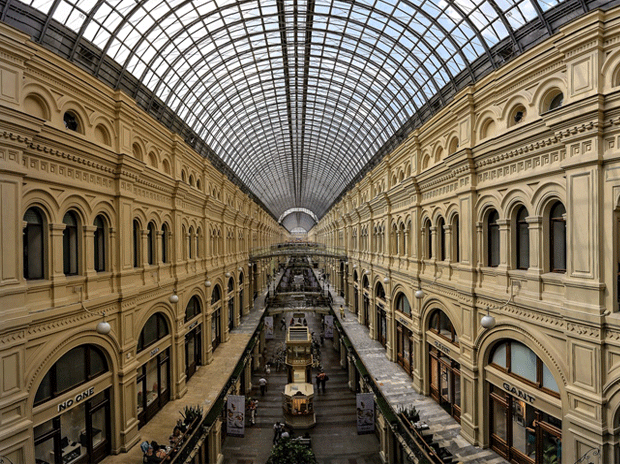
An interior of GUM department store. Photo courtesy: Robert Montgomery [CC BY 2.0] via Wikimedia Commons
Nobody seems to have figured this out yet. This was the first time in years I have been somewhere and seen practically no Indians — a bare handful in a week. There are few tourists from other countries, either. At the State Historical Museum bordering Red Square, there was a scrum for the few remaining Russian-language audioguides; but there wasn’t a single English one checked out at 2 pm on a Saturday. Most of the time, a foreigner in Moscow can feel genuinely, exhilaratingly alone — a bright reflection, I suppose, of the grim solitude that famously darkened the lives of Soviet-era defectors to Moscow like Ambala-born Kim Philby.
Russia today is not just surprisingly inexpensive; it is surprisingly complicated. It is, to an extent, in between national narratives, just beginning to find itself again. This is, of course, not as free a process as it sounds; the guiding hand of the Man in the Kremlin is everywhere discernible in Russia’s redefinition.
Russia’s reinvention of itself can confuse and fascinate the wandering foreigner. There are no guards at Lenin’s tomb; but Boris Yeltsin’s plans to rebury him have been dropped. The post-1991 revival of the symbols of Tsarist Russia continues: Putin recently inaugurated a giant memorial to the reformist Tsar Alexander I just outside the Kremlin walls, and other recent tributes to the Romanovs litter the centre of town — including, I suppose, the big posters advertising the hit musical “Count Orlov”, which boasts dresses studded with 15,000 gems and weighing 10 kilos, as a “Taste of Imperial Russia”. Yet the T-shirts on sale in Moscow subway stations don’t portray the tsars; besides Putin in various stages of machismo, they feature the familiar bushy moustache of a certain Josef Stalin, or even the buttoned-up coat, narrowed eyes and French beard of “Iron” Felix Dzerzhinsky, who developed the Revolution’s terrifying secret police.
Along the Moskva River, just by Gorky Park, stands the 20th-century wing of the Tretyakov Gallery. Inside are the masterpieces of Socialist Realism. But for anyone even vaguely interested in Russia’s recent past and possible future, the greatest treasure lies in its grounds. There, as the sounds of happy children playing in a fountain provide background noise, you can look at the monumental statues of the Soviet era, treated as works of art rather than worship, eerily similar to how churches were treated by the Bolsheviks. The most recognisable is not one of Stalin or of Lenin, but of that same dreaded Iron Felix. It stood in Lubyanka Square, opposite the prison-headquarters of the KGB; and only when it was toppled by protesters in 1991 was it clear the Soviet Union was finally going to fall. But, on a fine afternoon in July 2015, it stands outside the Tretyakov, with bouquets of summer flowers in front. While, across the river, an ex-KGB man sits in the Kremlin, and his Moscow is very different from the Moscow of 1991; a referendum of citizens is being scheduled on whether to restore the once-reviled statue to Lubyanka Square.
Visiting a people busy redefining themselves is a fascinating experience. Putin has told the nation’s historians to come up with histories that are “consistent”, a way for the blood and confrontation that marks Russia’s history to be both smoothened as well as pressed into the service of the new empire he is creating. Great men and women, those leaders who embody the strength of Russia, must be honoured regardless of ideology; even museum audioguides and literature invite you to admire the masculinity of Peter the Great’s pose, the determination in Catherine the Great’s eyes. Real leaders of Russia must understand photo-ops.
The White Rabbit restaurant
More even than this celebration of previous autocrats, Putin seems to be groping his way towards some Russian conception of the “mandate of heaven”, the Chinese concept that glorifies both those who hold power and those who seize power. This is most startling in a corner gallery of the Tretyakov that holds vast pictures of Stalin meeting an overjoyed delegation from a collective farm, and of examining battle plans with his generals (which canvas reveals one of the undiscussed perks of dictatorship: the Marshal is the only one smoking). The gallery has at its centrepiece a huge window that looks out on a skyline dominated by the huge, golden-domed Cathedral of Christ the Saviour, the tallest Orthodox church in the world. A video screen next to the window reminds you, through silent footage, that Stalin had demolished the original cathedral that stood on the site. It has been rebuilt exactly as before, except over a big parking lot this time. It is in this church in 2012 that the band Pussy Riot staged the protest against the Russian Orthodox Church for supporting Putin’s re-election that got them jailed. Putin said that they had “undermined the moral foundations of the nation”.
Inside, the cathedral is light and airy, with frescos soaring into the heavens. But my eye was caught by the two biggest at ground level. Both are familiar scenes from early medieval Russian history; the central figure is not a churchman or a scholar, but a prince who is being blessed by the church. Even an ignorant visitor can figure out what that means.
Russia is today at a precarious point, seemingly reversing its centuries-old drift towards the West. But, standing in the Kremlin Armoury Museum, you can suddenly realise it is returning to its true self by imagining itself once again as a Eurasian power. Putin’s view of how to manage dissent and democracy owes a great deal to the People’s Republic, whom many in Russia imagine have managed the transition away from communism far better. And, once you start looking, you can see Russia’s Eurasian origins everywhere. Go to the Armoury not just for the jewelled Faberge eggs commissioned by the last tsars — which are, incidentally, the only famous pieces of art I have seen that have not disappointed me. Go also to see the regalia and dress of the tsars — Turkish, even Persian more than they are Western. Even Russian Orthodox Churches are different. Christ the Saviour is atypical, in that it shares Western churches’ airy and vertical aesthetic. Usually they are small, low-ceilinged, intimate, bejewelled, heavy with incense and chanting — more like most Hindu temples than anything else.
For a visitor, this means that Russia is a unique experience: Europe, but not Europe. Along Maroseyka Street, echoing with high-pitched laughter and the sound of stilettos on pavement, the trendy 24-hour restaurants aren’t just spaghetti kitchens but also Georgian barbeques — the Georgians being surely the only peoples in the world who specialise in pork kababs. But the traditional signs of European culture, too, are wonderfully accessible; you can walk in, as I did, to concerts at the famed, quadrennial Tchaikovsky Competition for a pittance, or just sit in the park outside the music academy that also bears Tchaikovsky’s name with a glass of wine, while soaking up the sound of the world’s best pianists practising float out of third-floor windows. The museums of Western art — the Pushkin Museum, in particular — have collections of unexpected size and quality. Many of the pieces — particularly the eerie ‘Great Buddha’ by Gauguin, one of prisoners exercising by van Gogh, and the finest Cubist painting I have seen, a portrait of the collector Ambroise Vollard by Picasso — would have been world-famous, iconic, immediately recognisable, even considered their creators’ masterpieces, had they hung in a Western gallery.
Most unique of all, you can wander the centre of one of the world’s greatest cities — a millennium old and home to 17 million — walking from museum to bar to concert to square, and not feel like you are in a tourist trap. You can lunch at the White Rabbit, regularly rated as one of the 20 finest restaurants in Europe, looking out on a skyline dominated by the vast Stalinist foreign ministry across the street — and pay less than you would for a middling meal in Mumbai or Delhi. You can wander into GUM from Red Square, stand in line at the potato buffet, gawk with the schoolchildren at the spectacular steel-and glass ceiling just as peasants from the villages did in the 1930s, and smile at the dozen couples dressed in wedding finery having their portraits taken in that famous arcade. In Moscow, at least, aging Mother Russia looks very young.

 "Red Square on sale")


 Connect with us on WhatsApp