A new phase in India-UK defence ties

Defence partnerships signal deeper industrial and military cooperation between India and the United Kingdom
10 min read
Updated On: Nov 07 2025 | 2:10 PM IST
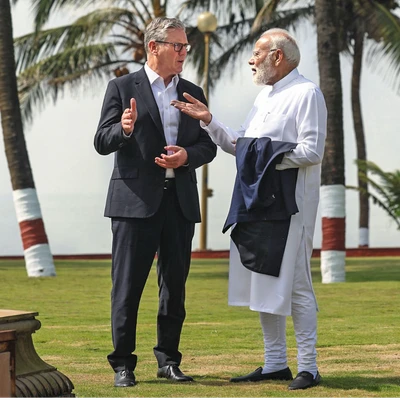
Prime Minister Narendra Modi with British Prime Minister Keir Starmer, at the Raj Bhavan premises, Mumbai, on October 9 (Photo: PTI)

Prime Minister Narendra Modi with British Prime Minister Keir Starmer, at the Raj Bhavan premises, Mumbai, on October 9 (Photo: PTI)

Following the completion of the long-awaited India-UK Comprehensive Economic and Trade Agreement (CETA) in July 2025, British Prime Minister Keir Starmer’s first official visit to India over October 8 and 9 formalised two significant defence industry collaboration deals.
  The first deal worth $335 million was for the joint development of naval electric power generation and propulsion systems by General Electric (GE) and Rolls-Royce with the Indian Navy. This followed a statement of intent signed in February 2025 by the United Kingdom’s (UK’s) GE Vernova and India’s Bharat Heavy Electricals Ltd. to design and develop an Integrated Full Electric Propulsion (IFEP) system for India’s next-generation Landing Platform Dock (LPD) fleet, with the country’s first maritime Land-Based Testing Facility to deliver the LPD by 2030.
  The UK is the world leader in naval electric power generation and propulsion, with GE and Rolls-Royce providing systems for the Royal Navy’s two Queen Elizabeth-class aircraft carriers. One of which, HMS Prince of Wales, travelled to India in October 2025. 
  Rolls-Royce is now the UK’s pre-eminent aerospace manufacturer in relation to India. The company has also signalled its intention to establish a maintenance, repair and overhaul (MRO) facility for the AE2100 engine, used by the Indian Air Force (IAF) C-130J Super Hercules fleet. 
The second major announcement was a new government-to-government partnership for lightweight multirole missiles, known for their versatility due to their surface-to-surface, air-to-air, surface-to-air, and air-to-surface capabilities. These will be coproduced by Thales UK and Indian public sector undertaking Bharat Dynamics Ltd. (BDL) in a deal worth $470 million, signalling long-term technological collaboration on complex weapons.
  Fresh policy
  Both these deals took place under the Labour-led UK government, elected in July 2024, in line with their fresh defence and security policy towards India. The UK’s Strategic Defence Review (SDR) of June 2, 2025, emphasised a “NATO-first” but not a “NATO only” defence policy. While there was to be no “tilt” towards the Indo-Pacific (and thereby, India) — the hallmark of the previous Conservative-led government — it recognised India’s role on the global stage, and sought to continuously deepen the bilateral defence relationship.   
The UK government’s National Security Strategy of June 24, emphasised its intent towards India. It stated that “India is a country with which we seek a genuine strategic partnership, reflecting India’s growing importance in the international system”. It went on to note the completion of CETA, the Technology Security Initiative (TSI) of July 24, 2024, and the Defence Partnership-India (DP-I) of February 10, 2025, all reflected a shared desire to create stronger ties. 
  In July 2025, during Prime Minister Narendra Modi’s visit to the UK, the two leaders launched the revamped and extended India-UK Vision 2035, which underscored both nations’ desire to unlock “the full potential of a revitalised partnership”. Defence and security initiatives included the launch of the Defence Industrial Roadmap and deepened collaboration on advanced technology and complex weapons, including via the Electric Propulsion Capability Partnership and Jet Engines Advanced Core Technologies. In addition, it noted a shared desire to strengthen research and development on capabilities, including underwater systems and direct energy weapons, increased cyber resilience through collaboration on cyber and digital governance, and the development of emerging technologies. 
From India’s perspective, increased defence industrial collaboration with the UK could help it achieve its goal of Atmanirbhar Bharat (self-reliant India), and enhance the sizeable growth potential for defence exports. Recent geopolitical dynamics further necessitated India’s need to diversify on defence. Both its traditional partners, Russia and Israel, had pivoted production domestically to support their military operations in Ukraine and Gaza, respectively. Current strained ties with the US over tariffs and India’s import of oil from Russia, also require greater domestic focus for the long term. Concurrently, India’s neighbourhood security challenges have sharpened, with the Operation Sindoor counterterrorism operations against Pakistan in May, and continuing security challenges from China on land and at sea. 
Military cooperation
  Nonetheless, India procured only 3 per cent of its arms and defence equipment from the UK, with Russia, Israel, France, and the US providing the majority of India's defence imports. The last major UK platform sale to India was the second 
tranche of Hawk Advanced Jet Trainers 15 years ago (worth $1 billion), followed by the acquisition of ASRAAM missiles 11 years ago ($400 million).  
On September 18, 2024, the UK-based think-tank International Institute for Strategic Studies (IISS), in partnership with Bharat Shakti, an influential Indian digital platform on defence led by Nitin Gokhale, held their third “track 1.5” workshop in Delhi on India-UK Strategic, Defence Business and Technology Security Partnerships: The Way Forward. This uniquely brought together three key stakeholders for bilateral defence industrial cooperation — government, business, and experts — from both countries to discuss, in a private, informal, and off-the-record manner, the “way forward” for bilateral defence and security partnerships. 
At the Aero India exhibition in Bengaluru in February, the DP-I was formally launched, along with the signing of several defence deals between British and Indian defence manufacturers.  In April, the 24th meeting of the UK–India Defence Consultative Group in London brought together senior Indian officials, including Indian Defence Secretary Rajesh Kumar Singh, along with a delegation from the Society of Indian Defence Manufacturers (SIDM), including representatives from Hindustan Aeronautics Limited (HAL), MKU Ltd, Bharat Forge, and BDL. These discussions culminated in the signing of the Roadmap for India-UK Defence Industrial Cooperation in the same month, designed to promote and support greater industrial cooperation. The framework specifically outlined the strategic intent by both countries to bring together their defence industries for collaboration, regional security, and economic growth, through government support and oversight. 
  In September, India’s Secretary of Defence Production, Sanjeev Kumar, attended the global Defence and Security Equipment International 2025 exhibition and conference in the UK. Alongside delegates from SIDM, Kumar opened the India pavilion and delivered a keynote address. This allowed Indian industrial leaders to showcase the strength and innovation of the country’s defence manufacturing while holding productive meetings with leading UK firms, including Rolls-Royce, Thales, MBDA, and BAE Systems, to explore opportunities for co-development, supply chain integration, and global partnerships. 
With bilateral defence cooperation boosted politically by an unprecedented two prime ministerial visits within four months — an outward visit by Modi to the UK in July and an inward visit by Starmer to India in October — there is a strong sense of optimism on defence between the two governments and business leaders. This has not been seen in over a decade.  
In effect, since November 2024, there have been important defence cooperation deals (see table). Rolls-Royce and the Defence Research and Development Organisation’s Gas Turbine Research Establishment also have a long-standing joint programme to develop engine technology for next-generation fighter aircraft engines. 
Bilateral defence collaboration has also extended beyond the industrial realm towards military cooperation. Starmer’s visit to Mumbai in October included announcements on expanded defence exchanges via joint exercises, training, and capacity building across all military functions. During his visit, the UK-led Carrier Strike Group engaged in military drills with the Indian armed forces, as part of Operation Highmast. Additionally, both countries announced the establishment of the Regional Maritime Security Centre of Excellence under the Indo-Pacific Oceans Initiative. Progress has also been made on integrating IAF Qualified Flying Instructors in Royal Air Force (RAF) flying training. Army collaboration is also expected, with the annual exercise Ajeya Warrior once again taking place towards the end of the year. Further collaboration will also take place through the attendance of Indian military educators at UK defence and staff colleges, including Royal Military Academy Sandhurst, RAF College Cranwell, and Britannia Royal Naval College Dartmouth, which enhances trust building.
  Future outlook
  The DP-I represents an important next step for bilateral defence cooperation through investment across a range of cutting-edge technologies and capability development partnership, including on next-generation weapons in the critical area of air defence, which has become far more important now in the aftermath of Operation Sindoor. 
  Yet, there remain challenges, which can be overcome. For example, India’s close defence ties with Russia, including its participation in the joint Russia-Belarus Zapad (West) 2025 military exercise in Belarus in September, raised concerns in the UK.
  Both sides have acknowledged that past failures in fulfilling contractual obligations have been a key factor limiting progress. A lack of flexibility in procurement processes in India has also hindered the development of partnerships. This has particularly harmed UK small and medium enterprises (SMEs), as they lack the time, resources, and capacity to compete for Indian business due to the long procurement timescales. Such entities could, however, play a vital and competitive role in the supply chain with Indian manufacturers. Restrictive foreign direct investment policies, high indigenous content and stringent intellectual property requirements further put strain on UK businesses when looking to invest in Indian defence. Yet, third-country exports represent a significant opportunity for the two countries to capitalise on. 
  One suggestion made within diplomatic circles is to develop a “big capability idea” that all can agree on and coalesce around. Something which can deliver a tangible stride towards enhancing the bilateral defence-industrial ties. The 2004 
US-India Next Steps in Strategic Partnership (NSSP) is a prospective model.
  A UK-India NSSP might address existing technological gaps at the intersection of the two countries' TSI and existing defence collaboration. Given the new and emerging threats alongside advances in military technology (as highlighted in the UK SDR), creating synergy between these two facets of India-UK collaboration could be a strong starting point for scaling up the relationship. Specifically, joint innovation in unmanned aerial vehicles (UAVs) and counter-UAV technologies has been highlighted as one area that could be enhanced, especially given the prominence of UK SMEs in this sector. The UK’s strengths in material science research and developing short-range missile guidance systems are other areas where Indian partners might reap benefits. The UK, too, could benefit from India’s thriving defence business ecosystem. 
  Meanwhile, strengthening governance procedures regarding the sharing of military technology is another trust-building mechanism. The US NSSP allowed for its officials to inspect the use of their defence technology and test the strength of firewalls to ensure such technology was not exposed to leakages to third-party countries.  
Finally, supporting initiatives that promoted more efficient and streamlined business-to-business (B2B) collaboration is another area of the relationship to consider. As part of this, simplifying procurement procedures for India is essential.
  So, after the key trade agreement and two prime ministerial visits this year, the new revitalised bilateral political relationship between India and the UK has helped build G2G and B2B ties and trust. It is now time for delivery, with the two defence industry collaboration agreements signed during Starmer’s visit to India, just the beginning.  
 
(Saurav Parmar, a former intern at IISS, contributed to this article)
 
Premium ContentPremium ContentSubscription ExpiredSubscription Expired

Your access to Blueprint has ended. But the story is still unfolding.

No longer a subscriber? There’s a new reason to return.

Introducing Blueprint - A magazine on defence & geopolitics

Introducing Blueprint - A magazine on defence & geopolitics

Like what you read? There’s more in every issue of Blueprint

From military strategy to global diplomacy, Blueprint offers sharp, in-depth reportage on the world’s most consequential issues.

Exclusive pricing for Business Standard digital subscribers

Choose your plan

Exclusive Pricing

Choose your plan

58% off
₹12,000

Blueprint Digital

₹5,000

annual (digital-only)

₹416/Month

72% off
₹24,000

Blueprint Complete

₹6,500

annual (digital & print)

₹541/Month

37% off
₹12,000

Blueprint Digital

₹7,500

annual (digital-only)

₹625/Month

62% off
₹24,000

Blueprint Complete

₹9,000

annual (digital & print)

₹750/Month

Here's what's included:

  • Access to the latest issue of the Blueprint digital magazine

  • Online access to all the upcoming digital magazines along with past digital archives

  • * Delivery of all the upcoming print magazines at your home or office

  • Full access to Blueprint articles online

  • Business Standard digital subscription

  • 1-year unlimited complimentary digital access to The New York Times (News, Games, Cooking, Audio, Wirecutter, The Athletic)

Written By :

Rahul Roy Chaudhury

The author is a senior fellow, South and Central Asia Defence, Strategy and Diplomacy, International Institute for Strategic Studies, London
First Published: Nov 07 2025 | 2:09 PM IST

Next Story