Are US-India relations back to the future?

Trade wars and cold calls aside, India and the US have had tensions before; however, both bounced back stronger
9 min read
Updated On: Nov 07 2025 | 2:12 PM IST
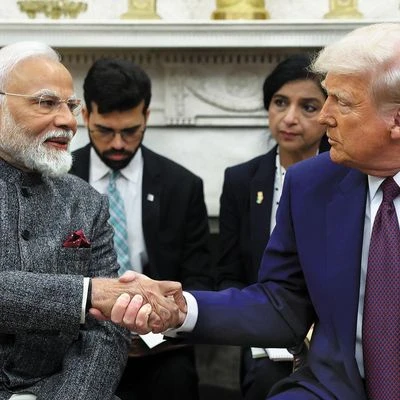
Prime Minister Narendra Modi with US President Donald Trump at the White House in Washington, DC, on February 13 (Photo: Reuters)

Prime Minister Narendra Modi with US President Donald Trump at the White House in Washington, DC, on February 13 (Photo: Reuters)

Over the past few months, relations between the United States (US) and India have reached a particularly low ebb. Differences over India’s purchase of petroleum from Russia, the imposition of high tariffs on India and the apparent failure or unwillingness of Prime Minister Narendra Modi to take phone calls from US President Donald Trump have all contributed to the current impasse. Many within India are lamenting this terrible backsliding in bilateral relations, fearing dire  straits. Such concerns are wholly understandable. 
However, from a historical standpoint, these misgivings may be a bit exaggerated. During the Cold War, US-India relations were notable for their lack of substance. People-to-people contacts were limited as there was no significant Indian diaspora in the US, there was no economic relationship worth the name owing to India’s autarchic economic policies, and India’s fitful commitment to non-alignment did not endear it to the US.
  Consequently, a discussion of a handful of episodes from that era will demonstrate that the relationship, which was far more tenuous during that time, almost reached a breaking point on several occasions. Today, while the relationship is fraught with some peril, it is unlikely to collapse. The economic, strategic, and cultural ties forged over the past several decades have now provided a degree of ballast that makes it difficult for either party to abruptly abandon it.
  Since such foundations simply were absent during the Cold War, the US-India relationship came perilously close to unravelling at several critical junctures. One of the first such moments came during the Vietnam War in the mid-1960s. The episode came about at a time when India faced the threat of a looming famine. The then Prime Minister Indira Gandhi had travelled to Washington, DC, to plead for food assistance and US President Lyndon Johnson, readily agreed to come to India’s aid.  However, on her way home she stopped off in Moscow, where she made some critical remarks about the US’ conduct of the war in Vietnam. Johnson, upon learning of this, was infuriated. In a fit of pique, he decided to control the flow of food assistance, making it conditional on India’s willingness to offer at least token support for the American role in Southeast Asia. Despite this crude pressure, Indira Gandhi refused to relent. However, the fracas led to a steep downslide in US-India relations.
  Another episode, better known to both the Indian public and its foreign policy elite, was the “tilt policy” under US President Richard Nixon and his then National Security Adviser, Henry Kissinger.  At this time, Nixon and Kissinger, wanted to exploit the breach between the Soviet Union and the People’s Republic of China after the Ussuri River clashes of 1969. To that end, Kissinger turned to Pakistan to serve as a conduit to China. This initiative came shortly after Pakistan’s first free and fair election in December 1970, which resulted in the overwhelming victory of Sheikh Mujibur Rahman’s Awami League in East Pakistan.  With Zulfiqar Ali Bhutto, the leader of the Pakistan People’s Party, unwilling to equitably share power with the Awami League, a political deadlock ensued. As negotiations broke down in March 1971, the Pakistani military resorted to a brutal military crackdown in East Pakistan, resulting in the deaths of thousands of students, journalists, and intellectuals. In its wake, close to 10 million people fled to India seeking refuge.
  Beholden to Pakistan, Kissinger and Nixon turned a Nelson’s eye to the mass killing in East Pakistan. Worse still, they ignored India’s legitimate pleas to help find a solution to the refugee crisis. Recognising that it could ill-afford to absorb the refugees into its own turgid population, India fashioned a politico-military strategy designed to intervene in East Pakistan and break up its neighbour. As a war ensued in December 1971 after a Pakistani attack on India’s northern airbases, the US sided with Pakistan, sending in a task force under the aegis of its Navy’s Seventh Fleet.  Most policymakers in India construed this action as a blatant form of gunboat diplomacy designed to cow the country. Once again, Indira Gandhi refused to back down. Her unwillingness to kowtow to the US led to a major rift in US-India relations and the episode, even to this day, remains etched in the memories of generations of Indian policymakers. 
  A final event, though not as momentous as the previous two, came in the wake of India’s first nuclear test in the Pokhran desert in May 1974. The US, which had little inherent interest in India otherwise, took notice of the test as it was a substantial challenge to its global non-proliferation policies. Immediately after the test, it imposed a raft of sanctions on India, placing significant constraints on its ongoing civilian and military nuclear programmes. These sanctions were to remain in place for decades, limiting India’s quest for nuclear weapons and civilian nuclear energy initiatives until the landmark nuclear accord that the US negotiated with India at the behest of President George W Bush in 2008.  
Recounting all these three episodes demonstrates that while US-India relations are in the doldrums right now, it might not lead to a long-term estrangement. There are compelling reasons to believe that despite the current tensions, they will recover and perhaps even flourish. 
  At least three different factors suggest that the palpable current gloom may ultimately prove to be a difficult but passing phase. At the outset, the relationship has largely been placed at risk owing to President Trump’s personal predilections. For reasons that can only be surmised, he has been piqued with India since the post-Pahalgam conflict and the ceasefire that followed. He has repeatedly insisted that he played a critical role in brokering the ceasefire. India, however, has forcefully denied it, which seem to have provoked his frustrations. Before that, he had been on good terms with Modi and trade negotiations with India, though rocky, were nevertheless making headway. Since US foreign policy is now mostly a function of his policy preferences, it can — assuming that his ruffled sentiments are addressed — shift in short order. This is hardly a certainty but there is nevertheless reason for optimism. 
  Apart from Trump’s pivotal role in shaping policy towards India, there is another reason to believe that matters can still return to an even keel before too long. India is the US’ tenth-largest trade partner. Despite Trump’s unhappiness with the ongoing trade deficit with India besides other matters, he is astute enough to understand that a prolonged trade war is not in the interest of either party. Also, unlike in the past when it had very little to lose owing to the slender nature of the relationship, India has deliberately not escalated its differences with the US. Instead, its responses to the administration’s many costly moves have been remarkably restrained. It realises that a hostile response is hardly in its interest in the immediate or the long term. 
  But the third factor may be the most compelling reason that leads to an eventual rapprochement between the two presently estranged capitals. For the past several decades, US foreign policy towards India has enjoyed a remarkable bipartisan consensus even at a time when ideological polarisation is at an apogee. This consensus, in turn, has both domestic and international sources. Indian-Americans, though small in absolute numbers, have nevertheless emerged as a viable lobby pushing for improved US-India relations. They have not been as vociferous as they could have been in speaking out on the current turbulence in bilateral relations.  Nevertheless, they remain a force to be reckoned with across the aisle in US politics, and one can hope they will act to prevent a steady deterioration of the US-India partnership. Apart from this domestic constituency which can make a positive difference, one structural factor is likely to ensure that the relationship does not fray beyond repair. This can be traced to the uncertainty that the US confronts in its dealings with China. Admittedly, Trump’s policies towards China do not have the hallmark of consistency largely because of his faith, however questionable, in the power of his personal diplomacy.  Since then, he has waxed and waned in terms of whether the US can reach an accord with China or must continue to treat it as an inexorable peer competitor, if not an outright adversary. That said, key individuals in his administration believe that China remains a long-term rival and a grand bargain with it is all but impossible. How much these policymakers will be able to prevail upon him remains an open question as he seems to follow his own instincts often ignoring professional advice, but a pact with China is extremely unlikely.
  Consequently, this structural feature of global politics, which had provided a significant impetus for US-India strategic  convergence, is likely to re-emerge. India, which remains locked in an enduring rivalry with China, should be able to again find common ground with the US. India’s policymakers should not allow this present discontent to lose sight of longer-term strategic concerns where US and Indian interests are likely to again overlap.
  There is little or no question that the relationship, which was on a relatively smooth course, has now quite abruptly entered troubled waters. However, even a cursory examination of the historical record suggests that it had previously weathered worse storms: during those times, there was no real safe harbour for a materially weak India.  Today, India is a far more materially capable and politically confident power. Unlike in the past, the US-India relationship is multifaceted and will prove difficult to dismantle easily. India’s policymakers will have to not only demonstrate a capacity for deft diplomacy but also exercise a degree of strategic patience. Acting in haste could have significant long-term, adverse consequences for India’s strategic interests. Fortunately, the country’s diplomatic establishment appears to have the requisite skills to steer it through these dangerous shoals.
Premium ContentPremium ContentSubscription ExpiredSubscription Expired

Your access to Blueprint has ended. But the story is still unfolding.

No longer a subscriber? There’s a new reason to return.

Introducing Blueprint - A magazine on defence & geopolitics

Introducing Blueprint - A magazine on defence & geopolitics

Like what you read? There’s more in every issue of Blueprint

From military strategy to global diplomacy, Blueprint offers sharp, in-depth reportage on the world’s most consequential issues.

Exclusive pricing for Business Standard digital subscribers

Choose your plan

Exclusive Pricing

Choose your plan

58% off
₹12,000

Blueprint Digital

₹5,000

annual (digital-only)

₹416/Month

72% off
₹24,000

Blueprint Complete

₹6,500

annual (digital & print)

₹541/Month

37% off
₹12,000

Blueprint Digital

₹7,500

annual (digital-only)

₹625/Month

62% off
₹24,000

Blueprint Complete

₹9,000

annual (digital & print)

₹750/Month

Here's what's included:

  • Access to the latest issue of the Blueprint digital magazine

  • Online access to all the upcoming digital magazines along with past digital archives

  • * Delivery of all the upcoming print magazines at your home or office

  • Full access to Blueprint articles online

  • Business Standard digital subscription

  • 1-year unlimited complimentary digital access to The New York Times (News, Games, Cooking, Audio, Wirecutter, The Athletic)

Written By :

Sumit Ganguly

Šumit Ganguly is a senior fellow and director of the Huntington Program on Strengthening US-India Relations at the Hoover Institution, Stanford University, US.
First Published: Nov 07 2025 | 2:11 PM IST

Next Story