How Galwan changed India's approach to China

China's step-by-step strategy and surprise tactics call for sharper intelligence, terrain-ready equipment, and stronger border infrastructure to deter future face-offs
8 min read
Updated On: Sep 03 2025 | 3:37 PM IST
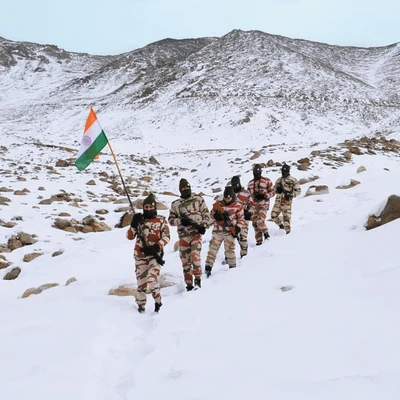
Indo-Tibetan Border Police personnel celebrate Republic Day in Ladakh in subzero temperatures in 2021 (Photo: ITBP)

Indo-Tibetan Border Police personnel celebrate Republic Day in Ladakh in subzero temperatures in 2021 (Photo: ITBP)

India and China signed four agreements between 1988 and 2013. These were designed to ensure that the Line of Actual Control (LAC) remains peaceful. Further, several standard operating procedures (SOPs) were agreed upon by both sides to prevent faceoffs between patrols from escalating. Since 2013, major incidents on the LAC were building up towards the Galwan incident — only that the tea leaves were to be read correctly. Faceoffs were taking place in Depsang (2013), Chumar (2014), and Doklam (2017) that preceded the Galwan clash. Of these, the former two are in Eastern Ladakh, and the third is on the Sikkim-Bhutan border. The way India reacted to China constructing a road in Doklam upset the People’s Liberation Army (PLA) of China — these were ominous signs that something adverse might happen.
 
Five years have passed since that fateful incident in the Galwan Valley on June 15, 2020. Many lessons have emerged from that clash, and it is time to take stock and see what has been done about them.
 
According to the 1993 Border Peace and Tranquillity Agreement (BPTA) and the 1996 Confidence Building Measures (CBM) Agreement, any exercise beyond 15,000 personnel should be intimated to the other side, and the direction of the exercise should not be towards the other. The Chinese used to move their troops for annual exercises to areas opposite Eastern Ladakh.  Therefore, even in 2020, it was assumed that these troops had come for their routine annual exercise. It was unexpected that China would violate the agreements and the SOPs that had been agreed upon between both the sides. The troops that had moved to carry out exercises turned on their flank towards the LAC, and moved into areas that were not hitherto fore occupied by them. This ultimately resulted in the Galwan clashes. Unless the agreements and SOPs are adhered to in letter and spirit by both sides, they are not of much use. Another question whether we need to look into new CBMs also arises. Even if new CBMs are agreed upon, they will not hold good if China’s PLA decides to not adhere to them. The answer lies in going through the agreements and SOPs with a fine-tooth comb and resolving the lacunae in them.
  The Chinese believe in doing everything one step at a time. In this case, they started carrying out exercises for a few years as a first step. When they felt confident enough, they moved the troops closer to the LAC. This aspect is also visible in the global initiatives that China has launched from September 2020. Starting from the Global Initiative on Data Security in September 2020 and culminating in A Global Community of Shared Future in September 2023, China launched a number of initiatives one by one with the aim of creating an alternative architecture, but under the UN Charter. All the other initiatives like Global Development Initiative, Global Security Initiative, and Global Civilisation Initiative feed into the latter. Therefore, it is imperative that the first steps taken by China on any issue be identified early, so that necessary action or reaction can be planned well in advance.
  Achieving surprise is part of China’s strategy. One of ancient China’s 36 Stratagems is “Make a sound in the east, then strike in the west”. This stratagem advocates the achievement of surprise. Also, Sun Zi, in his Art of War, says: “Appear at points which the enemy must hasten to defend; march swiftly to places where you are not expected.” Right from 1959, when the issue of the boundary question started hotting up, and in the 1962 war, it has always been part of China’s strategy to achieve surprise in any action that it takes. Similarly, when the PLA troops that had come for exercises opposite Eastern Ladakh turned suddenly, and moved towards the LAC, it took the Indian armed forces by surprise initially. Therefore, one needs to adhere to the dictum made popular by Late US President Ronald Reagan, “Trust but verify”.
  Constant surveillance is required, not only along the LAC, but also in depth areas on the Chinese side. When the PLA troops move, for whatever reason, they need to be kept under observation. Only then can one discern the motive and take countermeasures in time to avoid getting caught in an awkward situation.
  In the SOPs, it was agreed that neither side will point their weapons towards the other. This was done to avoid accidental fire, not to show an offensive intent, and to ensure that both sides do not resort to firing. The unorthodox employment of weapons started even before the Galwan clash. Stone-throwing by the PLA at the Indian troops was reported in Pangong Tso in Eastern Ladakh in 2017. During the Galwan clash, they went a step further by coming armed with sticks tipped with rolled barbed wire, and riot gear. Not only were these primitive, but also extended towards barbarism. India’s armed forces had to learn quickly and react to the situation. Given this, India’s armed forces need to be prepared for unorthodox weapons and methods of fighting.
Beijing has been saying that the boundary between India and China has been stable and, therefore, the boundary question should be put at the right place in India-China relations. It has also been saying that India and China should develop better relationship on other fronts like economy, people-to-people contact, etc. Having said all that, it violated the agreements and the SOPs. This does not mean that the bilateral relationship should not be improved, rather it should be done with caution as it is being done now.
  As China’s capability increases, its influence will expand outwards. While it is easier for it to expand that influence towards the East, that is the East and South China Sea, its idea of unification of motherland and the present dispensation’s frequent utterances of not ceding an inch of ground that has been bequeathed by its forefathers, will result in the PLA trying to reach China’s claim line. PLA’s increasing capability gives it the confidence to do so. In one of the academic dialogues, it was mentioned by a Chinese delegate that the Galwan incident happened because the PLA felt that it was now capable of moving up to the claim line in Eastern Ladakh. Therefore, there is a need to be constantly on alert all along the LAC.
  For a long time after the 1962 war, India did not develop infrastructure in the border areas. All along the LAC, China started to improve infrastructure in the early 2000s. When India started doing the same more than a decade later, it was objected to by the Chinese. One of the reasons put forward for the Galwan clash was that India was developing infrastructure close to the LAC. India needs infrastructure in the border areas not only for military purposes, but also for the civilians living there. Lack of infrastructure delayed the induction of troops in May 2020 when the Indian Army started a mirror deployment to counter the Chinese troops.
  Both sides employed mechanised forces during the Galwan standoff. The tanks of both sides came dangerously close to each other, and the efficacy of operating mechanised forces at such altitudes was vindicated. However, the drawbacks in the equipment in terms of their efficiency due to the high altitude were clearly felt. The importance of acquiring and inducting terrain-specific equipment was a lesson that clearly emerged.
  Drones were employed by both sides mainly for surveillance, and for monitoring the areas under temporary moratorium on patrolling. From that time, the employment of drones has evolved. The effect of that could be seen during Operation Sindoor where Indian drones were used for offensive, surveillance, and communication tasks. Indian armed forces learned important lessons about their employment in high-altitude areas.
  China and its PLA respect strength in an opponent. The Chinese idiom “Among the strong, there is always someone stronger” clearly implies strong adversaries should be respected. Moreover, the PLA tries to push the envelope along the LAC. If they are allowed to do that, they will continue to keep doing it. If strength is displayed by digging one’s heels to face the PLA’s challenge, it helps in resolving the issue.
  After the Galwan incident, many tunnel and road projects — both in the Western and Eastern sectors — are either under construction or completed. Two bridges on the Brahmaputra river have been opened, many railway lines are under construction to link the border areas with the hinterland, air connectivity to these areas is being improved considerably, and communication lines, including satellite communication where optical fibre connectivity is not possible, are being established. A “Vibrant Villages” programme is being implemented to establish 663 villages with the necessary amenities from Ladakh to Arunachal Pradesh.
  A light tank project and other equipment suitable for such terrain are under development. Surveillance along the LAC has been strengthened. One is confident that Indian armed forces are adapting themselves to unorthodox and sub-conventional threats.
Premium ContentPremium ContentSubscription ExpiredSubscription Expired

Your access to Blueprint has ended. But the story is still unfolding.

No longer a subscriber? There’s a new reason to return.

Introducing Blueprint - A magazine on defence & geopolitics

Introducing Blueprint - A magazine on defence & geopolitics

Like what you read? There’s more in every issue of Blueprint

From military strategy to global diplomacy, Blueprint offers sharp, in-depth reportage on the world’s most consequential issues.

Exclusive pricing for Business Standard digital subscribers

Choose your plan

Exclusive Pricing

Choose your plan

58% off
₹12,000

Blueprint Digital

₹5,000

annual (digital-only)

₹416/Month

72% off
₹24,000

Blueprint Complete

₹6,500

annual (digital & print)

₹541/Month

37% off
₹12,000

Blueprint Digital

₹7,500

annual (digital-only)

₹625/Month

62% off
₹24,000

Blueprint Complete

₹9,000

annual (digital & print)

₹750/Month

Here's what's included:

  • Access to the latest issue of the Blueprint digital magazine

  • Online access to all the upcoming digital magazines along with past digital archives

  • * Delivery of all the upcoming print magazines at your home or office

  • Full access to Blueprint articles online

  • Business Standard digital subscription

  • 1-year unlimited complimentary digital access to The New York Times (News, Games, Cooking, Audio, Wirecutter, The Athletic)

Written By :

S L Narasimhan

S L Narasimhan is a retired Lieutenant General, and an adjunct distinguished fellow at Gateway House, Mumbai
First Published: Sep 02 2025 | 2:53 PM IST

Next Story