First dawn - India's new hours of independence

Under a monsoon sky on Aug 15, 1947, Indians shared pure joy
3 min read
Updated On: Sep 15 2025 | 3:03 AM IST
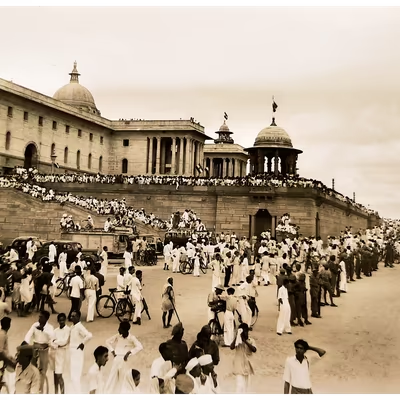
Indians gather near South Block, overlooking Vijay Chowk, in New Delhi, to celebrate the country's independence from British rule, on August 15, 1947

Indians gather near South Block, overlooking Vijay Chowk, in New Delhi, to celebrate the country’s independence from British rule, on August 15, 1947

When the clock struck midnight on August 15, 1947, India shed nearly two centuries of colonial rule. Inside the Central Hall of Parliament, Prime Minister Jawaharlal Nehru’s words carried the hush and hope of the moment: “At the stroke of the midnight hour, when the world sleeps, India will awake to life and freedom.” 
  For millions, that was when history turned. As dawn broke, New Delhi’s streets throbbed with celebration. Among the first images of India’s democracy rose from the sandstone blocks of the Central Secretariat — the South Block and the North Block — and the circular Parliament building. 
  Under the monsoon sky, ordinary Indians — men, women, and children — claimed as theirs what had been the power centre of the British Empire. The joy was raw and collective, spreading beyond the capital to towns, villages and even across borders.
For the diaspora, too, the moment carried deep resonance. In Bangkok, nearly 3,000 Indians gathered at the consulate to watch consul Bhagwat Dayal hoist the tricolour. Braving through the pouring rain, they stood at attention as he addressed them in Hindustani. 
Even commerce paused to salute. Independence Day editions of The Hindu, The Statesman, The Pioneer, and The Times of India all carried advertisements less about selling and more about belonging. In The Hindu’s 32-page edition, now a collector’s item, brands like Tata, Bosotto Hotel, Colgate, Amrutanjan, Philips and Hind Cycles pledged loyalty to the new nation. There was also a small announcement about Carnatic legend MS Subbulakshmi’s special Independence Day performance on All India Radio.
  Two days earlier, then US President Harry S Truman had sent a goodwill message pledging friendship. “In the years to come, the people of this great nation will find the United States a constant friend,” he wrote, expressing hope for “close and fruitful cooperation”.
  In The Bombay Chronicle, then deputy Prime Minister Sardar Vallabhbhai Patel paid tribute to those who had sacrificed their lives in the freedom struggle. Meanwhile, Edwina and Louis Mountbatten, until then the governor-general of India, vacated the Viceroy’s House (now the Rashtrapati Bhavan). 
  “At this historic moment, let us not forget all that India owes to Mahatma Gandhi,” Louis Mountbatten said. “We miss his presence here today.” Gandhi was not in Delhi for the official celebrations. He was in Calcutta (now Kolkata), trying to 
quell communal violence unleashed by the partition. Punjab, too, found itself in the shadows. Trains of refugees rolled in, many bearing witness to horrific carnage.  Independence had come, but it carried both triumph and tragedy. As Gandhi fasted for peace, his message of non-violence remained as powerful as during the struggle for independence: a reminder that freedom without harmony is incomplete.
Premium ContentPremium ContentSubscription ExpiredSubscription Expired

Your access to Blueprint has ended. But the story is still unfolding.

No longer a subscriber? There’s a new reason to return.

Introducing Blueprint - A magazine on defence & geopolitics

Introducing Blueprint - A magazine on defence & geopolitics

Like what you read? There’s more in every issue of Blueprint

From military strategy to global diplomacy, Blueprint offers sharp, in-depth reportage on the world’s most consequential issues.

Exclusive pricing for Business Standard digital subscribers

Choose your plan

Exclusive Pricing

Choose your plan

58% off
₹12,000

Blueprint Digital

₹5,000

annual (digital-only)

₹416/Month

72% off
₹24,000

Blueprint Complete

₹6,500

annual (digital & print)

₹541/Month

37% off
₹12,000

Blueprint Digital

₹7,500

annual (digital-only)

₹625/Month

62% off
₹24,000

Blueprint Complete

₹9,000

annual (digital & print)

₹750/Month

Here's what's included:

  • Access to the latest issue of the Blueprint digital magazine

  • Online access to all the upcoming digital magazines along with past digital archives

  • * Delivery of all the upcoming print magazines at your home or office

  • Full access to Blueprint articles online

  • Business Standard digital subscription

  • 1-year unlimited complimentary digital access to The New York Times (News, Games, Cooking, Audio, Wirecutter, The Athletic)

Written By :

Veenu Sandhu

Veenu Sandhu is Senior Associate Editor at Business Standard. Based in New Delhi, she has been a journalist since 1996, and has worked in some of India’s leading newsrooms across print, digital and television media, including NDTV 24x7, Hindustan Times and The Indian Express. At Business Standard, she writes, commissions, edits and gives direction to special, in-depth articles for the newspaper and the digital platform across beats and sectors. She also hosts video shows for Business Standard. Before this, she edited BS Weekend. She is a 2017-18 batch Chevening South Asia Journalism fellow.
First Published: Sep 03 2025 | 10:00 AM IST

Next Story