Defence manufacturing in India has been attracting international orders worth billions of dollars. Exports hit ~23,622 crore (around $2.7 billion) in 2024-25, up 12.04 per cent from ~21,083 crore the previous year, according to the Ministry of Defence (MoD).
Some of the most advanced defence systems built in the country are rolling off assembly lines in cities such as Pune and Bengaluru. Demand abroad is rising. Yet, while foreign buyers are signing contracts, India’s armed forces often appear reluctant to place orders — or are slow to act.
Bharat Forge’s main artillery platform — the 155-millimetre (mm), 52-calibre Advanced Towed Artillery Gun System (ATAGS) — was jointly developed by its subsidiary Kalyani Strategic Systems (KSSL) with the Defence Research and Development Organisation (DRDO) and Tata Advanced Systems. Designed to be the most advanced howitzer in its class, its journey began with a test-firing in 2016 that demonstrated a range of over 40 kilometres, alongside advanced fire-control systems and mobility.
Despite successful trials and preliminary approval for 307 guns in March 2023, the project ran into an acquisition deadlock. For years before that, it had no domestic orders — even as dozens of wheeled, self-propelled variants stood ready for export at Bharat Forge’s Pune plant. The wait ended only on March 26, 2025, when the MoD finally signed a ~6,900 crore contract for 307 guns — the first such order for an indigenous howitzer.
Even before the domestic deal was finalised, overseas buyers had shown interest. In 2022, KSSL announced an export order worth ~1,200 crore (about $155.5 million) for the 155 mm system, to be delivered to a “friendly foreign country” within three years.
“It is an irony that Indian companies are exporting before selling to the Indian armed forces. It should have been the other way around — first to our armed forces, then to others,” said Laxman Kumar Behera, associate professor at the Special Centre for National Security Studies, Jawaharlal Nehru University.
The buyer’s identity was not disclosed, but the timing was telling: the export deal came well before the Indian government’s own approval. It underscored a reality — foreign militaries were willing to commit large sums for Indian artillery even before the system was adopted at home. The deeper question remains: Why does the government, which acknowledges an artillery shortfall, appear reluctant to buy more from domestic firms?
A similar pattern in small arms
Bengaluru-based SSS Defence recently became the first Indian company to export sniper rifles designed and built entirely in India. According to reports, its .338 Lapua Magnum — capable of hitting targets over 1,500 metres away — was sold to a “friendly foreign country” in July.
“The dichotomy of the Indian defence industry is striking. On the one hand, we are a power in missiles and satellites, but we are not able to manufacture a rifle,” Behera observed.
He argued the problem lay not in technical ability but in political and institutional will, particularly within the Indian Ordnance Factory Boards (OFBs). “It is more a question of intent than capability. We had the capability, but there was mistrust between developers, production agencies and users, especially the army.” India’s notoriously slow procurement has also hampered rifle induction. “Even when prototypes are ready, long trials, procedural delays and uncertain timelines discourage private industry from scaling up,” Behera added.
SSS Defence Chief Executive Officer Vivek Krishnan offered a different view. He said delays were not due to reluctance towards indigenous products but because the armed forces must follow procedures such as rigorous testing and requests for proposals (RFPs). “State police and paramilitary forces have already placed multiple orders. There’s far greater openness today to indigenous products. But the army, navy and air force place much larger orders, so naturally testing and RFPs take longer,” he said.
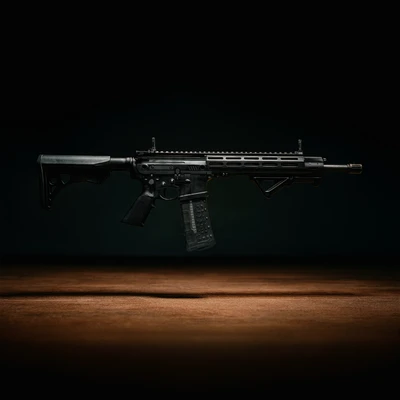
Traditional factories — Rifle Factory Ishapore, Small Arms Factory Kanpur, Ordnance Factory Tiruchirappalli, and Gun & Shell Factory Cossipore — have long been the main suppliers of small arms, serving as the primary suppliers of small-calibre weapons to the armed forces. But, Krishnan pointed out, such corporatised ordnance factories only manufacture DRDO-designed products and do not develop their own weapon designs. This gap creates space for private players to not only develop new products but also drive indigenous manufacturing for the armed forces.
Behera recalled that after Kargil, upgrades were needed for the INSAS rifle, but coordination between OFBs and the army was poor. Prototypes were built but never seriously trialled or evaluated.
Krishnan argued that SSS Defence is now among the world’s leading small arms makers, with a full portfolio — from pistols to sniper rifles and special-forces weapons. “In India, no other company matches this breadth under one roof, with every product indigenously designed, developed and manufactured.”
On shifting from INSAS to imports
Krishnan criticised the repeat order of SiG assault rifles. “Last year, the second round of 73,000 SiG 716 rifles from US company SiG Sauer, under the fast-track route, was not a good choice,” he said. The first order was justified, he explained, as no Indian firm then had comparable products.
The second order, however, was placed citing delays in production of the AK-203, nicknamed Sher, developed by Indo-Russian Rifles Private Limited (IRRPL) in Korwa, Uttar Pradesh.
Behera added: “Now, with several capable domestic manufacturers producing assault rifles, there’s no reason to buy directly from foreign suppliers.”
India and Russia signed an intergovernmental agreement in 2019 on small arms manufacturing, leading to the formation of IRRPL — a joint venture between Rosoboronexport and Kalashnikov Concern of Russia, and India’s Advanced Weapons and Equipment India and Munitions India. IRRPL was tasked with producing AK-203 rifles for the armed forces.
Large-scale production of around 600,000 AK-203 rifles began in 2023. But domestic manufacturers will now have to compete with the joint venture in upcoming RFPs. “The AK-203 is a foreign design, whereas our products are entirely Indian,” Krishnan said, adding that an RFP was underway and a contract was expected by year-end. Krishnan claimed SSS Defence was likely to receive orders for more than 10,000 rifles from Indian and foreign buyers this year, making it one of the largest producers of indigenously designed, developed and manufactured weapons in the country.
A spokesperson for the Adani group said India’s small arms industry had undergone a “significant shift” over the past decade, “driven by a stronger policy push under Make in India, simplification of defence procurement procedures, and increasing emphasis on indigenisation by the armed forces”. What began as a component unit just five years ago has evolved into a fully integrated facility with automated barrel production and the capacity to manufacture more than 100,000 small arms annually.
“We are already executing large-scale programmes, including 130,000 AK-203 rifles and 170,000 carbines recently awarded by the army, and are currently developing the light machine gun programme for 41,000 units,” the spokesperson said. The spokesperson also stressed the need for “deeper indigenisation, from components to fully integrated production capabilities”.
At the Global Business Summit in 2020, Defence Minister Rajnath Singh said the government aimed for $26 billion turnover in aerospace, and defence goods and services within five years, including $5 billion in exports.
As the development of ATAGS by Bharat Forge and sniper rifles by SSS Defence shows, India is shifting from a passive importer to an active exporter of advanced military equipment. In many cases, Indian firms are proving themselves on global markets even before domestic procurement kicks in.
What remains crucial now is ensuring procurement cycles are faster, more predictable, and aligned with the long-term national strategy.
Premium ContentPremium ContentSubscription ExpiredSubscription ExpiredYour access to Blueprint has ended. But the story is still unfolding.
No longer a subscriber? There’s a new reason to return.
Introducing Blueprint - A magazine on defence & geopolitics
Like what you read? There’s more in every issue of Blueprint
From military strategy to global diplomacy, Blueprint offers sharp, in-depth reportage on the world’s most consequential issues.
Exclusive pricing for Business Standard digital subscribers
Choose your plan
Exclusive Pricing
Choose your plan
58% off
₹12,000
Blueprint Digital
₹5,000
annual (digital-only)
₹416/Month
72% off
₹24,000
Blueprint Complete
₹6,500
annual (digital & print)
₹541/Month
37% off
₹12,000
Blueprint Digital
₹7,500
annual (digital-only)
₹625/Month
62% off
₹24,000
Blueprint Complete
₹9,000
annual (digital & print)
₹750/Month
Here's what's included:

Access to the latest issue of the Blueprint digital magazine

Online access to all the upcoming digital magazines along with past digital archives

Delivery of all the upcoming print magazines at your home or office

Full access to Blueprint articles online

Business Standard digital subscription

1-year unlimited complimentary digital access to The New York Times (News, Games, Cooking, Audio, Wirecutter, The Athletic)

Access to the latest issue of the Blueprint digital magazine

Online access to all the upcoming digital magazines along with past digital archives

* Delivery of all the upcoming print magazines at your home or office

Full access to Blueprint articles online

Business Standard digital subscription

1-year unlimited complimentary digital access to The New York Times (News, Games, Cooking, Audio, Wirecutter, The Athletic)