US President Joe Biden has honoured two Indian-American scientists -- Ashok Gadgil and Subra Suresh -- with the country's highest scientific awards for their contribution to the field of science and technology.
Biden presented the prestigious White House National Medal for Technology and Innovation to Gadgil, a Distinguished Professor Emeritus of Civil and Environmental Engineering at UC Berkeley, on Tuesday for providing life-sustaining resources to communities around the world.
The award, bestowed on leading US innovators, recognises those who have made lasting contributions to America's competitiveness and quality of life and helped strengthen the nation's technological workforce.
Suresh, a professor at large at Brown University's School of Engineering, was awarded the National Medal of Science for pioneering research across engineering, physical sciences and life sciences, and particularly for advancing the study of material science and its application to other disciplines.
Gadgil was one of 12 recipients of the White House National Medal for Technology and Innovation.
Gadgil has developed low-cost solutions to some of the developing world's most intractable problems, including safe drinking water technologies, energy-efficient stoves, and ways to make efficient electric lighting affordable.
He focuses on robust inventions that can be deployed as widely as possible, and together, his projects have helped more than 100 million people. Gadgil is also an expert in building energy efficiency and computational fluid dynamics of indoor air and pollutant flows.
The White House said Gadgil was presented the medal for providing life-sustaining resources to communities around the world. His innovative, inexpensive technologies help meet profound needs, from drinking water to fuel-efficient cookstoves. His work is inspired by a belief in the dignity of all people and in our power to solve the great challenges of our time.
Gadgil's award is the 17th national medal overall and the second National Medal of Technology and Innovation that Berkeley Lab researchers have earned.
The world is not a fair place. I try to bend my knowledge of science, engineering, and creativity to make it a little less unfair for the people who are holding the short end of the stick. If I can make that difference, go even a little bit in that direction, I think that's fantastic, Gadgil told Barkley Lab in an interview.
Gadgil earned degrees in physics from the University of Bombay (now Mumbai), the Indian Institute of Technology Kanpur, and his Ph.D. from UC Berkeley.
He then joined Lawrence Berkeley National Laboratory (Berkeley Lab) in 1980 and retired earlier this year as a faculty senior scientist; he is now an affiliate retiree of the Berkeley Lab.
He formerly served as the division director of the Environmental Energy Technologies Division now the Energy Technologies Area (ETA). He is also a distinguished professor emeritus of civil and environmental engineering at UC Berkeley.
The announcement from the National Science and Technology Medals Foundation noted Suresh's commitment to research and collaboration across international borders, which has demonstrated how science can forge understanding and cooperation among people and nations.
It's very satisfying, said Suresh, who said he takes special pride in the recognition because of what the medal signifies, according to a Brown University statement.
Suresh, the former head of the National Science Foundation (NSF), was presented with the prestigious science medal along with eight others.
Born in India in 1956, Suresh graduated from high school at 15 and by age 25, had earned his undergraduate degree, master's degree and Ph.D., which he earned in mechanical engineering from the Massachusetts Institute of Technology in just two years.
Suresh became a faculty member at Brown University in 1983 as the youngest member of the engineering faculty.
After 10 years at Brown, Suresh went on to become the first Asian-born American to lead the National Science Foundation (NSF), serving as its 13th director after he was nominated by then-president, Barack Obama.
He returned to Brown's School of Engineering in September 2023, and earlier this month, the school announced a biennial symposium in his honour focused on the frontiers of technology and society.
Under his leadership, NSF launched the Global Research Council, a virtual organisation of heads of science and engineering funding agencies from more than 50 countries, aimed at fostering global collaboration and data sharing.
He also oversaw the establishment of the Centre-Life Balance programme, an initiative to increase the number of doctoral-level women in the science and engineering fields from 26 per cent to 40 per cent between 2011 and 2021.

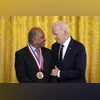 "Biden honours two Indian-American scientists with highest scientific awards")

