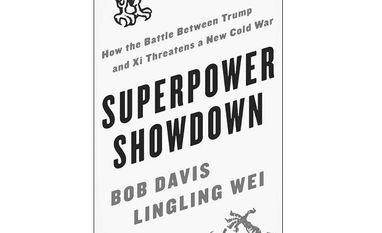
Hank Paulson, former US treasury secretary and one of the enthusiastic champions of closer US-China economic and commercial relations, is quoted in Superpower Showdown as warning, “An economic Iron Curtain may be descending, one that throws up new walls on each side and unmasks the global economy as we know it.” The book by Bob Davis and Lingling Wei, both journalists with The Wall Street Journal, traces the tortuous journey of how visions of benign symbiosis gave way to an intensifying trade war that has now taken on the character of geopolitical contestation. The book contains 20 short chapters arranged chronologically but with a useful backgrounder in the introduction and an epilogue looking at the possible shape of things to come. While Mr Davis focuses on the Washington end of the story, Ms Wei decodes the Beijing end with some gossipy insights into attitudes harboured by China’s top leaders. The basic contours of the story are fairly well known to China watchers and trade economists but a general reader will find the book informative and full of interesting anecdotes.
While China adopted the Open Door Policy from 1978 onwards, the more significant departure came with its entry into the World Trade Organisation (WTO) in 2001 facilitated by the US. In the decade that followed, the Chinese economy grew four times, its foreign trade by seven times. Foreign direct investment into China increased from $50 billion to $109 billion.
The book reveals how much corporate America acted as powerful lobbyists for China’s entry into the WTO and in expanding both trade and investment relations. Inordinate greed was at work and the Chinese leveraged that skilfully to gain market access and technology transfer. The myth was peddled that China would follow the path of other East Asian countries where economic prosperity had led to democratic freedoms. The book quotes President Clinton as claiming, “By joining the WTO, China is not simply agreeing to buy more of our products; it is agreeing to import one of democracy’s cherished values: economic freedom.” But Chinese leaders, in inner party parleys, saw the West as a source of danger; that China itself could become prey to subversive “colour revolutions” that the West was instigating elsewhere.
Nevertheless, the increasing economic integration continued, with American companies making large profits from the Chinese market and the Chinese obtaining much-needed capital flows, technology and access to the knowledge centres of the West. China amassed more than $3 trillion in foreign currency reserves of which US dollars constituted a major chunk. This phase lasted until the global financial crisis of 2007-08 in which the US as an economic model suffered a severe blow. Wang Qishan, who was Vice-Premier at the time, said to Mr Paulson, “You were my teacher but now I am in my teacher’s domain, and look at your system, Hank. We aren’t sure we should be learning from you anymore.”
Superpower Showdown: How the Battle Between Trump and Xi Threatens a New Cold War
Author: Bob Davis and Lingling Wei
Publisher: Harper Business
Price: Rs 599
An important deflection point had been reached and from then onwards we witness a steady fracturing in US-China relations. A defensive America shaken by the crisis began to see a more confident and assertive China as a dangerous adversary. Having emerged from the crisis relatively unscathed, China began to contest the US more openly. But it is with the coming to power of Xi Jinping in 2012 that the contestation takes on a sharper tone. Mr Xi’s view of the US is derogatory. In an inner-party meeting he describes the US as a “sheet of sand” and claims that China’s one-party system allows things to get done as long as the party itself is united in actions.
He began the process of moving the party’s role from a supervisory and policy-making entity to becoming a direct participant in administration and in business. There is reference to a conversation between Mr Xi and Vice Premier Ma Kai that is noteworthy. Mr Xi asked Mr Ma whether he thought the Party or the government had been more effective in running the economy. Mr Ma reportedly said, “The northern courtyard”, which is the part of the Forbidden City that houses the offices of the State Council. Mr Xi replied, “I don’t necessarily think so.”
On the American side, the pushback against China began in earnest when Donald Trump became president. But Mr Trump has long been torn between insisting on structural changes in China’s industrial policy but relieving the pressure if a deal could be made to advance his political interests. Chinese purchase of soya beans is a recurring theme. His trade team is invariably caught in these shifting presidential attitudes. Before the pandemic hit, the two sides reached a phase-1 trade deal, involving large purchases of US goods by China to reduce the trade deficit and measures to protect intellectual property. Thanks to the pandemic progress is stalled.
As the authors make clear, however, the trade war has now morphed into an all-round geopolitical contest with each side convinced of the other’s intent to overcome and subdue the other. This is unlikely to change even if a Democratic administration takes office in Washington in January. Hank Paulson’s scenario for the future is already taking shape.
The reviewer is a former foreign secretary and a senior fellow, CPR
Read this article for free
Register to continue reading premium journalism and analysis from Business Standard.

 "An economic Iron Curtain")












 Connect with us on WhatsApp