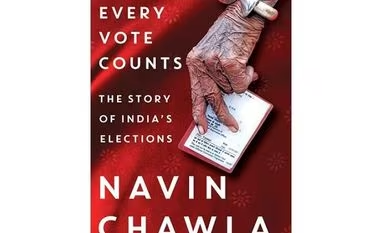
Every Vote Counts:
The Story of India’s Election
Navin Chawla
HarperCollins, Rs 699, 376 pages
The author, who spent five years as member and Chief Election Commissioner (CEC) of India, has provided not only a detailed account of the actual problems the Election Commission (EC) faces when it manages elections but many rich insights and anecdotes drawn from his experiences.
He also discusses at some length the contradictions, tensions and conflicts within the EC, especially the problems that arose when the institution became a multi-member one in 1993. Mr Chawla will be remembered for the clash with then CEC N Gopalaswami in 2009, who recommended his removal for alleged partisanship towards the Congress party, which was in power at the time.
For the most part, in 12 chapters and many appendices, Mr Chawla has provided a readable handbook of the Indian elections from 1951 to 2009, with detailed information about the evolution and organisational structure of the EC starting from 1951. Articles 324, 325, 326 and 329 of the Constitution and the Representation of People Act, 1951 (with later amendments) provide the framework for the organisation and functions of the EC to conduct and ensure “free and fair elections” for the world’s largest number of voters with the largest administrative apparatus for Parliament, 29 state Assemblies and seven Union Territories.
Chapter 2 deals with the first general election (1951-52) and the contribution of Sukumar Sen, who conducted first two elections and created the “electoral architecture” for 489 Lok Sabha seats, 4,000 Assembly seats and party symbols, which the author describes as “an ingeniously Indian enterprise”. The author quotes the 1954 EC report, which described that first exercise as “a great and fateful experiment, unique in the world in its spontaneousness (sic) and complexities” and “an important landmark in the history of democracy”. The other side of the picture was that communalism had raised its head in the 1951-52 campaign.
In chapter 3 the author tells a story of the 2009 general elections which were held under his supervision as CEC. One of the salient features of that elections was the involvement of NGOs and vibrant election watch groups along with the EC’s internal observation machinery and 1,51,000 micro observers to ensure the fairness of the process. It was because of these efforts, Mr Chawla writes, that “a considerable part of wealth seized during GE 2009 was from the mining barons, amongst others, of Bellary district”.
But he also noted the low voter turnout in Mumbai — just 41 per cent. Was that because the socially powerful strata of society in cities can get their jobs done on the basis of their influence in the corridors of power? Noting the rise of money power, muscle power, the criminalisation of politics and the abundant use of black money during elections, the author observes, “The truth, depressingly, was that foreign domination ... was replaced by a home-grown oligarchy which had placed power and wealth in the hands of a few”.
One critical contribution in the book is the author’s focus on the “compromised fourth estate”. He has devoted two must-read chapters to the pernicious rise of paid news, social media and the media’s partisan role. In the UP elections of 2007, for instance, Mr Chawla talks of local language newspapers asking for money and in the Madhya Pradesh Assembly elections some newspapers threatened to blank out coverage if they were not paid. “What was previously condoned as corruption indulged in by fringe elements or the odd journalist who had been wayward had now become mainstream,” he writes. In 2010, the Press Council of India “named some of the biggest media groups in the country” for indulging in malpractices during the elections.
“The use of money power to create biased media content for any candidate has already become endemic…and it has ... exploded to an unfathomable extent, ranging from paid news to often vitriolic social media campaigns”. Worse, the model code of conduct for elections, which prohibits any election campaign 48 hours before election day, has become irrelevant because of the role of the media.
The author observes that the “extensive universe of social media platforms is a labyrinth that will be very difficult, if not near impossible to control, often setting up a stage for legitimisation of personal biases and prejudices”. It is not without reason that major political parties are making huge investments to promote their views through social media and paid news. Media is traditionally considered a vigilant pillar of democracy but its role has been perverted; today even popular television channels and mega-circulation newspapers spread misinformation and partisan opinions instead of playing the role of impartial opinion makers.
The chapter on the electronic voting machines (EVMs) is critical in the context of the demand to revert to paper voting. On EVMs, Mr Chawla writes, “the commission has an almost impenetrable system in place which is unique amongst countries that use EVMs.” In spite of this, controversies around the functioning of EVMs persist with claims that they can be hacked and so on.
Two chapters on special election challenges — The Maoist Factor in Elections (Chapter 8) and Jammu and Kashmir 2008: A Historic Election (Chapter 9) — prove that India has the capacity to hold free and fair elections even in extraordinarily adverse circumstances.
All in all, the author has succeeded in the task he assigned to himself that “to capture the enormity of conducting a general election and in the process, record a vulnerable period or our electoral history”. To students of democracy, this quick history offers plenty of material for thought.