While the main stage of the Mehrangarh Fort was thronged by revellers at night, the many interior pockets of the citadel threw up vibrant surprises during the day. Visitors to the fort museum along with RIFF attendees are witness to the 'Fort Festivities' section of the festival, which comprises traditional dance forms such as the
dhol thali nritya, dance of the Algoza party and the
derun dance - all performed by men.
The
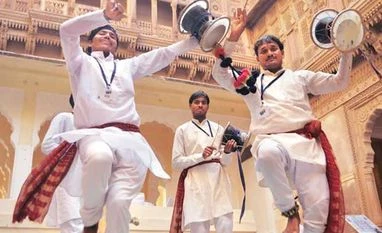
dhol thariya dancers come from Rajasthan's Churu district and are worshippers of Gogo Maharaj, a traditional folk deity also idolised in Haryana, Punjab and Uttar Pradesh since the 16th century. Traditionally performed in the month of
Badhaun (a month of the Hindu calendar that corresponds to August/September in the Gregorian calendar). The energetic dance to the trance-like music of crudely improvised instruments such as the
dhol, thali, patila is usually led by male dancers with
ghunghroos on their feet. The dancers tell me that when the women get caught up in Gogaji's
bhakti, and they too join in the
naach-geet. Derun, Chang and the Dhol-Thali Nritya are all from the Shekawati region in Rajasthan. The Derun dance is typically performed during
jaagran- all night vigils where the villagers stay up while fasting or in devotion. The musical accompaniments include the harmonium,
manjira, thali, as well as the
derun (a flexible twin-faced drum) while the male devotees clad in a white
salwar-dhoti sing and enact an extraordinary jumping dance with their
ghunghroo-strapped feet. The members of this community are mendicants who used to cure the effects of a snake bite by singing to Gogaji, known as the Snake God. "There is no medicine, there is only Gogaji's blessings that heal the sick," the dancers tell me. However, in recent years, their trade has been threatened by the onslaught of modern veterinary practices. Despite the various obstacles, they are determined to keep their traditions alive.
The Algoza party dancers are breathtakingly colourful - male dancers dressed in ethnic female attire (
ghaghra-choli and
ghoonghat) that they proudly proclaim they design themselves. Ashok Pahadiya is a veteran with over 30 years of experience, dancing an inventive version of the Bhawai form, performing graceful pirouettes and suggestive
thumkas with his layered
ghaghra, to the tunes of the
manjira, dhol and the
algoza (a double flute that emits a swinging, bouncing rhythm). Pahadiya has been dancing with the Algoza party for nearly a decade and performs in both male and female attires with sublime poise and agility. He shares how his love for dancing and cross-dressing drew a lot of flak from his family and friends when he was growing up, but slowly, times are changing.
"Pehle bahut mazaak udaya, ab kehte hai bada kalakaar ban gaya hai (They made fun of me before, now they say what a big artist you are)," says the beaming, self-taught dancer. In the traditional Bhawai dance, the performers balance a number of earthen pots as they dance nimbly, swaying with the soles of their feet perched on the top of a wheel, a glass, even the edge of a sword.
The striking thing about these rural dancers was how seasoned performers they are, interacting with their audience and posing for photographs, like rockstars in their own right. The artistic director of Jodhpur RIFF, Divya Bhatia, has this to say about their journey: "It has taken us time to facilitate a sense of self worth and instill a sense of artistic pride in the dancers. They always enjoyed themselves and were ever eager to perform, but because they saw themselves simply as villagers who danced on particular occasions, they weren't quite convinced that they were performers." He shares that folk artists now take pride in receiving an income for their art. "By performing in other regions and cities and exposing them to new, secular audiences, they now know that irrespective of occasion, they have something to offer that appeals to many - and that gives them an immense sense of satisfaction as well."
Many artists expressed gratitude towards The Jaipur Virasat Foundation that has taken them to locales all over India and across the world to perform in front of appreciative audiences. The foundation, a labour of love of John and Faith Singh (founders of the Anokhi label), is credited with bringing the myriad folk arts of Rajasthan to a much wider audience. "Typically, Holi is the best time (March, April) to view these dance forms as it is related to the change in season and farming in North India. Similarly, just before Navratri and Sharad Poornima - again the period heralding the change in season and farming," says Bhatia.

 "Jodhpur RIFF 2014: Dance of the dunes")


 Connect with us on WhatsApp