Revisiting the glory days of vadya vrinda, India's national orchestra

In those days, the dream was to raise a national orchestra that matched international classical orchestras
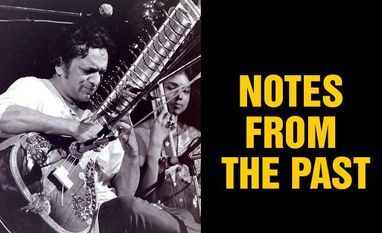
Ravi Shankar
Ravi Shankar once worked with the vadya vrinda | Photo: Markgoff2972 [CC BY-SA] / Wikimedia Commons
Malini Nair
8 min read Last Updated : Jan 18 2020 | 12:59 AM IST
Studio 1 is the largest recording suite at the All India Radio complex in New Delhi. And with good reason: It belongs to the Akashvani Vadya Vrinda, India’s national orchestra tasked with composing, performing and broadcasting original classical, folk and thematic works of great quality.

The kind of musicians who once worked for the ensemble, set up in the post-Independence verve of 1952, deserved that space too — sitar maestro Ravi Shankar, veena vidwan Emani Sankara Sastry, violinists T K Jayarama Iyer and S Gopalakrishnan, flautists Vijay Raghava Rao and Pannalal Ghosh, composer Anil Biswas, among them. Off and on, other classical greats such as Abdul Halim Jaffer Khan and Amjad Ali Khan, and Bollywood legends like Shankar Jaikishan would drop in as guest composers or musicians.

The studio was once packed with 60-80 masters of Indian and western instruments, ranging from the sitar, esraj, dilruba and kashta tarang (wooden xylophone) to the violin, cello and double bass. “The full orchestra was a feast for the eye and ears — the stalwarts, the 10 violins playing together, the many sitars, sarods. As a new, casual recruit I would stand behind the glass window of the studio, peering in, awed, wondering when I would be one of them,” recalls flautist Kailash Sharma who retired recently from the ensemble.

The studio that once buzzed from 10 am to 3 pm with rehearsals and creative give and take is today a sad shadow of itself — too large for the three musicians on the orchestra’s rolls, no permanent conductor to give direction to the paltry collection of sitar, violin and clarinet. “A white elephant that AIR doesn’t know what to do with,” says a senior musician who doesn’t wish to be named.

T K Jayarama Iyer conducting in front of Jawaharlal Nehru and Chinese Premier Zhou Enlai in 1954 | Photo: courtesy J Krishnamurthy
The space is now used to host AIR events and festivals, or, as an old hand says, “for post-lunch nap”.

The vadya vrinda is no longer the pride of AIR, its “brand equity/showpiece”, as a former musician describes it. Few know of it, it has no eagerly awaited daily slots as it once did. And to the horror of old-time musicians, it is not unusual for the ensemble to be called in to intersperse performances — mostly government-backed events — with filmi medleys.

“The vadya vrinda as we knew it is finished,” says veteran sitarist and former conductor Rash Behari Datta, a man known for speaking his mind, who retired in 1997. “It had an audience and if it was cultivated, we could have had a world-class orchestra. But it was systematically decimated by the authorities.”

According to current and former musicians of the ensemble, a host of factors precipitated its decline: bureaucratic apathy, the lack of inspired leadership and also, the shift in listener preferences. Today, AIR itself does not hold the prime place it once did in our lives, neither does classical or folk music and certainly not traditional ensembles like the vadya vrinda.

The eclectic Maihar band, set up in a village the same name in northern Madhya Pradesh by the legendary Baba Allauddin Khan, is believed to be the template for the vadya vrinda. Khan was also the guru of Ravi Shankar who served as music director of AIR, Delhi, between 1949 and 1956, and became the first conductor-composer for the vadya vrinda.

T K Jayarama Iyer Iyer conducting for a Unesco delegation | Photo: courtesy J Krishnamurthy
In those days ruled by the Nehruvian vision, the dream was to raise a national orchestra that matched international classical orchestras. Veena artist Saraswati Rajagopalan, who retired from the vadya vrinda two years ago, traces the ensemble’s history to a time when renaissance men and women headed the country’s cultural scene.

“When I joined AIR, the vadya vrinda was seen as radio’s contribution to India’s musical heritage, and the people who were brought to it were of that stature,” she recalls. “For example, Dr V K Narayana Menon, who later became the AIR director general, had heard violinist T K Jayarama Iyer run excellent Carnatic music features and ensemble works on the Trichy radio station. So he brought Iyer to AIR Delhi as the composer for Carnatic music, while Ravi Shankarji composed for Hindustani.”

AIR Chennai was to have its own vadya vrinda.

It was a rich, layered, splendid orchestra. “You could instantly spot a vadya vrinda composition — it was distinct for its quality and for the talent behind it, the grand musicians who were a class apart,” recalls Datta, who played under Shankar and went on to revive his Adi Basant as a conductor.

Shankar’s compositions like Gaon ki Gori, Awakening, Rangavali and Kari Badariya have passed into legend. Musician and music historian Peter Lavezzoli in his book, The Dawn of Indian Music in the West, estimates that Shankar’s experiments at AIR probably lay the foundation for his two Sitar Concertos for a western orchestra. 

Pannalal Ghosh once worked with the vadya vrinda | Photo: Abhiptr [CC BY-SA] / Wikimedia Commons
Other landmark vadya vrinda compositions included Biswas’s Jeevan Jamuna, Sastry’s Gauri Manohari and Swagatam and Ghosh’s Patdeep, Kalinga Vijay and Marwa. Iyer’s Gramotsava and Vagdeeshwara were path-breaking works that proved how Carnatic music could lend itself to orchestration.

“When you listen to these compositions, so complex and tightly knit, you realise how hard my grandfather — and the other composer-conductors — and their musicians must have worked to produce music that is so perfectly coordinated, performed live and in one take. And remember they were great soloist too, so this was like giving up a part of oneself to be a part of a whole,” says KVS Vinay, violinist and grandson of Iyer.

Datta recalls conducting a medley called “Journey of Vadya Vrinda” at an AIR Sangeet Sammelan in Bengaluru, which included all the landmark orchestra compositions of different masters. At the very first note, the entire audience had stood up to applaud, he remembers.

Hindustani vocalist Shanno Khurana, 92, who needed someone to conduct an orchestra for her path-breaking classical opera Sohni Mahiwal in 1963, settled on Sastry and a team of vadya vrinda musicians. “I couldn’t find a better conductor than Sastry ji or a more hardworking group of fantastic musicians,” she recalls.

For visiting foreign dignitaries, the vadya vrinda studio was their first stop in the AIR complex where they got to hear a composite slice of Indian music. Other times, the group would be taken to Rashtrapati Bhavan to regale visitors.

S ome critical changes began in the late 1990s. The conductor’s place in the team became undervalued. The last musician appointed as an official conductor was violinist Satyadev Pawar. After him, the composer-conductor began to be selected randomly from among the musicians on the orchestra.

“Conducting and composing for an orchestra — this is far tougher than playing solo. You have to know the workings of every single instrument, where it can shine and how to layer it with others, at what strength and volume. It is a challenging role,” says Rajagopalan. “Without a conductor, an orchestra is like an orphan.”

Over the following decades, the vadya vrinda lost its dynamism and grandeur. It lost its three daily, dedicated chunks of broadcast and began to be increasingly used for fillers. The reason was that musicians who retired or passed away were not replaced, no new recruitments were made and the orchestra’s strength dwindled. Rare instruments lost their place in the group and fewer of those that made for its core were being played.

Soon, musicians had to be called in on a casual basis to fill the orchestra when it was asked to perform. The creative camaraderie of rehearsals and daily work was dead. Word got around that the team did little but “masti”, was underworked and overpaid.

“I would walk in, swipe and sit and wait for work. It is demoralising for any creative person, we were dying to be given something to sink our teeth into,” says a former member of the ensemble.

Then to the horror of classicists, the keyboard arrived and then the rhythm pad. “It was all noise, no depth,” says a classically trained musician.

Datta believes that the orchestra came to be seen as a burden on the AIR establishment. “There were stalwarts and had to be paid high-grade salaries. And remember, there were so many of us,” he says.

Rajagopalan has recollections of the heyday of the orchestra and the highly anticipated travelling shows. “I remember having an entire bogey booked for us for a 10- to 15-day tour,” she says. 

The last big event involving the vadya vrinda that everyone recalls with pride was the 2004 celebration of 50 years of AIR Sangeet Sammelans. Both the Chennai and Delhi vadya vrinda units played together in Bengaluru to mark the occasion with a grand concert. It seemed like the old days again.

One subscription. Two world-class reads.

Already subscribed? Log in

Subscribe to read the full story →
*Subscribe to Business Standard digital and get complimentary access to The New York Times

Smart Quarterly

₹900

3 Months

₹300/Month

SAVE 25%

Smart Essential

₹2,700

1 Year

₹225/Month

SAVE 46%
*Complimentary New York Times access for the 2nd year will be given after 12 months

Super Saver

₹3,900

2 Years

₹162/Month

Subscribe

Renews automatically, cancel anytime

Here’s what’s included in our digital subscription plans

Exclusive premium stories online

  • Over 30 premium stories daily, handpicked by our editors

Complimentary Access to The New York Times

  • News, Games, Cooking, Audio, Wirecutter & The Athletic

Business Standard Epaper

  • Digital replica of our daily newspaper — with options to read, save, and share

Curated Newsletters

  • Insights on markets, finance, politics, tech, and more delivered to your inbox

Market Analysis & Investment Insights

  • In-depth market analysis & insights with access to The Smart Investor

Archives

  • Repository of articles and publications dating back to 1997

Ad-free Reading

  • Uninterrupted reading experience with no advertisements

Seamless Access Across All Devices

  • Access Business Standard across devices — mobile, tablet, or PC, via web or app

Topics :MusicWeekend Reads

Next Story


