I first set eyes on her in an FTII diploma film directed by Arun Khopkar — I think it was called Teevra Madhyam. There was a long shot in which she was playing the tanpura. I was struck by her raw beauty and the stillness she exuded. She was born for the camera. It lingered over her face and she held it captive without the slightest effort.
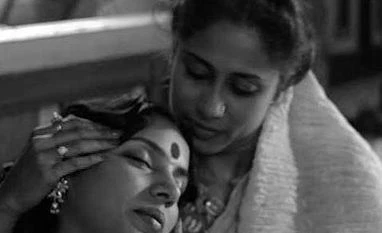
A few years later I met Smita Patil on the sets of Shyam Benegal’s Nishant. It was a difficult part for one as young as her. In the film, her husband, played by Naseeruddin Shah, gets enamoured by my character, Sushila, kidnaps her and brings her home. Smita, as Rukmini, smoulders in jealousy, anger, hurt and rage but doesn’t say anything. Her face expresses it all. It is clearly an antagonistic relationship between the two women. It is to Benegal’s credit and understanding of the complexities of feudal societies, ably aided by Vijay Tendulkar’s script, that two small, but significant, scenes stand out. Smita comes into my room to offer me food because I haven’t eaten for days. On the surface matter of fact, slightly resentful too, Smita played that scene with such a layer of empathy that the plight of the two women bonded together through a patriarchal feudal structure brought tears to my eyes without even trying.
That is the crux of what film acting is about — a collaborative effort in which how good your work is depends on the work of your co-actors. I have had the privilege of working with Smita in Nishant, Arth, Mandi and Oonch Neech Beech in roles far removed from one another. I felt both challenged and inspired by her as a co-actor.
We had so much in common; we came from similar backgrounds, were launched by the same director, had similar aesthetics and worked in the same kind of cinema. Today, in public memory Smita and I are so closely bonded together that I feel I could well be Shabana Patil and she Smita Azmi! She had a short career span and yet 29 years after she passed away, parallel cinema in India will never be mentioned without Smita Patil’s name emblazoned in golden letters.
Alas! We could never be friends. The rivalry between us, some of it manufactured by the media and some of it real, caused friction. I’ve said this before and I acknowledge it again that I have been guilty of making uncharitable remarks about her and I regret it. There were efforts at reconciliation and we were able to maintain civility but it never turned into friendship.
But at no point did that spill over to our families. Smita was a star by the time she did Sagar Sarhadi’s Bazaar and obviously she was given the best room in the hotel. My mother, Shaukat Kaifi, was doing a small but significant role in the film. When she joined the unit in Hyderabad two weeks later, Smita insisted on giving up her room for my mother and quietly shifted into a smaller room. It was only later that Mummy realised what Smita had done and protested, but Smita would have none of it. Such was the graciousness that came naturally to her because she was the daughter of Vidyatai and Shivajirao Patil who had instilled impeccable values in her.
Her family — Ma, Pappa, Anita and Manya — have embraced me as one of their own. Human relationships are complex and I am deeply grateful for the trust they have placed in me.
It’s a very personal thing I’m sharing in public. There was a time in young Prateik’s (Smita Patil’s son) life when he was troubled, directionless and didn’t know what to do. Both Ma and Anita asked me to take over his charge. Need I say more?
I’m fond of saying India is a country that lives in several centuries simultaneously and is full of contradictions. Smita was a microcosm of India —traditional and modern, strong and fragile, confident and vulnerable.
I would marvel at the panache with which she drove a Jeep from Bombay to Delhi with only a girlfriend for company, fixing flat tires and camping in remote places. She rode a motorbike like a professional and played volleyball like a champion. She was “one of the boys” on the sets of Mandi. But she was also very feminine and deeply traditional, at times easily intimidated. I think it’s these contradictions that were both her strength and her weakness. But it was also this that made her an artiste who will always be spoken of when the finest actors of Indian cinema are counted.
Shabana Azmi gave this tribute at the launch of Maithili Rao’s book Smita Patil: A Brief Incandescence in Mumbai on the late actress’ 60th birth anniversary

 "<b>Shabana Azmi</b>: The Smita Patil I knew")


 Connect with us on WhatsApp