Govt plans to give significant autonomy to Air India's board, with a rider

Airline to get cash infusion of Rs 150 billion for the last time
graph
graph
Arindam Majumder New Delhi
Last Updated : Oct 08 2018 | 2:21 AM IST
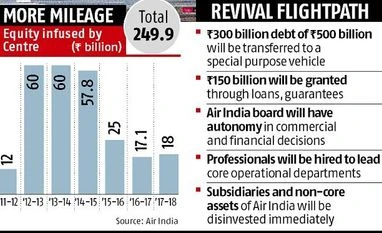
The government is planning steps to give significant autonomy to Air India’s (AI’s) board, in terms of capital expenditure and commercial decision-making. This, along with a debt-restructuring proposal and a financial support of Rs 150 billion, will be part of a package to improve the airline’s operational efficiency. 

However, the autonomy of AI’s board will depend on condition that the company will not seek financial support from the government after 2018-19, a top official said. 

The plan, which was approved by the Prime Minister’s Office last week, is meant to empower the airline’s board to take important business decisions like buying or leasing new aircraft, raising capital by mortgaging assets, hiring professionals at senior managerial positions, and rationalising the workforce through voluntary retirement scheme. 

Currently, AI needs permission from the Ministry of Civil Aviation for these matters.

The plan is also to make the board responsible for selling AI’s subsidiaries and monetising non-core assets like real estate and land parcel.

It is learnt that the airline will hire a chief operating officer (COO) with significant experience. The COO, who’s likely to get market level compensation, will report to the chairman and managing director and will be responsible for day-to-day operations of the airline. He will implement strategies for cost-rationalisation and improving efficiency. 

Professionals will also be roped in for strategic positions such as head of network planning and chief commercial officer.

ALSO READ: Take Delhi posting if you want to fly wide-body: Air India to crew

“There will be organisational reform of AI along with financial restructuring. Well-known professionals with exposure in running global airlines will be hired and the focus will be to increase the efficiency of the airline by strengthening the autonomy of the management in line of Navratna and Miniratna enterprise, so that they don’t have to come to the government for approvals,” said an official aware of the plan. Under government guidelines, the boards of profitable enterprises, which are classified as Navratna and Miniratna companies, are given the powers to take commercial decisions without moving the nodal ministries for permission.

As part of the process, top industrialists, including Yogi Deveshwar, former chairman of ITC, and Kumar Mangalam Birla, chairman of Aditya Birla Group, have already been inducted as independent directors. The government will have a representation in the board through a single nominee.

“The objective behind the plan is to reduce AI’s legacy issues - reducing the company’s debt burden and allowing professionals to run the business. This is expected to improve operational metrics of the airline and push the airline to profitability,” a top finance ministry official said. That means the airline should be able to sustain its operations from internal resources from the next fiscal year, he said.

The airline’s debt, too, will be restructured. Around Rs 300 billion of total debt is proposed to be transferred to a special purpose vehicle.


AI’s balance sheet is saddled with a debt of around Rs 500 billion and the company spends around Rs 50 billion annually as interest payment. In fact, consultancy firm EY, which was advising the government on AI’s privatisation, had blamed the high debt burden as one of the primary reason for failing to generate any interest from the market.

Further, around Rs 150 billion will be provided to the airline as cash or sovereign guarantee. Using government guarantee, the airline can raise money from lenders at cheap interest rates.

Experts said a professional board, independent of political and bureaucratic pressure, is essential to turn around the company, in the current market conditions of high fuel price and competition. “The board should have professionals with a deep strategic understanding of the business and proven credentials in commercial and planning domains and expertise in restructuring of large organisations,” aviation consultancy firm CAPA said in a note.


CAPA, however, cautioned that the government might find it difficult to hire reputed professionals over compensation issues. “As an alternative, we suggest an accomplished executive be identified from an Indian public sector unit, with a demonstrated track record in delivering results in difficult circumstances,” it said.

One subscription. Two world-class reads.

Already subscribed? Log in

Subscribe to read the full story →
*Subscribe to Business Standard digital and get complimentary access to The New York Times

Smart Quarterly

₹900

3 Months

₹300/Month

SAVE 25%

Smart Essential

₹2,700

1 Year

₹225/Month

SAVE 46%
*Complimentary New York Times access for the 2nd year will be given after 12 months

Super Saver

₹3,900

2 Years

₹162/Month

Subscribe

Renews automatically, cancel anytime

Here’s what’s included in our digital subscription plans

Exclusive premium stories online

  • Over 30 premium stories daily, handpicked by our editors

Complimentary Access to The New York Times

  • News, Games, Cooking, Audio, Wirecutter & The Athletic

Business Standard Epaper

  • Digital replica of our daily newspaper — with options to read, save, and share

Curated Newsletters

  • Insights on markets, finance, politics, tech, and more delivered to your inbox

Market Analysis & Investment Insights

  • In-depth market analysis & insights with access to The Smart Investor

Archives

  • Repository of articles and publications dating back to 1997

Ad-free Reading

  • Uninterrupted reading experience with no advertisements

Seamless Access Across All Devices

  • Access Business Standard across devices — mobile, tablet, or PC, via web or app

Next Story


