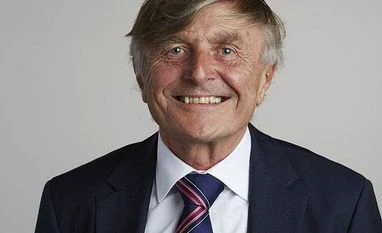
SIR ROBIN SAXBY, the founding chief executive officer of UK-based chip company ARM Holdings, was instrumental in building it into a global giant whose chip technology powers most of the world’s smartphones. In Bengaluru recently for the IET Future Tech Congress 2022, he spoke with Peerzada Abrar, dwelling on his entrepreneurial journey and the opportunities available to India in high-tech areas. Edited excerpts:
What are the lessons from your journey as a technologist and an entrepreneur?
You learn from your mistakes, and making mistakes is actually a good thing, especially in engineering. You have to try something new and make it work, and then you have to correct it. One piece of advice I give to start-ups is to think beyond the possible and then back off to reality. I had a radio and TV repair business when I was 13, and that made me pocket money. Somebody asked me who taught you. I said I read a book and built circuits.
Small children are not afraid to try new things. As we age, we have to pass exams and be better than somebody else. As we become more successful, the more garbage we get on our shoulders. Money doesn’t make you happy, but relationships and health make you happy. There is also a danger of having too much money. If we look at some of the richest people on the planet today and how they’re behaving, I don’t think that’s a good way to behave.
I was a poor engineer when I joined Motorola. It taught me to understand marketing and the importance of the voice of the customer, and to fit the technology to the customer’s needs. My first CEO role was at a security company, which was into access control. It was a baptism by fire for me. The culture of my boss was different. He believed in only managing through fear, but I survived. That hard time was the best thing that ever happened to me and later helped me make ARM work.
Today 95 per cent of premium smartphones are powered by ARM. What are the reasons behind ARM’s success?
I retired from ARM in 2007. When I joined in 1991, it had 12 engineers and was looking for a CEO. It had got an investment of $1.5 million from Apple. I’m a great believer in teamwork. The job definitions matter less than the quality of the teamwork. The reality is that it takes a very long time for change to happen. If you look at the early days of ARM, the plan was that we were going to get a lot of chip shipments and royalties. But the first two products didn’t take off. In the early days, we were licensing technology but the royalties were never coming. The dial-up modem was the first product of ARM to take off.
The first brand-recognised product of ARM to take off was the Nokia 6310, followed by Nintendo Game Boy Advance. What you’re seeing now with ARM’s royalty growth is the momentum, and it takes time. When we started I said we are going into every market segment except the computer. I said we are not going head-to-head with Intel because they are the market leader. With new technology, you’ve got to create your new space. Now that we’ve got tablets, finally ARM is getting into the new Apple MacBooks. My advice to start-ups is to find a new space, do something different, and create your own market. Don’t go head-to-head with the number one in the space, because they would have more money and resources.
At a time when the world is looking at a China-Plus-One diversification strategy, what kind of opportunity do you see for India in the electronics and semiconductors space?
India has got unique opportunities, like in the area of health care and automotive. India could look at its own opportunities. Here the government, academia and business can collaborate, and think about new start-up businesses. When we started ARM, we said we are going to license the chips and do something completely different. You need to look at where your biggest opportunities are and invent your own unique business model that capitalises on your strengths. Then look outside for other examples and learn from them. India has a younger population that’s bigger than the ageing population in other countries. That gives you an advantage.
You have also become a promoter of young entrepreneurs. What are the start-ups that you find exciting?
I’m a fellow of the Royal Academy of Engineering, which is the highest level you can get as an engineer. I and some other entrepreneurs, who have made some money, asked the Academy, what are we doing about wealth creation? So, we formed the Enterprise Hub. It has people like me who are engineers with commercial experience and act free of charge as mentors to start-up CEOs. For example, if a company is in the area of semiconductors or licensing, I would be mentoring it. The fellows are passing their experience back to the start-ups.
With the startups I am in, we were hoping to get some exits, or some of them going public. Because of the current economic climate, those things got delayed. But the best CEOs get exits even in the most difficult times. Something goes wrong with start-up companies that you think are doing really well. And the one that you thought was a disaster ends up being fantastic.
I’m not fundamentally a venture capitalist, who wants to see a return on their money in five years. I’m more inspired by helping people do a good job and make good technology work. There is a start-up in the UK which is headed by an Indian and he has got amazing battery technology. I have also backed a company which is looking at collecting battery metals from the seabed using robots.