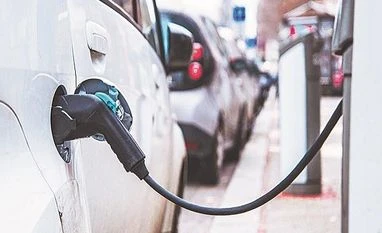
The government on Wednesday said Indian Standards for low-cost AC charging point for electric vehicles (EVs) will be released within the next two months with target prices starting as low as Rs 3,500 for a charging unit.
A committee involving all key stakeholders, including EV manufacturers, auto and electronic component suppliers, power utilities, and communication service providers, has worked in fast-track mode to develop specifications, prototype products, and undertake testing and validation of the proposed standards, an official statement said.
"These will be formally issued by the Bureau of Indian Standards (BIS)," it said, adding the draft Indian Standards has been taken up by the BIS Committee on Electromobility Standards.
The formal release of the standards will be done within the next two months, after completion of field and durability trials of sample products. It is expected that a new industry sector will emerge catering to the high volume, low-cost charging infrastructure for EVs, the statement added.
With most charging systems developed across the globe addressing higher levels of power and very expensive for wide-spread deployment, the Department of Science and Technology (DST), the Office of the Principal Scientific Advisor (PSA) to the Government of India, in close coordination with NITI Aayog team had taken on this challenge, the statement added.
"The group had set a target price of less than Rs 3,500 (USD 50) for a smart AC charge point operated with a smartphone, for a global breakthrough in affordable EV charging infrastructure. Fast-track development of the standard, close working between industry and government, and diligent testing and validation has met with success," it said.
Several Indian manufacturers are already on board to make this charging point device as per Indian Standards, with target prices starting as low as Rs 3,500.
As per industry estimates, the charging units currently available for electric two and three wheelers in the market are priced upwards of Rs 10,000.
The government said the fastest adoption of EVs is expected to be in two-wheelers and three-wheelers as the share of Internal Combustion Engine (ICE) versions of these vehicle types account for around 84 per cent of total vehicle sales in India.
"By 2025, forecasts expect up to 4 million of such vehicles (EV) could be sold each year, growing to almost 10 million by 2030. Any charging solution to serve this sector must be highly scalable, easily accessible by public; it should support interoperability, and be affordable," the statement added.
NITI Aayog Vice Chairman Rajiv Kumar said the emphasis on charging points rather than costly charging stations has led to the accelerated efforts by the team for developing the LAC charging standard for the light electric vehicles segment, as the next logical step.
V Sumantran, Chairman, DST-PSAO Group on Charging Infrastructure said this effort brought out the talent in India for intelligent cost-innovation.
"Affordability constraints in India demand that we address problems keeping in mind both cost and scalability," he added.
According to the statement, the low-cost AC chargepoint (LAC) allows up to 3kW of power to be drawn to charge e-scooters and e-autorickshaws. It is intended to be highly scalable and deployed in any place where a 220V 15A single phase line is available mainly targeting parking lots of metro and railway stations, shopping malls, hospitals, office complexes, apartments and even kirana and other shops.
The user's smartphone will communicate with the LAC via low-power Bluetooth and links up to a back-end where transaction payment and analytics are enabled. The user's smartphone can be used for multiple accounts and payment options, the statement said.

 "Indian Standards for low-cost AC charging point for EVs within 2 mos: Govt")


 Connect with us on WhatsApp