Prices of key raw materials such as palm oil, mentha oil and crude oil were down 11-23 per cent year-on-year in the July-September quarter. Packaging costs, which accounts for about 15-20 per cent of the cost of goods sold, are also cooling off. However, input costs as a per cent of sales has remained firm for most firms during this period.
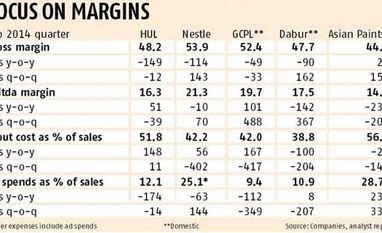
Of the five FMCG companies that have announced results so far, only Dabur has witnessed a significant contraction of 100 basis points to 38.8 per cent while others have posted a marginal fall of 20 basis points up to an increase of 167 basis points in this metric. Though copra and milk prices are up 95 per cent and 12 per cent, respectively, during this period, analysts say, companies have their own sourcing agreements with raw material suppliers and hence the benefit of soft raw material prices typically reflects with a lag in their books.
As a result, compared to this quarter the previous year, all companies except for Asian Paints witnessed gross margin contraction (see table). Gross margin is a ratio which determines the proportion of money/profit left over from revenues earned after deducting the cost of goods sold.
But that’s where the bad news ends, as analysts expect margin gains from the October-December quarter.
Meanwhile, despite the trend seen in the July-September quarter, some companies saw Ebitda margins improve. The movement of Ebitda margin was largely a function of intensity of advertising and promotional spends of most companies. HUL, Dabur and Godrej Consumer Products Limited (GCPL) reduced this metric in the quarter to support their Ebitda margins.
“During times of benign palm oil prices, small local soap players come back to the market. This, in turn, pushes sales and promotion expenses, not necessarily advertising spends. Thus, the nature of competition is key to determine margin expansion due to falling input costs,” the GCPL management said in a post-results call with analysts. “We decided to cut our advertising expenditure during the quarter. But I don't think it affected our competitive abilities,” Sanjiv Mehta, MD and CEO, HUL, told Business Standard in a media interaction post its results.
Asian Paints, again, was an exception of the five companies and chose to reinvest most of the gains back in the business, resulting in about 200 basis points fall in its standalone Ebitda margin, both sequentially as well as on a year-on-year basis. On a year-on-year basis, HUL and GCPL outpaced their peers on Ebitda margin front thanks to lower ad spends, while Dabur (standalone) and Asian Paints fell behind.
Going ahead, the benefits of lower inputs costs should soon start showing in the gross margins of FMCG companies. Analysts say the full impact of soft input costs is likely to be visible in the next two quarters.
“In second half of this financial year, gross margin of most companies should improve on a year-on-year basis given the benign input costs. We believe soap and paint companies should benefit the most from lower input costs,” said Abneesh Roy, associate director, institutional equities, research, Edelweiss Securities. Typically, analysts look at the year-on-year changes given the seasonality factor for the FMCG business.
The expected gains in the gross margin can also be gauged from the performance of FMCG companies compared to the June 2014 quarter, which provide further confidence.
Input costs as a per cent of sales fell by 200-400 basis points sequentially for three out of the five FMCG companies that have reported September 2014 quarter results so far. Nestle, Dabur and Asian Paints witnessed sequential gross margin expansion of 143-162 basis points. HUL and GCPL saw nearly flattish gross margins.
For the September 2014 quarter, Colgate, which is slated to announce its results on Wednesday, is likely to witness strong margin gains given the stable competitive environment and could also see sharp cut in its ad spends, believe analysts.
But, how much of the gains from lower input prices will trickle down to higher Ebitda margins are yet to be seen. That’s because, as input prices fall attracting local players into the fray, companies will have to up their ad spends and promotional activities. On the whole, expect margins to remain firm translating into higher earnings for most companies.

 "Lower input costs to benefit FMCG firms in second half")


 Connect with us on WhatsApp