We chose to focus on improving the operating income: Himanshu Kapania
Interview with MD, Idea Cellular
Malini Bhupta Mumbai Falling realisations in the voice business, high spectrum charges and huge investment to build data capabilities have hurt the earnings of telecom operators. Idea Cellular, fastest growing in the segment, decided on course correction in the March quarter to improve financial performance.
Himanshu Kapania, managing director, talks about the shift in strategy with Malini Bhupta. Edited excerpts:
The quarter has been rather good for Idea. Take us through the key highlights. For the past six quarters, the voice-realised rate has been falling. In the first three quarters of FY16, it fell by 11 per cent year-on-year. This was impacting revenue growth and margins. This quarter, we reversed our volume-led strategy to a balanced growth one. We reduced promotional offers for new and existing customers. As a result, voice-realised rate improved by 4.4 per cent sequentially. This has helped us grow revenue by 5.2 per cent and helped improve Ebitda (earnings before interest, taxes, depreciation and amortisation) by 16.4 per cent.
We have chosen to slow down subscriber and minutes growth to improve operating income, as the cost structures of telecom companies have moved below Ebitda, with depreciation, amortisation and interest costs rising.
How has Idea managed to grow the voice business in double digits? For the financial year, our growth was volume-led. We added 22 million active subscribers and our overall consumer base crossed 182 million. Idea is the only company to report a double-digit voice minutes growth, of 15 per cent, and our annual voice volume has crossed 786 billion minutes, an incremental addition of 103 bn. The increase in subscribers and minutes was on account of elasticity, as prices declined. The company still believes there is sufficient juice in voice growth and we will pursue a balanced growth strategy, retaining current voice rates.
Any plan to raise voice rates?
We don’t wish to. Even at our current headline rate, our realised rate is still discounted. We will make every attempt to reduce promotions, to improve voice realisations.
What led to the fall in your full-year net profit?
Idea participated in the spectrum auctions of February 2014 and March 2015, where we committed Rs 30,000 crore. This was primarily to renew licences in nine circles. This year, we increased capital expenditure (capex) to Rs 7,700 crore. The gross block has increased by Rs 37,000 crore in FY16. Most of the spectrum purchased has been deployed. We launched 4G (fourth-generation technology) in all 10 circles. We launched 3G services in Kolkata in the third quarter and a second carrier on 900 MHz in Maharashtra and Madhya Pradesh in the fourth quarter. The March quarter profit after tax includes the interest cost on net debt of Rs 38,000 crore, of Rs 25,000 crore was added during the year. Our net debt to Ebitda ratio has peaked at 2.92. Despite this, we have exceeded the market's estimates.
What is your capex expectation for FY17?
Between Rs 6,500 and Rs 7,000 crore, primarily to expand broadband coverage.
What’s your strategy on spectrum auctions? You do not have data spectrum in all 22 circles.
Idea has 3G and or 4G in 17 of the 22 circles. In FY16, we also added 35,000 wireless broadband sites, a 110 per cent addition during the year. The current capacity utilisation of broadband is 15-20 per cent. The demand for mobile broadband is growing much slower than the supply increase. Given all this, our auction strategy will be selective and discretionary. We will focus on coverage expansion, rather than increasing capacity. I wouldn't like to comment on individual bands.
How did data fare for Idea?
Currently, our data coverage is 87 per cent of the company's revenues. In the last 100 days of FY16, we moved integrated 4G services to 3,500 towns and villages, 50 per cent of the locations as first mover. We now cover 21 per cent of the overall population in all these 10 states. Idea's overall coverage of broadband has increased to 400 million Indians. Over the past year, 23 million Idea users have upgraded their phones to 3G or 4G ones; over six mn Idea consumers own smartphones.
However, adoption of mobile broadband services is much slower than we'd expected. Only 10 mn have actually started using Idea's wireless broadband services. We believe FY17 will be a better year for mobile broadband.

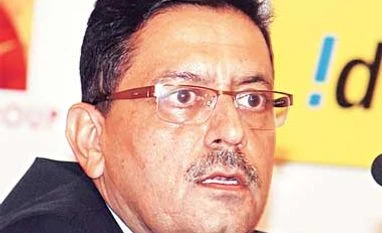 "We chose to focus on improving the operating income: Himanshu Kapania")

