Reliance, BP to invest Rs 40,000 crore in KG block over 3 to 5 years

Will jointly explore options to develop differentiated fuels, low-carbon energy businesses in India
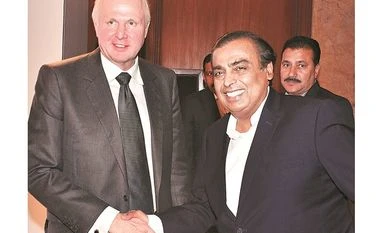
RIL CMD Mukesh Ambani (right) with BP Group Chief Executive Bob Dudley at a press conference in New Delhi on Thursday. Ambani said demand for fuel was expected to grow by 5-7% every year over the next decade. Photo: Sanjay K Sharma
Jyoti MukulShine Jacob New Delhi
Last Updated : Jun 16 2017 | 8:23 AM IST
Reliance Industries (RIL) on Thursday announced it would invest Rs 40,000 crore ($6 billion) in three projects, over three to five years, for developing discoveries in the KG-D6 block along with its 30 per cent partner BP Plc.

These discoveries are in deepwater gas fields and are expected to bring onstream 30-35 million cubic metres (1 billion cubic feet) of gas a day over 2020-22. The investment announcement comes even as the two companies are involved in arbitration with the government over pricing of natural gas.

The first project will be for R-series (D34), which will produce 12 mmscmd gas. The implementation of two other projects in Block KGD6 was subject to applicable regulatory and government approvals, the company said. RIL and BP plan to submit development plans for the next two projects for government approval before the end of 2017. 

“We still have pending arbitration with the government. We will follow the normal course of the law,” Mukesh Ambani, chairman and managing director, RIL, told reporters here. “We are sure that we will get a fair outcome and we don’t think it will come in the way of our investment,” he added.

The two partners will award contracts for development of the ‘R-Series’ fields soon. Since the formation of the partnership in 2011, the two companies have invested over Rs 10,000 crore ($1.6 billion) in deepwater exploration and production in the period to May 2017. Gas production from the integrated development is expected to reduce India’s import dependence by over 10 per cent in 2022.  

RIL and BP will also expand their existing partnership for strategic cooperation in new opportunities across India’s energy sector.
 
The two companies will jointly explore options to develop differentiated fuels, mobility and advanced low-carbon energy businesses in India.
 
Ambani said demand for fuel was expected to grow by 5-7 per cent every year over the next decade. In addition to conventional transportation and aviation fuel retailing, the companies expect to collaborate on unconventional mobility solutions, addressing electrification, digitisation and disruptive mobility trends. Together, these collaborations will seek to address the mobility needs of urban, rural/farm, industrial/commercial, and highway consumers in India, applying the leading capabilities of both partners.

Ambani said, "This strategic partnership not only strengthens the relationship between two global energy leaders, but is also in line with and supports the forward-looking policies and vision of the government.” He said the two companies would also look at working together on carbon emissions trading and share knowledge around technology and management practices utilising their unique infrastructure systems. Bob Dudley, BP group chief executive, said, “India’s demand for both energy and mobility is growing and evolving rapidly. This presents many opportunities for BP and Reliance to build on our existing strong relationship in upstream and expand our partnership further downstream.”

On the stagnating production from KG-D6, Dudley said, "The change in policy will allow us to develop new resources just in time." BP has government permission to put up 3,500 petroleum retail outlets for which Dudley said the company would look at collaboration with RIL.

Oil & Gas partnership
  • In February 2011, London-based BP bought a 30% stake in 21 oil and gas production-sharing contracts operated by RIL for $7.2 billion
  • In 2013, BP and RIL announced two significant gas and condensate discoveries
  • In Krishna Godavari (KG) basin gas block, RIL owns a 60% stake and BP 30%, while Niko Resources holds the remaining
  • The producing fields in KG basin are D1, D3 & D26
  • Three new projects, with total investment of Rs 40,000 crore, expected to bring a total 30-35 million cubic metres gas a day
  • New gas production to go onstream in phases over 2020-2022
  • RIL, BP to focus on mobility solutions, look at both conventional and non-conventional fuels
  • BP, which got approval from the government to set up 3,500 fuel retail outlets in India, will have marketing and downstream tie-up with RIL

One subscription. Two world-class reads.

Already subscribed? Log in

Subscribe to read the full story →
*Subscribe to Business Standard digital and get complimentary access to The New York Times

Smart Quarterly

₹900

3 Months

₹300/Month

SAVE 25%

Smart Essential

₹2,700

1 Year

₹225/Month

SAVE 46%
*Complimentary New York Times access for the 2nd year will be given after 12 months

Super Saver

₹3,900

2 Years

₹162/Month

Subscribe

Renews automatically, cancel anytime

Here’s what’s included in our digital subscription plans

Exclusive premium stories online

  • Over 30 premium stories daily, handpicked by our editors

Complimentary Access to The New York Times

  • News, Games, Cooking, Audio, Wirecutter & The Athletic

Business Standard Epaper

  • Digital replica of our daily newspaper — with options to read, save, and share

Curated Newsletters

  • Insights on markets, finance, politics, tech, and more delivered to your inbox

Market Analysis & Investment Insights

  • In-depth market analysis & insights with access to The Smart Investor

Archives

  • Repository of articles and publications dating back to 1997

Ad-free Reading

  • Uninterrupted reading experience with no advertisements

Seamless Access Across All Devices

  • Access Business Standard across devices — mobile, tablet, or PC, via web or app

Next Story


