Art of Living founder Sri Sri Ravi Shankar may have decided to open 1,000 stores over the next year to sell beauty products, but his flagship stores could have a hard time catching up with Baba Ramdev’s booming business. Sri Sri Ravi Shankar’s stores, Sri Sri Tattva, will sell toothpastes, detergents and soaps. They will aim to take on Baba Ramdev’s Patanjali stores and look to claim a share in the growing pie of India’s herbal beauty and wellness products market.
Records show that Sri Sri Ayurveda Trust has only two trademarks for products in Class-III, under which cosmetics are grouped. Under the Trademarks Act, 1999, this class of products includes, among other things, “cosmetics, perfumery, soaps, essential oils, hair lotion and dentrifices”. This allows both Ramdev and Sri Sri Ravi Shankar’s enterprises to register their trademarks for products like talcum powders, petroleum jellies, herbal cosmetics and various other products.
In all, Sri Sri Ayurveda Trust has four trademarks registered under Class-III. By comparison, Patanjali Ayurveda has 37 trademarks registered for different products under this class of goods.
One of the two products for which Sri Sri Ayurveda has a trademark is ‘Laxmitaru’; for this, an application was filed in 2015. Another one is for ‘Sudant’, for which an application was filed in 2014. While it is unclear what Laxmitaru will be used for, Sudant will be used for a brand of toothpastes likely to be retailed through the new stores.
The cosmetic trademark arsenal of Ramdev’s Patanjali Ayurveda is more impressive than that of Sri Sri Ayurveda. And, it goes beyond the generic herb- and toothpaste-trademarked brand and formulations of the latter. Among Patanjali’s trademarks are a whole range of products like toothpastes, soaps, body lotions, face cleansers, detergents and baby oils. Some of these are similar products but have been trademarked with different herbal names. For instance, Patanjali Ayurveda has registered ‘Kanti’ as a trademark with authorities. Under this brand name, it has further trademarked different products with different formulations. These include Patanjali Kesh Kanti hair cleanser, Kesh Kanti Silk and Shine hair cleanser, Kesh Kanti Milk Protein hair cleanser, Haldi Chandan Kanti body cleanser, Dant Kanti dental cream, Kesh Kanti Shikakai hair cleanser, Kesh Kanti anti-dandruff hair cleanser, Aloe Vera Kanti body cleanser, Neem Kanti body cleanser, and Kesh Kanti Silk & Shine hair cleanser.
Not only is Ramdev’s business eons ahead of Sri Sri’s in terms of trademarks, Patanjali has also had a head-start in setting up stores across strategic locations in virtually every nook and corner of India. The $1.6-billion fast-moving consumer goods (FMCG) company reportedly has 47,000 retail stores and 3,500 warehouses across India. It also counts Kishore Biyani’s Future group as its sales partner pushing Patanjali products at Big Bazaar stores across the country.
But both Sri Sri Ayurveda and Patanjali Ayurveda have one thing in common – most of their trademarks for cosmetics were registered after the Modi government came to power in 2014. As many as 23 of Patanjali’s trademarks in cosmetics were filed after 2014, while Sri Sri Ayurveda’s Sudanta and Laxmitaru were registered in 2014 and 2015, respectively.
Sri Sri Ayurveda is organised as a trust and there is little clarity on its business revenues. Though it has been selling Ayurveda products and yoga for over a decade, the growth of the herbal cosmetics business in India can partly explain its aggressiveness. A 2016 report of the US government’s Department of Commerce estimated India’s cosmetics industry had a size of $5 billion and was growing at 15 per cent every year – much faster than American and European markets. The report stated, “In India, there is a strong interest in local ingredients and herbal traditions and the properties that these essential oils and other products can bring to personal care products and cosmetics.”
Read this article for free
Register to continue reading premium journalism and analysis from Business Standard.

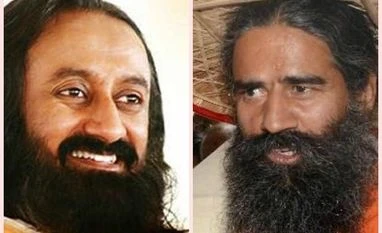 "Sri Sri Ravi Shankar losing beauty battle with Ramdev")












 Connect with us on WhatsApp