The high-powered panel of experts constituted by the Supreme Court to study the three repealed farm Acts has said a great majority of the agricultural organisations it had interacted with were in support of them.
Of all the farm organisations it had talked to, around 86 per cent of them, representing almost 33 million of the farming community, had supported the laws.
While advocating retaining the Acts, the panel, whose recommendations are of little consequence now, has suggested that states be allowed flexibility in implementing and designing the laws, with prior approval from the Centre.
It has said a repeal or long suspension of the Acts would be “unfair” to the silent majority who supported the laws.
The panel was constituted by the Supreme Court in January 2021 while staying the implementation of the three laws.
It initially had four members, including agricultural economist Ashok Gulati, Shetkari Sanghatana (Maharashtra) President Anil Ghanwat, former South-Asia Director of the
International Food Policy Research Institute Pramod Kumar Joshi, and the president of a faction of the Bhartiya Kisan Union, Bhupinder Singh Mann.
Mann later opted out of the panel.
Pune-based farmer leader Anil Ghanwat on Monday said at a press conference that he had on three occasions written to the Supreme Court, requesting the release of the report of the committee but in the absence of a response, he was doing it.
The panel in its report said it interacted with 73 organisations, representing almost 38.3 million farmers. Around 86 per cent of them fully supported the Acts while four groups, representing around 5.1 million, did not do so.
Another seven organisations, representing 360,000 farmers, supported the Acts with some modification.
That apart, the panel invited comments. It received 19,027 representations and suggestions. Two-thirds of respondents there supported the Acts, the panel said.
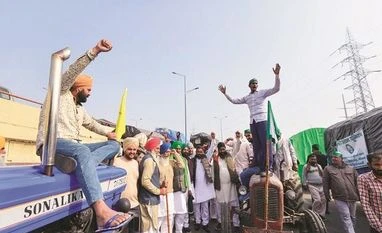
The panel noted the farmer groups protesting on the Delhi borders did not participate in any of the interactions but their objections and concerns as highlighted in the media were reckoned on while it gave its recommendations.
On the farmer unions’ demand to legalise the minimum support price (MSP) system, the panel said it was not based on logic and was therefore infeasible.
“Any product that is produced needs to be traded at a viable price. MSP is an indicative floor price to protect the farmers against any undue fall in prices, especially at the time of harvest. The government does not have the financial coffers to buy whatever is produced of all 23 commodities that are currently under the cover of MSP,” the report said.
The MSP and procurement support policy, as designed for cereals during the Green Revolution time, needs to be revisited, given that huge surpluses of wheat and rice have emerged.
The panel gave a few options on how to proceed, looking at least 10 years ahead.
“One of the options that the committee deliberated upon is to allocate the current expenditure by the central government on procurement, storage and PDS of wheat and rice across states based on an objective formula giving due weightage to production, procurement and poverty. The states should be given the freedom to devise their own approaches to support farmers and protect poor consumers in their respective states,” the report said.
The committee has recommended that procuring crops at a declared MSP can be the prerogative of the states in accordance with their specific agricultural policy priorities.
Another option the panel suggested is to give freedom of choice to the beneficiaries of the public distribution system to choose cash transfers equivalent to MSP + 25 per cent for every kg of grain entitlement or get it in kind (wheat or rice).
A road map for gradual diversification from paddy to more sustainable high-value crops, especially in the Punjab-Haryana belt, needs to be formulated, the panel said.

 "86% farmer groups supported 3 repealed laws: SC-appointed panel found")












 Connect with us on WhatsApp