
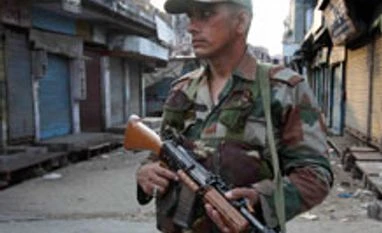
Army begins leaving Muzaffarnagar
Police officer Kumar said that the police were in complete control and it was time for the army to leave
 "Army begins leaving Muzaffarnagar")
WebinarsNew
Deep DiveNew
Explore Business Standard
Police officer Kumar said that the police were in complete control and it was time for the army to leave
Soldiers Tuesday started pulling out of Muzaffarnagar in Uttar Pradesh after being deployed there for the last one week following communal violence.
"There is absolute calm and the district administration and police are in complete control of the situation. Hence the army is being withdrawn," Additional Director General of Police Arun Kumar told IANS.
"The process will be completed today," he added.
Twenty-eight units of the army were requisitioned to assist the district administration after communal clashes erupted in Muzaffarnagar city, about 130 km from New Delhi, and the adjoining rural areas Sep 7-9.
More than 40 people were killed and scores injured in the violence, forcing the authorities to deploy the military for the first time in over two decades to quell communal clashes.
Police officer Kumar said it was time for the army to withdraw.
Informed sources said that while it was decided earlier to pull out the army in phases, it was later felt that this would "unnecessarily create an atmosphere of tension.
"Hence, a decision was taken at the political level, paving way for the (full) pullout."
District Magistrate Kaushal Raj Sharma said the administration's focus was now to rehabilitate the people who fled their homes and have taken refuge in makeshift centres.
Officials will also distribute the financial compensation sanctioned by the state government for the riot victims.
Deputy Inspector General of Police Ashok Mutha Jain said special teams had been formed to catch people booked for their involvement in the riots. Police said door-to-doors checks were still on in rural areas to nab the culprits and to seize weapons.
But despite official claims of normalcy returning to Muzaffarnagar, thousands have refused to return to their homes saying they felt unsafe in villages where they came under attack.
Prime Minister Manmohan Singh and Congress president Sonia Gandhi were confronted by hundreds of victims who said they were unwilling to go back to their homes for now.
In Wasi Kalan village where an Islamic seminary has been converted into a relief camp, refugees told Manmohan Singh and Gandhi that they had little faith in the state government.
According to them, police were mute spectators when they were attacked and their houses burnt.
More than 43,000 people have taken refuge in 38 relief camps set up by the administration.
People say they want to resume normal life but are vary of stepping out of the camps.
First Published: Sep 17 2013 | 3:36 PM IST


 Connect with us on WhatsApp