
At least 631 people died cleaning sewers, septic tanks in last 10 yrs: NCSK
A total of 631 people have died in the country while cleaning sewers and septic tanks in the last 10 years, the National Commission for Safai Karamcharis (NCSK) said
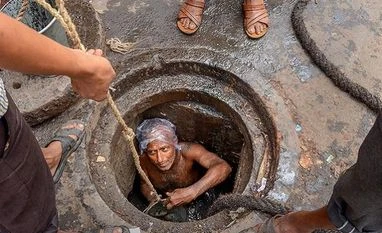 "At least 631 people died cleaning sewers, septic tanks in last 10 yrs: NCSK")
Explore Business Standard
A total of 631 people have died in the country while cleaning sewers and septic tanks in the last 10 years, the National Commission for Safai Karamcharis (NCSK) said
A total of 631 people have died in the country while cleaning sewers and septic tanks in the last 10 years, the National Commission for Safai Karamcharis (NCSK) said.
The figure was provided by the NCSK in response to an RTI query on the number of deaths reported while cleaning sewers and septic tanks from 2010 to March 2020.
According to the data, 631 such fatalities were reported during the period.
The highest number of deaths were reported in 2019 at 115.
Among states, Tamil Nadu reported the highest number of such deaths in total in the 10-year period at 122 followed by Uttar Pradesh at 85, Delhi and Karnataka each reported 63 deaths and Gujarat reported 61 deaths.
In Haryana, 50 fatalities have been reported in the last 10 years. In 2020, two people died while cleaning sewers and septic tanks till March 31. In 2018, 73 such deaths were reported while in 2017 as many as 93 people died while cleaning sewers, the data showed.
In 2016, 55 people died while cleaning sewers and septic tanks, 62 in 2015, 52 in 2014, 68 in 2013, 47 in 2012, 37 in 2011 and 27 in 2010, it said.
The NCSK said the data is based on the information received by it from various sources and actual information may vary.
"Further, this is a dynamic data which keeps changing as it is updated as and when information is received by the commission from any source," it said in the RTI response.
An official said sanitation is a state subject and the NCSK maintains the data it receives from states and UTs.
Activists, however, said that such deaths continue to happen because of poor implementation of the Prohibition of Employment as Manual Scavengers and their Rehabilitation Act.
Bezwada Wilson, national convener of Safai Karmachari Andolan, an organisation working to eradicate manual scavenging, said the poor implementation of the law has left the sanitation workers in a lurch.
"A single person has not been punished under the Prohibition of Employment as Manual Scavengers and their Rehabilitation Act since its enactment. An Act should not be a false promise like an election manifesto, an Act should be what we should implement in an unequal society," the Magsaysay award winning activist said.
Sanjeev Kumar, secretary of Dalit Adivasi Shakti Adhikar Manch (DASAM) agreed with Wilson that strict implementation of the act is the biggest issue.
"A person entering inside a sewer or septic tank must be completely banned and machinery must be brought in place instead. We have such cases too where sewer workers are struggling to survive after inhaling the toxic gases inside and they are not able to regain strength. The people who survive live with a lot of pain," he said.
Kumar said in many cases, they don't have any proper training or equipment.
"No one is taking seriously effective implementation of the Act. There is lack of awareness that making a person entering sewer or septic tank is a crime and for that the law has to be implemented strongly," he said.
Akhila Sivadas, the managing trustee and executive director of the Centre for Advocacy and Research (CFAR) - a non-profit organisation, said firstly there is a need to recognise the magnitude of the problem and through the National Urban and Rural Livelihood Mission, pursue the issue with determination.
While collaborating with unions and associations of safai karamcharis, take forward aggressively alternate means of livelihood and modernise and regulate fecal sludge and septage management to utmost safety of sanitation workers, she said.
"The government needs to walk the talk. As long as there is poor implementation of the law prohibiting manual scavenging no one will have any faith in the ability of the system to liberate them from the worst form of bondage and servitude," Sivadas added.
According to data presented by the Social Justice and Empowerment Ministry in February in Parliament, there are about 63,246identifiedmanual scavengers across the country in 17 states and about 35,308 have been identified from Uttar Pradesh alone.
Parliament had enacted the Prohibition of Employment as Manual Scavengers and their Rehabilitation Act, 2013 which came in force from December 6, 2013.
The Act makes it clear that cleaning of sewers or septic tanks without protective gear amounts to hazardous cleaning and attracts penal consequences.
In the ongoing Parliament session, the government is likely to bring Prohibition of Employment as Manual Scavengers and their Rehabilitation (Amendment) Bill, 2020 that makes the law banning manual scavenging more stringent by increasing the imprisonment term and the fine amount.
(Only the headline and picture of this report may have been reworked by the Business Standard staff; the rest of the content is auto-generated from a syndicated feed.)
First Published: Sep 20 2020 | 12:05 PM IST

