Home / India News / Coronavirus second wave: How oxygen for medical use is extracted
Coronavirus second wave: How oxygen for medical use is extracted
There has been a lot of conversation lately around liquid oxygen, medical oxygen, oxygen concentrators and so on. The govt has explained what each of these is and the methods to extract oxygen
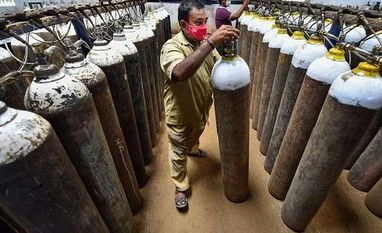
Shortage of oxygen during the second Covid wave has caused the number of deaths to rise in the country. Shortness of breath is a symptom of Covid-19 and may require the patient to be put on oxygen support. In the last few weeks, there has been a lot of conversation around liquid oxygen, medical oxygen, oxygen concentrators and so on. The government has, in a statement, tried to explain what each of these is and the methods used to extract oxygen.
Why liquid oxygen?
Due to its low melting and boiling points, oxygen is in a gaseous state at room temperature. Liquification allows it to be stored in larger volumes and makes it easier to transport.
Producing liquid medical oxygen
The most common production method is separation of oxygen in “Air Separation Units”. These separate large volumes of gases using the fractional distillation method to produce pure oxygen from atmospheric air.
Atmospheric air is first cooled to minus 181° degrees Celsius. Oxygen liquefies at this point. Nitrogen, which is the major component of air, remains in a gaseous state since its boiling point is minus 196 degrees Celsius, but a significant amount of argon liquefies along with oxygen. (Argon is the third-most abundant gas in the Earth’s atmosphere.) The resultant mixture of oxygen and argon is drained, decompressed and passed through a second low-pressure distillation vessel for further purification.
We then finally get purified liquid oxygen that is transported using cryogenic containers.
Why cryogenic containers
Cryogenics is the production and behaviour of materials at very low temperatures. A cryogenic liquid is defined as one with a normal boiling point below minus 90°C. These containers are highly insulated in which liquid gases are stored at very low temperatures.
Pressure swing adsorption technique
Hospitals can also opt for on-site generation of oxygen using this method, where oxygen is produced from ambient air by concentrating it. Producing oxygen near hospitals has the additional advantage of eliminating the need for transportation.
This method leverages the property that under high pressure, gases tend to be attracted to solid surfaces. The higher the pressure, the more the adsorption of gas.
If a gas mixture such as air is passed under pressure through a vessel containing an adsorbent bed of “zeolite” that attracts nitrogen more strongly than oxygen, a part or all of the nitrogen will stay in the bed, and the gas exiting the vessel will be richer in oxygen relative to the mixture entering the vessel.
There are also portable oxygen generators known as “oxygen concentrators” that can be used at home.
Read this article for free
Register to continue reading premium journalism and analysis from Business Standard.

 "Coronavirus second wave: How oxygen for medical use is extracted")










 Connect with us on WhatsApp