Parts of India are recording lower reservoir water-levels than normal with the onset of summer.
Western region water levels were 2.2 per cent lower than last year, shows Central Water Commission data as of April 7th. The eastern region had low water storage during 2021, shows a perusal of the weekly reports from last year. It is now a fifth higher than in 2021, but still remains 0.9 per cent lower than the previous 10-year average. All other regions have higher water storage than the previous 10-year average (see chart 1).
The Western region includes the states of Gujarat and Maharashtra. Eastern covers Jharkhand, Odisha, West Bengal, Tripura, Nagaland and Bihar. The other regions as per the Central Water Commission classification include Northern (Himachal Pradesh, Punjab and Rajasthan), Central (Uttar Pradesh, Uttarakhand, Madhya Pradesh and Chhattisgarh) and Southern (Andhra Pradesh, Telangana, Karnataka, Kerala and Tamil Nadu).
The decline in stored water for the western region is largely because of lower storage in Gujarat where it is at 7.54 billion cubic metres (bcm) compared to last year’s 8.32 bcm. Odisha has contributed towards the dip in the Eastern region with current storage of 6.48 bcm compared to the 10-year average of 7.25 bcm.
Seven projects had 50 per cent or less of the water levels seen on average over the previous ten years. Similar trends were seen in the previous year as well when ten projects showed similar deficiency in the first fortnight of April. The projects which showed a deficiency this year include the states of Karnataka, Odisha, Rajasthan and Gujarat. Three of the seven water deficient projects are in Gujarat (see chart 2).
The government think-tank Niti Aayog rated Gujarat the highest in water resource management in its periodic rankings.
“Several of the high and medium performers—Gujarat, Madhya Pradesh, Andhra Pradesh, Karnataka, Maharashtra, Telangana—are states that have suffered from severe droughts in recent years. The action taken by these states, and their subsequent good performance on the Index, are likely driven by necessity in the face of looming water shortages. This correlation shows, positively, that corrective action is starting in some of the areas that need it the most,” said its June 2018 report.
Odisha follows with two projects which have less than 50 per cent storage compared to the ten-year average. This includes Machkund(Jalaput) and Upper Kolab. Data from Odisha’s Department of Water Resources shows that it has created additional storage capacity of 17.34 billion cubic metres (BCM) as of 2018-19. Another 1.77 BCM in storage capacity was also in the works.
The Niti Aayog has previously noted in its June 2018 report that 600 million people in the country face high to extreme water stress and nearly 70 per cent of the water is contaminated. It had also noted that the majority of states are in the low-performing category in its August 2019 update on water management.
“The 16 low-performing states collectively account for ~48% of the population, ~40% of agricultural produce, and ~35% of economic output for India…(four) large non-Himalayan states in this category alone—Uttar Pradesh, Rajasthan, Odisha, and Bihar—make up about 35 per cent of India’s population, and produce about 35 per cent of its agricultural output,” it said.

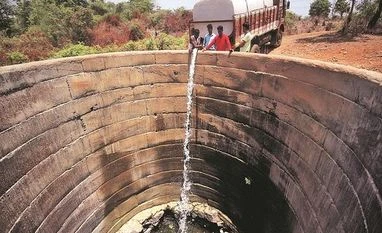 "Eastern, western regions show dip in water levels with onset of summer")











