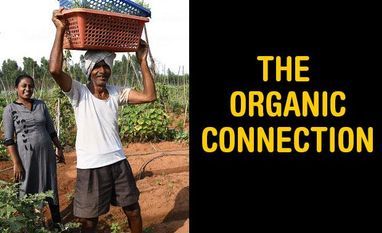
Well over an hour’s drive from Bengaluru’s central business district, beyond stretches of prelapsarian land, a smooth mud road leads to the Ramdhoota Organic Farm. Here, Manjunatha N, 32, his pants rolled up to his knees, is harvesting bales of enticing greens, free-formed gourds, tomatoes and other such vegetables. Maintaining 7.5 acres of farmland is hard work, but it is his land and he wouldn’t have it any other way.
For close to seven years, Manjunatha grew monocrops and took up civil contracts because farming alone wasn’t enough to sustain him and his family.
Things took a happy turn after he signed up with a Bengaluru-based agri-tech startup called Farmizen that connected him with city-dwellers looking to grow their own food.
Manjunatha’s wife, Bhavani, joins us in the field with their four-year-old-son, Abhiram, a spirited fellow who knows how to glide across the wet soil, seamlessly avoiding vegetable beds and creepers which could trip the unwary. “Farming is tricky, but this model of renting out our farm is working for us,” says Bhavani, formerly a mathematics lecturer, about Farmizen’s pre-paid monthly subscription model.
Edible Routes’ Aali Farm near Okhla bird sanctuary in Delhi | Photo: Saggere Radhakrishna
While every supermarket today is piling up on organically grown food, and services that would deliver them to your doorstep are also aplenty, a growing breed of urban residents is choosing to drive good distances to farm its own produce. Owing to initiatives such as Delhi’s Edible Routes, Gurugram’s Green Leaf India and Bengaluru’s Farmizen, people are now getting to rent out organic farmlands like Manjunatha and Bhavani’s.
The couple’s farm is divvied up into 301 plots of 600 sq ft each, and 278 of these have been rented out for Rs 2,500 per month per unit. “You should see the place on a Saturday. The farm is packed with people, including children,” says Manjunatha. People come on weekdays, too, but often that’s only if they want to plant something that isn’t already a part of Farmizen’s extensive seed-menu featuring amaranthus, beetroot, French beans, kale, methi, brinjal, cauliflower…. Some time ago, a software engineer from Andhra Pradesh had planted the indigenous fiery Guntur chillies from his hometown. Today, another subscriber is slotted to come over; she wants to plant Malabar spinach.
“Wanting to own a farm is a rather romantic idea, but a year down the line you get bogged down by daily needs of the land and those romantic ideas fade away,” says Sunith Reddy, a techie and a trader who is part of Beforest, a Hyderabad-based farming collective. Start-ups such as Kapil Mandawewala’s Edible Routes have now emerged to nurture those same romantic ideas.
A common story among renters who have not had a history of green thumbs is that with farmers being directly involved in the growing process, there’s no fear of “killing the plants”. But there’s more to it than this. For Gurugram’s Amita Goel, an interior designer and sustainable architect on sabbatical, renting a farmlet through Edible Routes was about connecting with the land and taking control of what she and her family ate, especially since a majority of India’s food comes without proper labels. This was also the case with Anita Mani, founder and editor of children’s newspaper Child Friendly News. Mani currently drives an hour to reach her Damaali farmlet outside Delhi, managed by Edible Routes. “These days you honestly don’t know what’s in your vegetables; neither does the farmer,” she says. Though one may not be able to grow everything on these mini-farms, Mani says her bountiful and “clean” supply of gourds, tomatoes, ladyfingers, beans and custard apples is worth the trip and the additional cost.
At Beforests' Tamarind Valley collective near Bengaluru | Photo: Saggere Radhakrishna
Agri-startup is a tough space to be in. Similar operations have made headlines in the past but have had to fold up or pivot their business due to the farm’s distance, dearth of commitment, increase in farm rentals, funding woes and so on. But well-positioned tweaks in the general renting model have worked in favour of those that have been up and running for the past year and more.
Though Edible Routes has been offering farmlets (mini farms) for only about 10 months, it already has 200 families as subscribers who rent out a minimum of 1,200 sq feet and pay Rs 3,000 to Rs 5,500 per month. Its Damaali farm is near the Sultanpur bird sanctuary and its Aali Farm lies close to the Okhla bird sanctuary. The newest farm in its basket, Nilgiri, is in Vasant Kunj. Mid-week home deliveries here are optional.
Similarly, when Farmizen started in 2017, it had about 24 farms across Bengaluru and Hyderabad. Now it has launched in Surat, Chandigarh and Coimbatore. Next it plans to expand to 100 cities that include Chennai and Pune.
An additional benefit of partaking in a share of the land, says Mandawewala of Edible Routes, is having a community to share recipes with when nature grants you an excess of, say, pumpkins or if you want a helping of seeds not easily available. Every seed and batch of homemade compost is carefully scrutinised to ensure they are free of chemicals and pesticides before being allowed on the farm.
Edible Routes’ Nilgiri Farm in Vasant Kunj, Delhi | Photo: Saggere Radhakrishna
“We also regularly test the soil and water (borewell) to ensure the land is organic,” says Shameek Chakravarty, one of the three co-founders of Farmizen. While the farmer takes care of the produce, Farmizen brings in customers, facilitates what’s to be grown and handles weekly deliveries of fresh harvest.
“We don’t have any home delivery system because the whole idea is for the people to engage with the land themselves,” says Deen Mohammad Khan, the district horticulture officer in Gurugram whose family (“My Mrs,” he says) is one of those that rent out land through Green Leaf India.
Green Leaf India, which has farms in Tikli village near Gurugram, rents out 5,400 sq ft units for Rs 4,479 (inclusive of labour and maintenance) per month. Essentially a community-driven project, this started about two years ago after Khan, who is its honorary advisor, gave a talk detailing how vegetables supplied to Delhi and surrounding areas were cultivated using drain water. “There are a lot of heavy chemicals that seep through bad water, slowly poisoning our bodies,” says Khan, who began negotiations to check if farmers would lease out their organic lands. The collective has 80 members today.
Ramdhoota farm | Photo: Saggere Radhakrishna
Khan recalls the time when the vice-president of an international tech company complained to him that while everyone seemed to have large potatoes, his plot hadn’t borne any. “He didn’t know his farm too had potatoes because he didn’t know they grew underground!” he says.
Anecdotes such as these only emphasise the need for urban dwellers to connect with the land. It’s a movement that has already started taking shape in the form of full-fledged collectives such as Hyderabad’s Beforest.
With a utopian take on things, Beforest aims to give people their own fixed patches of land that would one day also support housing facilities. These will also have common areas with food trees planted in a way to mimic a forest. With a food forest-approach, one isn’t really concerned about seasonal undulations like one truant monsoon. “You’re essentially building a farm for future generations; you’re not looking at one cycle, but the next 100 years. The yield may change, but the forest will survive,” says Reddy.
Beforest has two collectives in Krishnagiri district near Bengaluru, one in Kodagu and another near Hyderabad. A little over 100 people have bought farming (and future residence) plots across these properties that total about 400 acres. Those who’ve joined the collective regularly help out Beforest’s on-ground team in sowing plants and trees hand-picked according to microclimates.
All of Beforest’s collectives have fixed, pre-determined plots of land chosen according to parameters that include affordability and the minimum area needed to sustain a family of four. The Hyderabad collective, for instance, has plots fixed at 1.25 acre per person and priced at Rs 40 lakh. One of its Bengaluru initiatives, named Tamarind Valley in recognition of the trees here, has five-six acres of land giving forth both grains and vegetables. “Our cities are becoming unliveable; sustainable living practices are no longer a matter of choice,” says Farmizen’s Chakravarty, also a member of the Beforest collective.
As he preps for the 30 deliveries listed for the day, Manjunatha stacks bags of freshly harvested leafy greens and vegetables aside. “The only pleasure greater than growing organic food on your own land is the knowledge that we are helping others do the same,” he says. This symbiosis between city-dwellers and farmers, where both share the fruits and the responsibility of the land, is India’s most feasible solution to a mounting clean-food crisis.