
Hong Kong begins mass-testing for virus amid public doubts
The virus-testing program has become a flash point of political debate in Hong Kong, with many distrustful over resources and staff being provided by the China
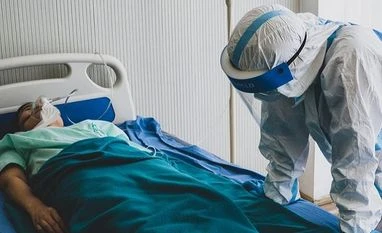 "Hong Kong begins mass-testing for virus amid public doubts")
WebinarsNew
Deep DiveNew
Explore Business Standard
The virus-testing program has become a flash point of political debate in Hong Kong, with many distrustful over resources and staff being provided by the China
Hong Kong began a voluntary mass-testing programme for coronavirus on Tuesday as part of a strategy to break the chain of transmission in the city's third outbreak of the disease.
The virus-testing programme has become a flash point of political debate in Hong Kong, with many distrustful over resources and staff being provided by the China's central government and fears that the residents' DNA could be collected during the exercise.
The Hong Kong government has dismissed such concerns, saying that no personal data will be attached to the specimen bottles and that samples will be destroyed in Hong Kong after the exercise.
The testing programme began at 8 am with residents heading to more than 100 testing centres staffed by over 5,000 volunteers.
More than 500,000 people in the city of 7.5 million signed up in advance for the programme, which will last at least a week. It is aimed at identifying silent carriers of the virus those without symptoms who could be spreading the disease.
The government expects 5 million people will take part in the programme, which could be extended to two weeks depending on demand.
Hong Kong's worst outbreak in early July was blamed in part on an exemption from quarantine requirements for airline staff, truck drivers from mainland China and sailors on cargo ships.
At its peak, Hong Kong recorded more than 100 locally transmitted cases a day, after going weeks without any in June.
The outbreak has slowed, with the city reporting just nine cases on Monday, the first time in two weeks that daily infections had fallen to single digits. However, the government and some experts say that community testing can help detect asymptomatic carriers to further stop the spread of the virus.
Respiratory medicine expert professor David Hui that even though infections have dwindled, the proportion of cases with untraceable sources of infection remain between 30% and 40%.
That means there must be some silent transmission going on, so community testing has some role in picking up these silent transmitters, said Hui, who is a public health adviser to the city's government. Hopefully if we can identify these people and isolate them for a period of time that may help to break the transmission chain in the community.
The programme is more effective if most of the population takes part, Hui said.
If only 1 or 2 million people take part, then we may not be able to achieve that objective, he said.
Other experts, such as Dr Leung Chi-chiu, a respiratory specialist and a member of the Medical Council of Hong Kong, said the testing programme plays only a supplementary role in controlling the pandemic in the city, due to the long and variable incubation period of the coronavirus.
Leung said mass-testing may not be the most cost-effective method, as it is not easy to pick up the disease in its early development, especially if a person is not having symptoms or have not had recent exposure to an infected patient.
Even if mass-testing could identify infected patients, they may already be past the infectious stage, he said.
Leung said large-scale testing will not be able to replace traditional methods of social distancing and contact tracing measures, and should only be used as a complementary measure.
(Only the headline and picture of this report may have been reworked by the Business Standard staff; the rest of the content is auto-generated from a syndicated feed.)
First Published: Sep 01 2020 | 8:54 AM IST


 Connect with us on WhatsApp