In last book , A P J Abdul Kalam wanted politicians to respect laws
Kalam finished the manuscript of "Pathways to Greatness" in March 2015
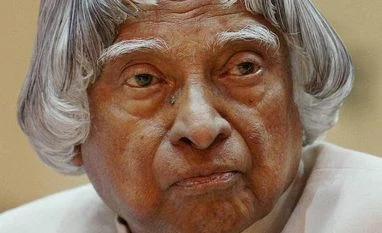
Press Trust of India New Delhi Politicians breaking law misusing power, existence of irrelevant and old laws and expression of intolerance through violence are some of the concerns raised by A P J Abdul Kalam in his last book.
Kalam finished the manuscript of "Pathways to Greatness" in March 2015, barely four months before he passed away. The book, published by HarperCollins India and termed by the former president as a manifesto for a better human life, will hit stands next month.
"Political leaders should set an example for civil society by articulating a vision for the nation and engaging in development politics. There is a need for political leaders to respect the laws of the land and ensure that political power is not used to circumvent them," he wrote.
On laws, he stressed on the need to simplify them and discard irrelevant and old acts with a certain periodicity.
"The system should be such that the dispensation of justice is fast and fair. Our education system should promote legal literacy through formal and informal mechanisms, particularly for the rural community," he suggested.
He also reminded people of the necessity to work for the unity of minds in society for the smooth functioning of democracy.
"The increasing intolerance for others' views and way of life - and the expression of this intolerance through lawless violence against people - cannot be justified in any context. All of us have to work hard and behave in a civilised manner in our day-to-day lives to ensure that the rights of our fellow citizens are protected."
Touching upon the perennial problem of backlog of court cases, he wrote: "The speed of delivery of justice is crucial. While deterrent laws, good role models and moral education at a young age can help reduce crime, timely delivery of justice will make the public less cynical about the system."
According to Kalam, the book offers his "observations about how the life of every average Indian can be transformed into one of dignity, purpose and, above all, divinity.
"I have evolved unique oaths for students, teachers, farmers, civil servants and medical professionals to ensure that this better human life becomes possible for all," he wrote.
Kalam urged parents to read the book and pass on its message to their children, teachers to discuss it with their students and political leaders to spread the word in Parliament and to the people of India.
He also appealed to the people to have respect for others' rights.
"They should use the legal system for good purposes and not for petty, selfish ends. Moreover, feedback from citizens is most valuable in a democratic system, and their vigilance in selecting the right type of representatives helps create conditions conducive to growth," he wrote.
"All of us as citizens, irrespective of the profession to which we belong, have to regulate ourselves by a code of behaviour ordained by the Constitution. We should always act with discretion and be circumspect about our actions. I voice this thought as a citizen who is concerned about the denial of the fruits of the rule of law to others who are less privileged.
"Privileges are meant to be enjoyed with prudence by those on whom they are conferred; they are not meant to make others suffer. Certainly, they are not meant to be flaunted. Rights are meant to be exercised to achieve the right thing; they are not to be brandished. Politeness and moderation are virtues to be inculcated by each one of us," he further wrote.

 "In last book , A P J Abdul Kalam wanted politicians to respect laws")


