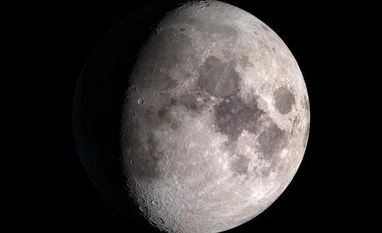
Is the Moon drifting away from Earth? Laser beams unravel a new mystery

By measuring how long it takes laser light to return to Earth - about 2.5 seconds on average - researchers calculate the distance between Earth laser stations and Moon reflectors

Moon
The laser experiment on the Moon has been going on since Astronaut Neil Armstrong and Buzz Aldrin landed on its surface in 1969. (NASA)
Shibu Tripathi New Delhi
5 min read Last Updated : Aug 16 2020 | 12:36 PM IST
While the Moon has always been a source of mystery for people across the world, a new observation has raised the curiosity in astronomy circles even further: Is the Moon drifting away from Earth? 

On several occasions during the last decade, scientists have fired laser beams at reflector panels placed about 240,000 miles (385,000 kilometers) away from Earth, on the Moon. By measuring how long it takes laser light to return to Earth — about 2.5 seconds on average  — researchers calculate the distance between Earth laser stations and Moon reflectors. 

The signals they received back this time indicate that the Earth and Moon are slowly drifting apart at the rate at which fingernails grow or 1.5 inches (3.8 centimeters) per year.  This widening gap is the result of gravitational interactions between the two bodies. 

The results were published this month in the Journal Earth, Planets and Space. 

“Now that we’ve been collecting data for 50 years, we can see trends that we wouldn’t have been able to see otherwise,” said Erwan Mazarico, a planetary scientist from NASA’s Goddard Space Flight Center, who coordinated the LRO experiment. 
Analysis of lunar laser data shows that the Moon has a fluid core. (NASA)

There are five reflecting panels on the Moon. Two were delivered by Apollo 11 and 14 crews in 1969 and 1971, respectively. They are each made of 100 mirrors that scientists call “corner cubes,” as they are corners of a glass cube; these mirrors reflect light back to any direction it comes from. Another panel with 300 corner cubes was dropped off by Apollo 15 astronauts in 1971. Soviet robotic rovers called Lunokhod 1 and 2, which landed in 1970 and 1973, carry two additional reflectors, with 14 mirrors each. Collectively, these reflectors comprise the last working science experiment from the Apollo era still active on the natural satellite.

Is dust the culprit on the Moon?

Some experts suspect that the reason why some of the reflectors are returning only a 10th of the expected signal could be dust. They suspect dust could have settled on the panels over decades after getting kicked up by micrometeorite impacts. These dust particles could be blocking the light from reaching the mirrors, insulating them leading to overheating, and reducing their efficiency. 
There are five reflecting panels on the Moon. Two were delivered by Apollo 11 and 14 crews in 1969 and 1971. (NASA)

Following the research, scientists are hoping to use Lunar Reconnaissance Orbiter (LRO) reflector to determine if that’s true by trying to find a discrepancy in the light returned from LRO’s reflector versus the surface ones, they could use computer models to test whether dust or something else, is responsible. 

The reflector scientists aimed for is mounted on the LRO, a spacecraft that has been studying the Moon from its orbit since 2009. The reflectors were placed on the spacecraft so that it could serve as a target to help test the reflecting power of panels left on Moon’s surface by Apollo missions about 50 years ago.

The art of beams

The laser experiment on the Moon has been going on since Astronaut Neil Armstrong and Buzz Aldrin landed on its surface in 1969. Four telescopes at observatories in New Mexico, France, Italy, and Germany fire lasers at the retro-reflector arrays, measuring the time that it takes for a laser pulse to bounce off the reflectors and return to Earth. Apart from measuring the distance, the beams have helped in determining orbit, rotation, and orientation of the Moon over the years which are critical for spacecraft that orbit and land on the lunar surface. 
They are each made of 100 mirrors that scientists call “corner cubes,” as they are corners of a glass cube. (NASA)

The beams have helped understand the natural phenomenon of tides on the planet, which are highest not when the Moon is overhead, but hours later. The highest tide is east of the Moon. They have helped identify Earth's gravity tugs on the Moon, causing two tidal bulges of the lunar rock. According to NASA, the positions of the reflecting arrays have varied as much as six inches (15 centimeters) up and down each month as the Moon flexes. 

Analysis of lunar laser data shows that the Moon has a fluid core. Further, laser experiments could help reveal if there’s a solid material in the Moon’s core that would’ve helped power the now-extinct magnetic field. “The precision of this one measurement has the potential to refine our understanding of gravity and the evolution of the solar system,” said Xiaoli Sun, a Goddard planetary scientist who helped design LRO’s reflector. 
Laser beams being fired upon moon to study the lunar properties. (NASA Goddard)
Getting more photons to the Moon and back and better accounting for ones that are lost because of dust are a couple of ways to help improve precision in the future. But it’s a herculean task.

One subscription. Two world-class reads.

Already subscribed? Log in

Subscribe to read the full story →
*Subscribe to Business Standard digital and get complimentary access to The New York Times

Smart Quarterly

₹900

3 Months

₹300/Month

SAVE 25%

Smart Essential

₹2,700

1 Year

₹225/Month

SAVE 46%
*Complimentary New York Times access for the 2nd year will be given after 12 months

Super Saver

₹3,900

2 Years

₹162/Month

Subscribe

Renews automatically, cancel anytime

Here’s what’s included in our digital subscription plans

Exclusive premium stories online

  • Over 30 premium stories daily, handpicked by our editors

Complimentary Access to The New York Times

  • News, Games, Cooking, Audio, Wirecutter & The Athletic

Business Standard Epaper

  • Digital replica of our daily newspaper — with options to read, save, and share

Curated Newsletters

  • Insights on markets, finance, politics, tech, and more delivered to your inbox

Market Analysis & Investment Insights

  • In-depth market analysis & insights with access to The Smart Investor

Archives

  • Repository of articles and publications dating back to 1997

Ad-free Reading

  • Uninterrupted reading experience with no advertisements

Seamless Access Across All Devices

  • Access Business Standard across devices — mobile, tablet, or PC, via web or app

Topics :moonNASA moon missionChandrayaan-3NASAISRO

Next Story