Message from Ritu Kumar's exhibition: Handloom needs urgent attention

Designer and revivalist Ritu Kumar shares with the public her personal collection of textiles from her travels, as well as reflections and commentary
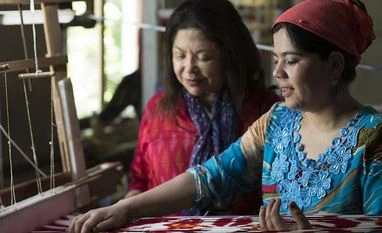
Ritu Kumar archives
Ritika Kochhar
Last Updated : Mar 23 2018 | 9:50 PM IST
Ritu Kumar has built a huge cave of textiles inside the Visual Art Gallery at Delhi’s India Habitat Centre. The walls gleam with digital prints of ancient textile patterns that have inspired her journey as a revivalist and fashion designer over the past fifty years. When you peer closely at the prints, you realise that each is made up of many old designs sourced by Kumar from textile centres across India and Asia. The prints include the classic blue hexagonal star from the mosques of Uzbekistan as well as collages from Odisha, Andhra Pradesh, Gujarat, Varanasi, Bhutan etc. The pride of place, opposite the entrance, belongs to a huge Srikalahasti Kalamkari piece.

Along with pages from the books, the exhibition also displays archival textiles, vintage photographs, collages and paintings. The paintings even include pictures of the flowers that grow in these regions and their seasons
On closer look, you realise that the cloth walls are a background for paintings and textiles. The first painted collages show murals from the Ajanta Caves (2nd-5th century BCE) and Chaurapanschasika paintings (12th-15th century CE). They offer proof that several textile patterns that we sport so thoughtlessly today, including ikat and bandhini, have an ancient provenance. The Uzbeki series includes the bazaar, the mud huts where some of the most renowned textiles in the world are created and an image of Babar — the founder of the Mughal Empire in India and a man forgotten in his own country. There’s an image of Kumar’s favourite block printer, Dipakar, and of Beliaghata in West Bengal, where the first workshop she attended on textiles was held. The textiles are sourced from Kumar’s own vast collection and include ancient robes that she brought back from her travels in Uzbekistan, Bhutan and Myanmar.

Kumar’s exhibition centres on a series of travelogues on her travels through textile centres such as Kashmir, Varanasi, Bengal, Tamil Nadu, Masulipatnam, Goa, Maharashtra, Gujarat, Rajasthan, Bhutan and Myanmar.  “I think this is the first time that an Indian designer has shared with the public her personal writings by way of a travelogue, and that too in the form of an exhibition. We have chosen to present excerpts from her personal diaries and this gives a personal and intimate insight into Mrs Kumar’s work, in contrast to her work in the public domain,” says Mayank Mansingh Kaul, curator of this exhibition.

Kumar’s first travelogue, which is being released along with the show, focuses on her travels through Uzbekistan. The rest of the publications will also be launched this year. While they reflect her research and reflection on the textile arts of the regions and their unique histories, they are also meant to help people navigate these relatively unknown places — there’s commentary on everything from the flora and fauna, food, where to stay and whom to get in touch with these to ease your travels.

Kumar’s background as an art historian and artist also play a big role in the book and exhibition. Along with pages from the books, the exhibition also displays archival textiles, vintage photographs, collages and paintings. The paintings even include pictures of the flowers that grow in these regions and their seasons. Kumar wants these contemporary travelogues to be light bedtime reading. Thus, the travelogues help offer a personal perspective on the ever-changing field of textiles, show the interconnections between distant cultures that have ancient shared artistic heritages and tell the story of handcrafted traditions at the crossroads of change in India. For example, old family portraits in a photographer’s studio in Bukhara provided the missing link between hand-block printing, ikat and zardozi.

Kumar’s exhibition centres on a series of travelogues on her travels through textile centres such as Kashmir, Varanasi, Bengal, Tamil Nadu, Masulipatnam, Goa, Maharashtra and Gujarat
The name of the exhibition, “Crossroads”, displays her concern for the status of handloom and workers in India, a subject that Kumar has spoken on often. “Eighteen million people in India earn a daily livelihood from the handloom industry. We are at a crossroads right now because of commercial reasons. People do not want to work in the handloom industry, even those who are highly skilled. It would be a terrible pity if people left. Nowhere in the world do they have this breadth of textiles. It requires a huge amount of sensitivity and understanding from people in the fashion world and those in the government to ensure that they continue.” Her predominant response to her trip to Uzbekistan was melancholy. “I felt sad that they’ve lost their traditions and we’re going the same way.” ‘Crossroads: Textile Journeys with Ritu Kumar’ is on display at Visual Arts Gallery, India Habitat Centre, New Delhi, from March 23 to April 5

One subscription. Two world-class reads.

Already subscribed? Log in

Subscribe to read the full story →
*Subscribe to Business Standard digital and get complimentary access to The New York Times

Smart Quarterly

₹900

3 Months

₹300/Month

SAVE 25%

Smart Essential

₹2,700

1 Year

₹225/Month

SAVE 46%
*Complimentary New York Times access for the 2nd year will be given after 12 months

Super Saver

₹3,900

2 Years

₹162/Month

Subscribe

Renews automatically, cancel anytime

Here’s what’s included in our digital subscription plans

Exclusive premium stories online

  • Over 30 premium stories daily, handpicked by our editors

Complimentary Access to The New York Times

  • News, Games, Cooking, Audio, Wirecutter & The Athletic

Business Standard Epaper

  • Digital replica of our daily newspaper — with options to read, save, and share

Curated Newsletters

  • Insights on markets, finance, politics, tech, and more delivered to your inbox

Market Analysis & Investment Insights

  • In-depth market analysis & insights with access to The Smart Investor

Archives

  • Repository of articles and publications dating back to 1997

Ad-free Reading

  • Uninterrupted reading experience with no advertisements

Seamless Access Across All Devices

  • Access Business Standard across devices — mobile, tablet, or PC, via web or app

Next Story



