Did the Chinese promise Prime Minister Narendra Modi the beginning of a great friendship or merely proffer a limp handshake? It isn’t always easy for outsiders, including Indians, to understand the inscrutable Chinese. But to gauge the impact of the three-day visit of the PM to China, the Indian foreign policy establishment has taken to highlighting how well the visit, despite the initial critical opinion pieces, was covered in the Chinese media.
External affairs ministry spokesperson Vikas Swarup tweeted on Friday with pictures of Chinese publications: “PM dominates news coverage in China on day two of his visit.” Today, Swarup tweeted with another picture of Chinese newspapers: “What does the Chinese press say about PM’s visit? Plenty! Media coverage on Day 3 of PM in China.”
It isn’t just the Chinese leadership that accorded Modi the “highest level reception”, the mostly state-regulated Chinese media also devoted substantial space to the visit over the last three days.
On the eve of the visit, The Global Times, the English language tabloid run by the Communist Party of China, carried a commentary critical of the Indian elite’s bias against China and how Modi was “playing little tricks” over security issues, a reference to his visit to Arunachal Pradesh, which the Chinese consider disputed territory.
But at the end of the second day of the Modi visit, the tabloid took a more positive view of ties. An opinion piece on Friday was titled "Modi's Nixonian pragmatism refreshes ties", while an editorial criticised the "Western elite" for pouring suspicions at the "dragon-elephant dance duet". It said the Western elite didn't want to see India and China drawing close to each other as it will affect its geopolitical interests in Asia, and advised the two Asian neighbours to avoid “distractions” and "think out of the box where delusions of persecution prevail".
News reports and opinion pieces in Chinese publications referred to the 1962 war, cross-border tension but also Modi's efforts in trying to forge stronger bilateral ties. There was also a map of India on CCTV, the state-run television, with the entire Jammu and Kashmir and Arunachal missing from it.
The cheer in the Chinese media aside, the Modi visit has largely failed to enthuse, by the evidence of media reportage and comment, not just most of the Western capitals but also New Delhi and Beijing's neighbours like Islamabad, Tehran and Moscow. This could possibly be attributed to the visit failing to achieve any major breakthrough, apart from the two neighbours committing themselves to a joint pursuit of wealth.
Leading English newspapers in Pakistan, like The Dawn and The Express Tribune, consigned their coverage of the visit to agency stories on their international pages. An editorial today in Pakistan's The International News focused on the China-Pakistan Economic Corridor that was signed during the visit of Chinese President Xi Jinping to Islamabad last month. India has officially lodged its concerns over the project.
On May 13, the New York Times ran a story on how Modi and Xi “aim to shelve rifts amid economic courtship", but doubted India and China's resolve to overcome contentious issues. Several other international publications, including The Guardian, carried a Reuters copy on Modi's selfie with Chinese PM Li Keqiang. “World's most powerful selfie? Indian and Chinese leaders pose for photo,” it said. There was little on the visit in Russian media or Iran's state run media.
Today, All India Radio news bulletins repeatedly highlighted how the PM's announcement that New Delhi will grant Chinese tourists e-visas has been lauded both in the Chinese media as well as on Chinese social networks.
As for the Chinese media, Xinhua, the Chinese state-run news agency has been optimistic of bilateral ties. It said the visit was an opportunity for the two Asian giants to consolidate trust. In a reference to Xi hosting Modi in his hometown in ancient Xi'an city, Xinhua said how it wasn't often that top Chinese leaders travel outside Beijing to meet foreign guests.
“The tour of the ancient Xi'an City, a place closely connected to China and India's deep historical links, was a carefully orchestrated choice," Xinhua said, but did point out the recent decades of bitter relations marked by trust deficit. On May 14, Xinhua wrote: "Growing rapport between Chinese, Indian leaders marks new era of ties”.
An op-ed piece in China Daily commended Modi for his efforts in building stronger bilateral ties, and how well he has prepared for the visit, including joining Chinese microblogging site Sina Weibo. Another China Daily post was headlined “Cheers for Modi reflect closer links”. It went on to describe how the Indian PM asked his chauffeur to stop at a street side where he saw people waving at him. He “left the car to greet them and shake hands, and they responded by waving and calling out his name.”
Most Mandarin newspapers devoted entire pages with details of the agreements signed and photographs of Modi with Chinese President Xi at the ancient Buddhist temple that they visited in Xi'an on Thursday, and the Indian PM with his Chinese counterpart Li at the Temple of Heaven in Beijing on Friday.
The Indian PM, it would seem, struck a chord in China by focussing on civilizational links. Modi will be returning home after a successful public relations exercise that could possibly rival that of the then PM Rajiv Gandhi's 1988 visit to Beijing, but without any substantive progress on contentious bilateral issues.

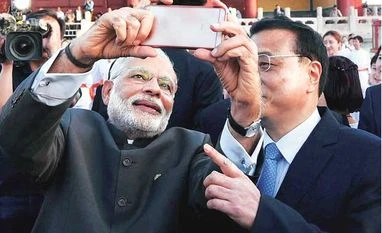 "Modi visit cheered by Chinese media, goes unnoticed elsewhere")


 Connect with us on WhatsApp