As Sea Harriers retire, Naval Tejas readies to fly off
The light combat aircraft will operate from India's indigenous aircraft carrier, INS Vikrant
Ajai Shukla New Delhi At the end of thirty years of flying from Indian Navy aircraft carriers, the iconic Sea Harrier jump jet made its ceremonial last flight on Wednesday. Readying to take its place is the naval version of the Tejas Light Combat Aircraft (LCA), which recently completed a successful flight-test campaign in Goa.
While the Sea Harriers operated from the INS Vikrant and INS Viraat, now both retired, the Naval Tejas will operate from the Vikrant’s successor, an indigenous aircraft carrier that is scheduled to be commissioned in 2018.
Commodore (Retired) CD Balaji, chief of the Aeronautical Development Agency (ADA), which oversees the Tejas development programme, told Business Standard that taking off and landing from a 200-metre deck has been fully established. So has “hot-refuelling” --- topping up the aircraft after a sortie with the engine running and the pilot in the cockpit --- which allows a rapid turnaround between sorties.
For the navy, it is vital to ready the Tejas for the INS Vikrant and, subsequently, INS Vishal. The MiG-29K will be the medium fighter on INS Vikrant, as it already is on INS Vikramaditya. The Tejas is crucial for filling in the light fighter slot.
Balaji reveals a committed navy is funding 40 per cent of the development cost of the Naval Tejas. The MoD has allocated Rs 3,650 crore for the naval programme.
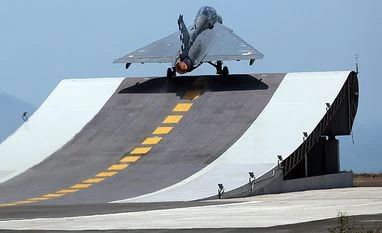
The ADA chief described the flight trials in Goa between March 27 and April 25, in which two Naval Tejas prototypes flew 33 sorties from a Shore Based Test Facility (SBTF) -- a full-scale replica of an aircraft carrier deck. Built on land, the SBTF allows carrier deck take-offs and landings to be validated, without unduly endangering an aircraft carrier, or an aircraft prototype and pilot.
When taking off from an aircraft carrier, a fighter revs up its engine to the maximum, while held back by a “restraining gear system” (RGS). Then, the RGS is disengaged, and the fighter shoots forward, accelerating to take-off speed in just 200 metres of deck. At the end of the deck runway, a “ski-jump” lifts the aircraft upwards, after which it flies on its own power.
In December 2014, the Naval Tejas had taken off from the SBTF ski-jump after rolling 300 metres. Now, the fighter has proven it can take off from just 200 metres, even carrying two R-73 close combat missiles.
“With this campaign, ski-jump launches are no longer a challenge. We will now explore the limits the fighter can be taken to. We will further fine-tune the control law software to take-off with higher payloads,” said Balaji. In aircraft carrier combat operations at sea, the Naval Tejas must take off with up to 3.5 tonnes of payload--- more fuel for longer range; and more weapons for a lethal punch. For this, the aircraft carrier would steam into the wind, ensuring a “wind-over-deck speed” of up to 20 knots. That would provide added lift to the aircraft, allowing higher payloads.
In aircraft carriers with catapult launchers, as the navy’s next indigenous aircraft carrier, INS Vishal, could be, the catapult allows higher launch speeds and, therefore, higher payloads.
Similarly, fitting the Tejas Mark-2 with the more powerful General Electric F-414 engine (the current Mark -1 fighter has the smaller F-404 engine) will allow greater payloads and more ambitious mission objectives. Even more challenging than taking off from a 200-metre carrier deck is to land an aircraft back on the carrier. This requires touching down precisely at the edge of the runway, aligning the approach with the help of an “optical landing system” and a “landing control post”. At landing, an “arresting gear system” --- including wire cables across the deck runway --- latches onto a hook on the fighter’s tail and rapidly decelerates it to a halt. “In the current campaign, the Tejas did over 60 approaches (without actually touching down) to gather data for fine-tuning the control law software. In the next campaign this month, we will do “touch and go” approaches to validate the software and then graduate to full landings,” explains Balaji. Finally, the Naval Tejas demonstrated its “fuel jettison” capability --- a safety feature that allows the fighter to quickly jettison on-board fuel if it encounters a problem soon after launch and must quickly return for an emergency landing on the carrier.
“By mid-2017, we will have established on the SBTF that the Naval Tejas can be flown off an actual carrier, and we will then graduate to ship-based testing. We currently have two prototypes in testing, and will build a third by then”, says a satisfied ADA chief.

 "As Sea Harriers retire, Naval Tejas readies to fly off")


 Connect with us on WhatsApp