Home / India News / New files cast doubt over Netaji being alive after 1945
New files cast doubt over Netaji being alive after 1945
A statement was recorded by Juichi Nakamura in 1956, who claimed to be an eye witness to Netaji's death
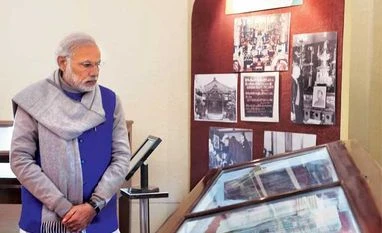
Prime Minister Narendra Modi at the National Archives of India where he released digital copies of 100 declassified files related to Netaji Subhas Chandra Bose. Photo: PTI
If the 64 files declassified by Mamata Banerjee last September suggested that Subhas Chandra Bose may have been alive after 1945, the 100 files put in the public domain by Prime Minister Narendra Modi, on Saturday, hinted otherwise.
A statement was recorded by Juichi Nakamura in 1956, who claimed to be an eye witness to Netaji's death. The statement was forwarded by J N Dixit from the Embassy of Japan in 1964 to to M Kutty, then under secretary, Ministry of External Affairs in New Delhi.
Nakamura, who knew English, was employed by the Foreign Office of Taiwan for about a year and had apparently met Netaji four times.
In his statement, Nakamura said that he remembered clearly that the accident took place on August 18, 1945, in which Netaji was involved. The statement was a descriptive account of Netaji's last hours.
The hospital room in which Netaji was kept was rather big - 60ft long and 60ft wide. Three others injured in the crash were in the same room, while Netaji's bed was screened off. His face and head were covered in bandage.
Netaji's first words to Nakamura were: a few more of my men are coming after me. Please take care of them when they come to Formosa.
What apparently had surprised everyone in the room, including Nakamura, was how composed Netaji was even in pain.
His last words were, "I want to sleep." He died 10 minutes later.
Nakamura's account completely negates the mystery around Netaji's death which Banerjee had stoked when the West Bengal government had declassified the files last year.
Her suggestion that Netaji may have been alive after 1945 were, however, derived from letters.
A letter from Amiyanath Bose to Sisir Kumar Bose (sons of Sarat Chandra Bose, elder brother of Netaji) in London, dated November 18, 1949 had mentioned: For the last one month, a rather strange broadcast is being heard over the radio. We are getting this broadcast on the short-wave near 16mm. The broadcast only says "Netaji Subhas Chandra transmitter katha boltey cheyechhen (in Bengali script)".
This sentence is repeated for hours. We do not quite know where it is coming from because that is not announced. It is possible, however, to find out the location of transmission. The letter was intercepted (like many or most others) by intelligence officials.
While there was nothing particularly new from the 64 declassified files, the interesting thing that emerged was the intense surveillance that Netaji's family was subjected to between 1948-1968.
Banerjee, however, didn't want to let go of the political mileage that was due to her for declassifying the files first. At a celebration marking Netaji's 119th birth anniversary, she demanded the status "Leader of the Nation" for him.

 "New files cast doubt over Netaji being alive after 1945")


 Connect with us on WhatsApp