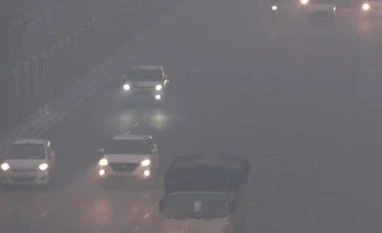
NHRC summons chief secretaries of Delhi, 3 neighbours over air pollution
The National Human Rights Commission said it is "not satisfied" with the actions taken so far to address the issue and that "much more" needs to be done to reduce pollution in Delhi.
Press Trust of India New Delhi Alarmed over the rise in pollution in Delhi-NCR, the NHRC has asked the chief secretaries of Punjab, Haryana, Uttar Pradesh and Delhi to appear before it on November 10 to discuss the matter, an official statement said on Friday.
The National Human Rights Commission said it is "not satisfied" with the actions taken so far to address the issue and that "much more" needs to be done to reduce pollution in Delhi.
The Air Quality Index (AQI) in Delhi stood at 426 (severe) at 9:30 am on Friday, according to Central Pollution Control Board (CPCB) data.
An AQI above 400 is considered 'severe' and can affect healthy people and seriously impact those with existing illnesses.
The NHRC asked the chief secretaries to inform it within a week about the steps taken by their respective governments to stop stubble burning.
"Their reports must also inform about the effect of smog towers and anti-smog guns. It should also have information on how many anti-smog guns are operational and what further steps the Delhi and other governments are taking in the near future.
"The report of Punjab and Haryana must also specifically inform about the effect of the scheme of in-situ management of crop residue," the NHRC statement said.
The commission said its directions follow a report and material on record received from the Union Ministry of Environment, Forest and Climate Change (MoEF&CC) in response to a notice issued by it on June 22.
It said it had issued the notice after taking suo motu cognisance of media reports alleging that air pollution is a great threat to human health in India and might reduce life expectancy for the people of Delhi.
"The commission has noted the measures taken so far but observed that these are not enough to reduce the pollution level in Delhi-NCR. It is of the considered view that much more needs to be done to reduce the pollution level immediately," the statement said.
Despite several directions from time to time, "nothing much has improved". One of the major causes of air pollution in the Delhi-NCR region is stubble burning in the states surrounding it, it said.
The NHRC further stated that "notwithstanding several directions of the Supreme Court, the National Green Tribunal and other authorities, the air quality in Delhi-NCR has not seen required improvement for a human-friendly environment, which cannot be allowed to remain so perpetually".
As many as 31 out of the 36 monitoring stations in Delhi recorded 'severe' AQI, the CPCB data at 9:10 am showed.
Delhi's 24-hour average AQI stood at 450 at 4 pm on Thursday, just a notch short of the 'severe plus' category.
(Only the headline and picture of this report may have been reworked by the Business Standard staff; the rest of the content is auto-generated from a syndicated feed.)

 "NHRC summons chief secretaries of Delhi, 3 neighbours over air pollution")

