
Pollution levels dip in Delhi, air quality remains in 'very poor' category
The city recorded an air quality index (AQI) of 315 at 9 am. The 24-hour average AQI was 344 on Wednesday and 476 on Tuesday
 "Pollution levels dip in Delhi, air quality remains in 'very poor' category")
WebinarsNew
Deep DiveNew
Explore Business Standard
The city recorded an air quality index (AQI) of 315 at 9 am. The 24-hour average AQI was 344 on Wednesday and 476 on Tuesday
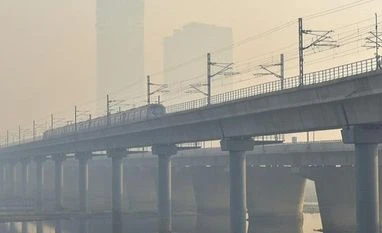
People in Delhi woke up to a further spike in air pollution as the city continued to remain engulfed in a blanket of smog with the air quality index in 'severe' and 'very poor quality' at several places on Saturday morning.
The Air Quality Index (AQI) was at 424 (severe) in Anand Vihar, at 328 (very poor) in IGI Airport area, 400 (very poor) in ITO, and 354 (very poor) in RK Puram, according to Delhi Pollution Control Committee (DPCC) data today.
An AQI between 0-50 is marked good, 51-100 is satisfactory, 101- 200 is moderate, 201- 300 is poor, 301-400 is very poor and 401-500 is considered severe. According to experts, the severe category affects the health of people and seriously impacts those with existing diseases.
India Meteorological Department (IMD) has predicted that the Air Quality Index (AQI) of the national capital is expected to go in the 'severe' category on Diwali.
"Presently Delhi's Air Quality is very poor and is expected to go worse to severe on Diwali. It can be worse if there are additional emissions. AQI will improve after Diwali and there are chances of drizzle and rain on November 15," Dr VK Soni, Head, Environment and Research Centre of IMD told ANI.
"During this period the meteorological conditions are not favourable for good dispersion of air pollutants and further there will be little additional emission from firecrackers and traffic. Although the government has taken a lot of steps to control air pollution, still these external emissions will impact negatively," he added.
In a bid to prevent the COVID-19 pandemic from worsening owing to poor air quality, the National Green Tribunal imposed a total ban on the sale and use of firecrackers in the National Capital Region from midnight of November 9 to midnight of November 30.
The visibility in the national capital has reduced due to the presence of a high level of smog in the air. As per health experts, people who are suffering from asthma or other respiratory ailments should prefer working from home.
(Only the headline and picture of this report may have been reworked by the Business Standard staff; the rest of the content is auto-generated from a syndicated feed.)
First Published: Nov 14 2020 | 8:44 AM IST

