
Wearing two fitted masks may double protection against Covid-19: Study
This can help in preventing virus particles from reaching the wearer's nose and mouth and causing Covid-19, according to a study
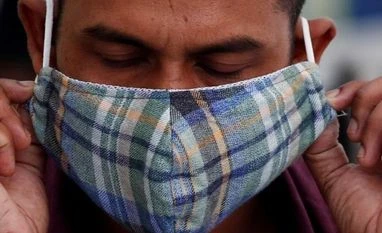 "Wearing two fitted masks may double protection against Covid-19: Study")
WebinarsNew
Deep DiveNew
Explore Business Standard
This can help in preventing virus particles from reaching the wearer's nose and mouth and causing Covid-19, according to a study
Wearing two tightly-fitted face masks can nearly double the effectiveness of filtering out SARS-CoV-2-sized particles, preventing them from reaching the wearer's nose and mouth and causing COVID-19, according to a study.
The research, published in the journal JAMA Internal Medicine, shows that the reason for the enhanced filtration is not so much adding layers of cloth, but eliminating any gaps or poor-fitting areas of a mask.
"The medical procedure masks are designed to have very good filtration potential based on their material, but the way they fit our faces isn't perfect," said Emily Sickbert-Bennett, an associate professor at the University of North Carolina (UNC) in the US, and lead author of the study.
To test the fitted filtration efficiency (FFE) of a range of masks, the team filled a 10-foot by 10-foot stainless-steel exposure chamber with small salt particle aerosols.
The researchers wore a combination of masks to test how effective they were at keeping particles out of their breathing space.
Each individual mask or layered mask combination was fitted with a metal sample port attached to tubing in the exposure chamber that measured the concentration of particles entering the breathing space underneath the researcher's mask.
A second tube measured the ambient concentration of particles in the chamber.
The researchers determined the FFE by measuring particle concentration in the breathing space underneath the mask compared to that in the chamber.
"We also had the researchers in the chamber undergo a series of range-of-motion activities to simulate the typical motions a person may do throughout their day -- bending at the waist, talking, and looking left, right, up and down," said Phillip Clapp from the UNC School of Medicine.
According to their findings, the baseline FFE of a mask differs from person to person, due to each individual's unique face and mask fit.
Generally, a procedure mask without altering the fit, is about 40-60 per cent effective at keeping COVID-19-sized particles out, the researchers said.
A cloth mask is about 40 per cent effective, they said.
Their latest findings on doubling of face masks shows that when a cloth mask is placed over a surgical mask, the FFE improved by about 20 per cent.
The filtration efficiency improved even more with a snug-fitting, sleeve-type mask, such as a gaiter, according to the researchers.
When layered over procedure masks, cloth masks improve fit by eliminating gaps and holding the procedure mask closer to the face, consistently covering the nose and mouth.
When a procedure mask is worn over a cloth mask, FFE improved by 16 per cent.
"We've found that wearing two loosely fitted masks will not give you the filtration benefit that one, snug-fitting procedure mask will," Sickbert-Bennett said.
"And with the current data supporting how effective mask-wearing is at preventing the spread of COVID-19, the best kind of double-masking is when you and the person you are interacting with are each correctly wearing a very snug-fitting mask," she added.
(Only the headline and picture of this report may have been reworked by the Business Standard staff; the rest of the content is auto-generated from a syndicated feed.)
First Published: Apr 19 2021 | 4:49 PM IST


 Connect with us on WhatsApp